What I owe the International Debut Novel Competition

Let’s say you’re a writer – as-yet unpublished, but that doesn’t matter; you’ve absolutely earned your stripes. You would move heaven and earth to get time at your desk. You’ve attended the workshops, you’ve sought out the advice of beta readers over multiple drafts, you revise obsessively, if not aggressively. Moreover, you are never not writing, technically, because you write in your head while you walk the dog, grocery shop, drive to and from work. You talk to your characters in your sleep, and worry sometimes you might know them better than you know yourself.

If any of this sounds like you, then now is a very good time to check out the Irish Writer Centre’s International Debut Novel Competition.

Three years ago, this was me. And, if I’m being honest, it’s still me. The only material difference is that I’ve now finally published that book which was eating me alive, and have moved on to being eaten alive by another. Please don’t send help; I’m quite happy like this. If my head wasn’t currently in the mouth of a manuscript I wouldn’t know what to do with myself.

But in September of 2021, I was on the verge of letting it all go. After over a decade at work on my novel, Lightborne, I had nothing to show but a teetering pile of rejections – all told, close to 200, a perfectly respectable number at which to throw in the towel.

I had heard about the International Debut Novel Competition (then known as the Novel Fair) through the Irish writing community grapevine, despite being an American living in Spain. I knew the deadline was approaching and had been dragging my feet on submitting, sure I wouldn’t be chosen anyway. After nigh on 200 rejections, why on earth should I expect a “yes”?

Eventually, I submitted on a whim, telling myself this was it – if I didn’t get in, I’d take it as the universe’s way of telling me to give up.

And let me tell you, by the time acceptances went out, I had given up. In fact, I’d forgotten about the whole thing, and nearly missed my chance altogether when my acceptance letter ended up in spam (CHECK YOUR SPAM, PEOPLE!) Fortunately, I was able to get in touch with the IWC in the nick of time.

But things didn’t end there, because the International Debut Novel Competition is like no other. In fact, I’d just signed up for the ultimate novel-pitching boot camp.

At the heart of the competition are the two Pitch Days, held remotely or onsite at the IWC’s glorious location in central Dublin, wherein we little unpublished hopefuls (twelve of us, at the time) met individually with agents and editors, and, well, did our best to sell them our books. Going into it, I had read press write-ups describing Pitch Days as “Dragon’s Den for writers,” which had done nothing for my nerves. But rather than stone-faced bigwigs just salivating for a chance to dash someone’s dreams, the agents and editors we met with were universally kind, friendly, and genuinely interested in our projects. Even those who were not appropriate for my particular book asked insightful questions and patiently answered my naive inquiries. I learned more about the publishing world in those two days than I had in 10 years.

Let’s say I didn’t strike gold at the Pitch Days – a possibility for which I mentally prepared myself, even as things seemed to be going quite well. An agent offer or publishing deal are after all not guaranteed by participating in the competition. What would I have gotten out of it then?

In a word: confidence. Halfway through the first Pitch Day, well before I received my first manuscript request, I already felt like a rockstar. Moreover, I now had tools I’d never even known I needed as a writer. Pathways I had never thought to try before, or didn’t even know existed, had opened up before me. Yes, in the end I was lucky enough to meet my amazing agent during those days, but even if I hadn’t, I would have come away leagues ahead of where I’d started.

I also came away with lifelong connections to other writers, and to the wonderful Irish Writers Centre itself. Despite living in another country, I know I can find support and resources through the IWC – and, whenever I do make it to Dublin, an open door and friendly faces.

This is all a long-winded way of saying that, as a writer, I owe the International Debut Novel Competition a LOT. Maybe everything, I dunno.

Since I participated in 2022, I’ve seen old writing connections from back home in the States enter and win, I’ve seen writers who thought of themselves as mere hobbyists discover they’ve got a hit on their hands, I’ve seen writers who had no luck on Pitch Days end up internationally published anyway. No matter what, winning the International Debut Novel Competition is not the end of the road, but only a beginning. And what a beginning it is!

Submissions to the International Debut Novel Competition close THIS SUNDAY, September 14th, 2025.

All relevant info, including past winners, submission guidelines, and tips on how to prepare your application (even the dreaded synopsis) may be found on the Irish Writers Centre’s website.

Featured Image courtesy of the Irish Writers Centre.

Lightborne Updates: UK Trade Paperback OUT NOW!

Today is filled with all the usual excitement, expectation, and nail-biting dread of every milestone I’ve faced thus far in this weird business of being a published author. However, today also marks a bittersweet end of the road in my publishing journey. Unless I pull a Pachinko within the next year or two, this will be the last UK pub day Lightborne ever gets.

I loved this book. I worked on it through my 20s and 30s, and into my 40s. It was a way of life for so long that tearing myself away from it took nearly as much discipline as writing the damn thing. Now I’ve moved on, and it already feels distant at times, but the lessons I learned in writing it will hopefully stick with me forever.

I’ve been living a weird double-life over the past two years, embarking on my next book while my first was making its international debut by slow stages. In the beginning, transitioning away from a book I knew so well I could set the characters free in the maze of my head and simply sit back and “observe” them was painful at times. After two years, I still don’t know my new cast of characters that well, although I am getting closer. It’s a strange feeling to be back in a part of the writing process which I last experienced so long ago it’s only a distant memory for me, leading me to second-guess myself – to think I’m doing it wrong. Connecting with other writers is keeping me grounded, but I already can’t wait to be in the 15th or 20th revision again, at the point where “mess becomes book.”

Those are some of my most treasured memories of Lightborne, even now. While publication is exciting and vindicating, it’s also a lengthy process of letting go. And while I still love “my boys” – even the wicked ones (looking at you, Poley) – I will never again experience that sense of mutual habitation that came with writing their story. This is what people mean, I suppose, when they talk about being visited by the Muse: a collaboration between me and the imaginary beings I’ve created, acting not independently of me (obviously) but in ways I can’t entirely explain. People also call writing a lonely profession, but when the writing is going well, it’s anything but.

So I’m a bit sad, but very excited to keep working, keep writing, and celebrate not the last, but the first of many last, glorious voyages of my debut into the world, with hope that it will find readers who will love it and need it as much as I did.

Safe travels, boys. 💙

Lightborne Updates: Paperbacks & Staying Alive

I must admit I love a good paperback. Smaller, lighter, easy to carry, a paperback book feels like a close friend. I love the subtly textured surface and faint newsprint smell of the paper, and the way the spine of a truly beloved paperback becomes grooved and whitened with age. Hardbacks are great and all, don’t get me wrong – but a paperback is a living thing.

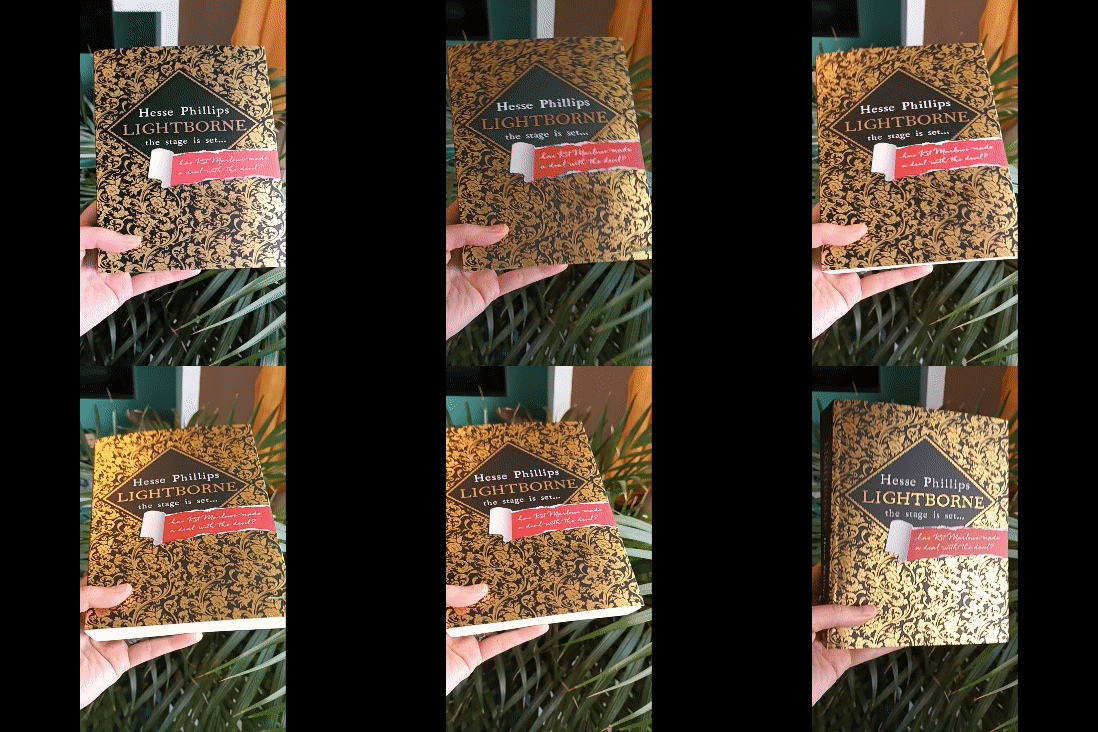
So naturally I was giddy with excitement when my complimentary author’s copies of the forthcoming Lightborne paperback edition showed up at my door the other day. I’ve seen PDFs of the new cover and therefore thought I knew what I was getting into when I opened the box, but no PDF could possibly do it justice.

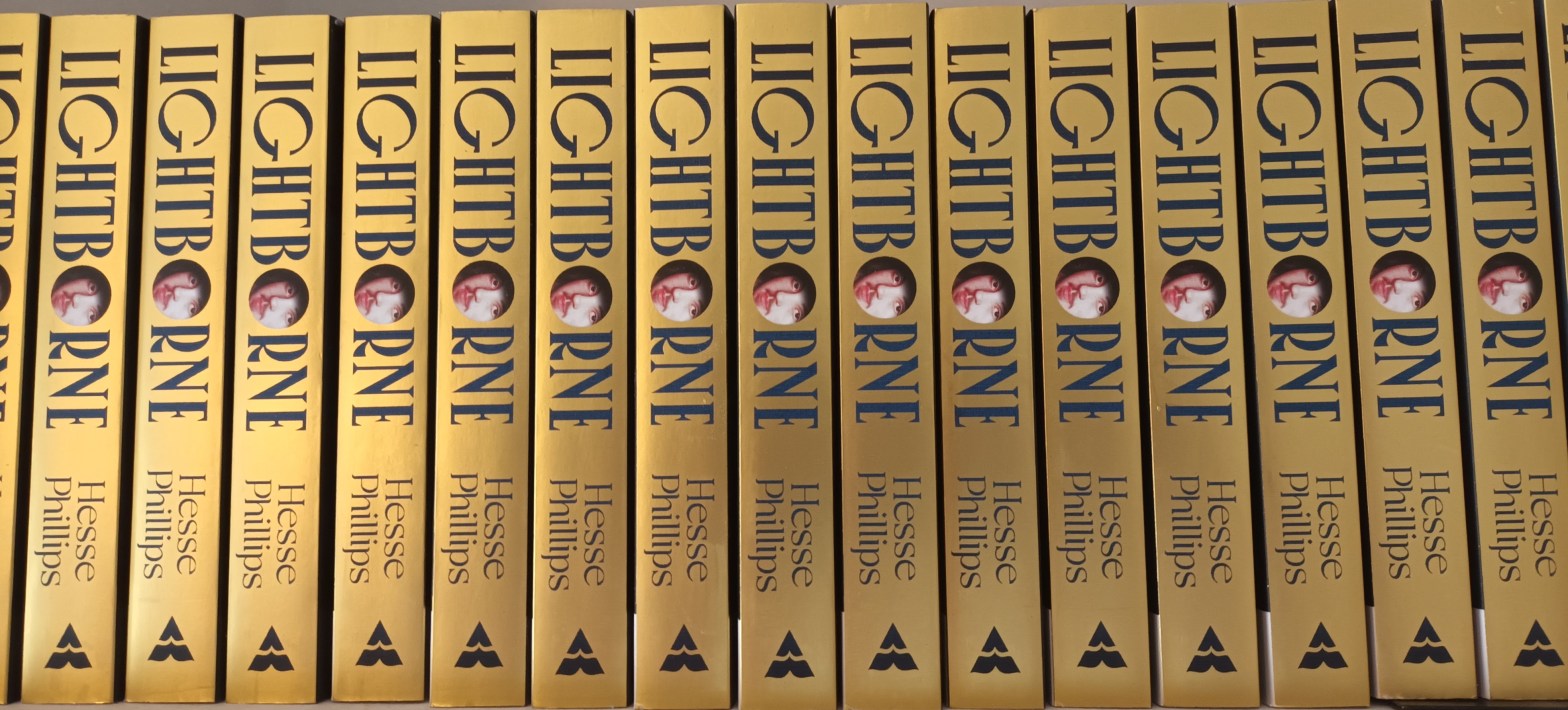
I think someone in the design department at Atlantic Books must have heard me going on and on about how much I loved the gold on the “deluxe” edition cover from last year, because they went all-out with it. Believe me when I tell you, this baby glows.

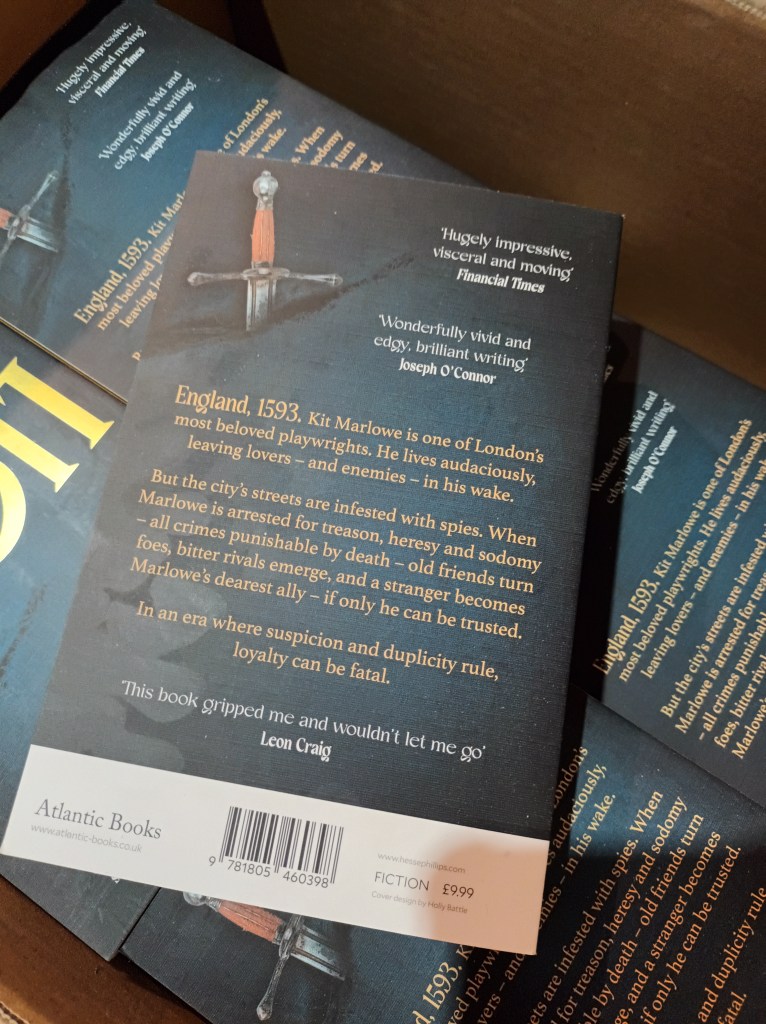
And it looks pretty great from the back too.

With the official paperback launch date set for 6 March, preorders are of course available (and encouraged!) But for those who prefer ebooks, the ‘Zon is also running a Kindle Deal on Lightborne for the month of February, where you can score a copy for just £2.19.

It should probably go without saying that all of this is coming at an exceedingly weird time, particularly yet not exclusively if you’re American like myself, and particularly yet not exclusively if you happen to also be queer, and writing queer books, and plan to continue being and doing all of those things for as long as you have breath in your body. I am glad, at the very least, that I made some difficult but necessary decisions to start out the year, and intend to carry that energy with me into whatever comes next.

The intersection of my self and my obsession with history means I cannot avoid writing about queer survival under truly intolerable conditions – history is sadly saturated with them. It also means, of course, that not everybody makes it out alive, and those that do emerge scarred, battered, and at least a little bit broken. But we will always have a future, even in the bleakest of times. History may often show us in our darkest hour, but it also offers hope: we’ve always been here, and will always be here.

For me, the most important words I wrote in Lightborne were these:

You must live because I love you – because you must be avenged
– because to live is a form of vengeance, when so many have
sought to destroy you
.

Sometimes it comes down to that: staying alive. Because us staying alive really pisses off the ‘phobes.

And if I’ve learned anything about myself this year, it’s that I get a kick out of pissing off ‘phobes.

Lightborne Updates: UK Paperback Sneak Peek

I can’t help but want to talk about perhaps too many things in this post, as I know many of us are still reeling after last week. Perhaps shocked and blindsided, perhaps proven right in the worst way possible, perhaps teetering just above despair. Anyone celebrating is invited to leave at this point. Anyone lashing out, lighting fires, throwing blame at those more vulnerable than themselves, screeching “I told you so” as they rub salt into others’ open wounds, is invited to seek therapy.

It feels very strange and not a little delusional to be talking about my book at a time like this. Not that it doesn’t feel strange to talk about the future at all, given how little we can say for certain about it, other than that things look bleak. They certainly look bleak if, like me, you are a queer author who writes queer books. As I discussed at length in my previous blog post, we could easily be entering a dark age in terms of art and literature, an age in which books like mine will become hotly contested objects. But it’s one thing to worry about whether or not your book might still be legal in your home country a year from now, quite another to worry whether you, as a human being, will also be legal: your marriage, your passport, your family, your friends, your livelihood, your joy, your resistance, your thoughts, your dreams.

However, as a number of other queer authors have also pointed out, there’s no sense whatsoever in backing down before the fight has even truly begun. We are already tired, especially those of us who have been targeted before, but I hope we are far from giving up. Now is a time for those of us who can afford to be loud to scream with all our might.

Knowing my history as a queer person is a double-edged sword, because I’ve seen my community in its darkest hour, but I’ve also seen us emerge from that darkness, again and again. Whatever is coming, we have every right to feel dread in the pits of our stomachs, but also every reason to believe we will find ways to survive it. As Marlowe says in Lightborne, “to live is a form of vengeance, when so many have sought to destroy you.”

As long as humanity lives, we live. I’m sure it drives those who hate us crazy.

All that said, I’m extremely lucky to have exciting things to look forward to in 2025, among them the paperback launch of Lightborne in the UK. Come what may, in March there will be a whole new edition of the book out in the world, with a stunning new cover to rival the old one.

And now, without further ado:

Courtesy of Atlantic Books

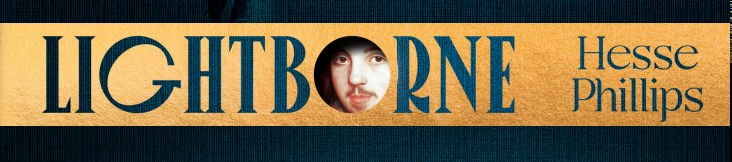
We still have the beautiful gold accents that gave the original cover such a bold presence on the shelf, but now with a much darker, moodier atmosphere, and even a subtle appearance from Kit Marlowe himself. I chose this design among several options – it wasn’t easy, as they were all impressive – but I loved this one for that rich blue tapestry background, and the vintage feel of the design.

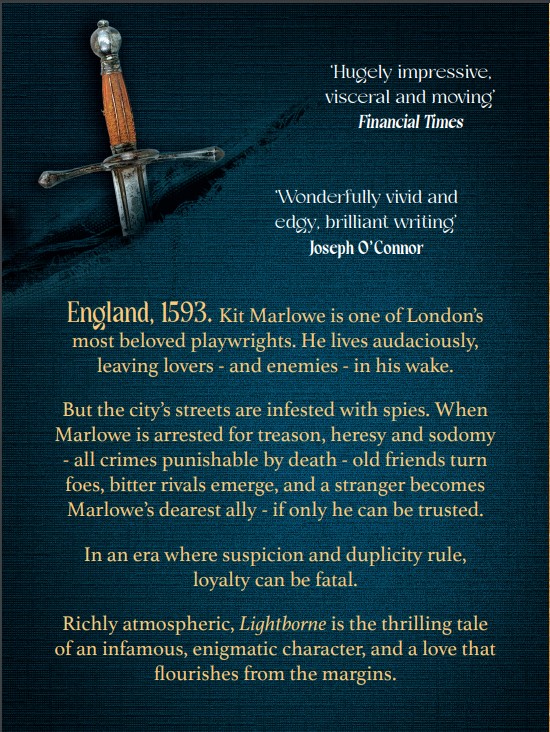
The back cover, I should add, is equally gorgeous:

Courtesy of Atlantic Books.

Those who have read the book already will surely recognize Frizer’s knife peeking out! I fought for that knife, I will say, and I’m so glad I did. Authors – this is me advising you to fight for things you want on the cover. You might not get them, but you’ll have no regrets.

I’m beyond excited to see the paperback in its full glory, as I hope readers will be as well. Whatever dangers are barreling down at us from the future, I hope we’re able to find reasons to stay excited and engaged. After all, the world desperately needs that from us. Our anger and outrage is necessary, but so is our hope, our creativity, our joy.

It might mean the difference between simply getting through whatever comes next, and doing the work that desperately needs to be done: of building a better world than the one we started with.

Lightborne Launches Stateside

I look back on the past version of myself who brought their laptop to their US book launch with the intention of keeping their blog updated and think, “Oh, you sweet summer child – so innocent, so full of big dreams!” In the end, I didn’t have time to unpack the laptop, let alone to sit up through my jetlag reaping the whirlwind of emotions for content. Even now, much of my trip to Boston, Massachusetts remains a blur of happy reunions with old friends, rooms filled with watchful, attentive faces, visits to old stomping grounds, old favorite beers in old favorite bars, new favorite books bought in new favorite bookshops.

At least one thing is clear: I’m extremely lucky. Not everyone gets their dream launch in their dream location with their dream conversation partner; not everyone gets to sit on a panel of rockstar authors and read their work to a packed audience. But I’ve been lucky for quite some time. I was lucky twelve years ago, when I discovered GrubStreet Boston’s Novel Incubator program and joined a community full of lifelong friends who all share a passion for the craft of writing. I was lucky to have some of the best writing instructors out there, Michelle Hoover and Lisa Borders, who gave me all the support I could possibly need.

There’s a bittersweetness to it all. Returning to the last place I called home just as the whole country is turning its gaze towards the abyss infuses even joyful moments with a sharp tang of dread. I fear for many of the friends I left behind, nearly all of whom said the same thing as we bade each other goodbye: “If the shit hits the fan, I’m coming to stay with you!” They were only half-joking, I could tell, just as I was only half-joking when I answered of course they could stay with me, I’d take every single one of them in if I could. Many told me how lucky I was to have gotten out when I did, how lucky I am to be so far away, which is a hard thing to hear, given how much I’ve missed them, and how much I’ve missed the place where, they say, I’m so lucky to no longer live.

I’ll have more to say on all of that later. For now, I’d like to just hang onto the excitement and gratitude of these days. I’d like to thank Nicole Vecchiotti and Timothy Deer, the organizers of Craft on Draft, as well as our hosts at Trident Booksellers, our Master of Ceremonies Cameron Dryden, and my fellow panelists Thérèse Soukar Chehade, Henriette Lazaridis and Janet Rich-Edwards. Thanks to Porter Square Books and to Marketing Director Josh for throwing Lightborne a launch party to remember, and to my conversation partner Michelle Hoover for knowing exactly the right questions to ask. A huge thanks to my publicist Meghan Jucszak at Pegasus Books, who helped put everything together.

A final shout-out also to the many dear friends who rallied together to give Lightborne the send-off I’ve always dreamed of. I told many of you that we have to come back and do it all again soon, and I mean it. This is a world that needs more art, more joy, more luck to go around. I sincerely hope we get to share in that.

Lightborne’s USA Launch Schedule & Event Registration

At long last I can finally announce my US “mini-tour” plans – “mini” because it is indeed very wee, but “tour” because it requires way more travel than the average book tour to pull it off. Though returning to my old stomping grounds in Boston, Massachusetts from my new home here in Spain gets more complicated (and expensive) every year, it has always been my dream to launch Lightborne in the same city where it first leaped onto the page – albeit in a very different form than now.

It’s been over ten years since that first version came about, but finally, this October, I’ll be making a few stops around the Boston area to celebrate Lightborne’s US birthday:

October 22, 2024: “Craft on Draft” at Trident Booksellers, Newbury St. Boston, MA at 7pm – 9pm.

From the organizers: “Craft on Draft is a reading series created and managed by alumni of GrubStreet Boston’s Novel Incubator program devoted to great fiction and the mechanics behind it. This session’s topic: ‘Whose History?’ asks, can historical fiction radicalize and revolutionize? Come hear four authors discuss how they’re working to change mainstream perceptions of historical fiction by broadening the genre to include queer folx, non-white/non-Occidental people, even the ‘ordinary,’ non-aristocratic, outsiders, boundary pushers, changemakers… Spend an evening discussing stories that go beyond dead kings and queens to hash out what’s at stake in our reimagining of the past.  

With Hesse Phillips (Lightborne), Henriette Lazaridis (Last Days in Plaka), Therese Soukar Chehade (We Walked On), and Janet Rich Edwards (Canticle). Moderated by Carla Miriam Levy.”

Free and open to all, but please do register.

October 23, 2024: Lightborne Official US Launch at Porter Square Books: Hesse Phillips in Conversation with Michelle Hoover, Massachusetts Ave. Cambridge, MA at 7pm – 8pm.

From the time Lightborne was still a sprawling mess of loosely connected, overly ambitious ideas, I’d always dreamed of one day having a launch at Porter Square Books’ Cambridge location, just down Spring Hill from my old apartment in Somerville. They’ll be in brand new quarters by the time I finally get to do it, but no matter – we’re still in for a great evening in one of the most vibrant independent bookstores in the Boston area. With lively discussion led by Michelle Hoover, host of The 7AM Novelist Podcast, founder and instructor of the Novel Incubator Program at GrubStreet Boston (where Lightborne was born) and author of Bottomland and The Quickening; along with a reading (or two) performed by yours truly.

Free for all to attend, but please register here to help out our hosts!

Before I jet back across the Atlantic, I’ll also be stopping in at all my old favorite book shops to load up on probably more books than luggage weight restrictions will allow, and to leave a trail of signed copies in my wake. You’ll soon be able to pick one up at Porter Square Books’ locations in Cambridge or Boston, The Harvard/MIT COOP, Trident Booksellers, All She Wrote Books, or the Harvard Book Store.

This post will be updated with further information as it becomes available, so do check back. I hope some of you out there can join me on what will be an incredibly special trip – a return to the city I still often think of as home, even from the other side of the world, and a chance to see friends new and old, some for the first time in years.

Dublin Event: “From Novel Fair to Novel Debut,” 25 Sept

Quick update to announce that on 25 September at 6:30PM I’ll be participating in an evening of readings at the Irish Writers Centre along with three of my fellow Novel Fair winners from 2022. This will be my first experience reading my own work in [mumbles indistinctly] years, so naturally I’m quite nervous, though there is a theatre-kid in me who is definitely treating this like an opening night on the West End.

It’s damn near impossible to overstate how much I owe the IWC’s legendary Novel Fair. When I applied to the Novel Fair in September 2021 it was truly a last-ditch effort to make the past 20 years I’d spent writing, revising, and unsuccessfully querying my novel Lightborne all worthwhile. I honestly felt I had little hope of being selected, and so had no sooner sent in my application but forgotten about it. So, you can imagine my surprise when an email from Ireland landed in my inbox a month or so later, with very good news. It’s hard to believe now just how close I’d been to giving up – even harder to imagine where I might be today had I not decided to give Lightborne one final push.

Being a debut author is hardly all glitz and glam. Mostly you just bite your nails and pray you’ll make back your advance eventually. But publishing a book is absolutely worth celebrating. I can’t think of a more perfect place than the IWC, the place where my struggling little book got a second chance at life, nor better company than my fellow Novel Fair alums.

So, here are the details for any Dublin friends who might like to attend:

Join Novel Fair winners Alison Langley (Ilona Gets A Phone), Phyllida Taylor (Across the Ford), Brian Kelly (Murph) and Hesse Phillips (Lightborne) as they read from their debut novels and talk about their publishing journeys, all of which began at the Irish Writers Centre. With Q&A hosted by Cauvery Madhavan, book signing, and a wine reception to follow.
25 September 2024, 6:30 PM – 8:30 PM
19 Parnell Sq. Dublin 1

Lightborne Update: A Sunday Times Book of the Month!

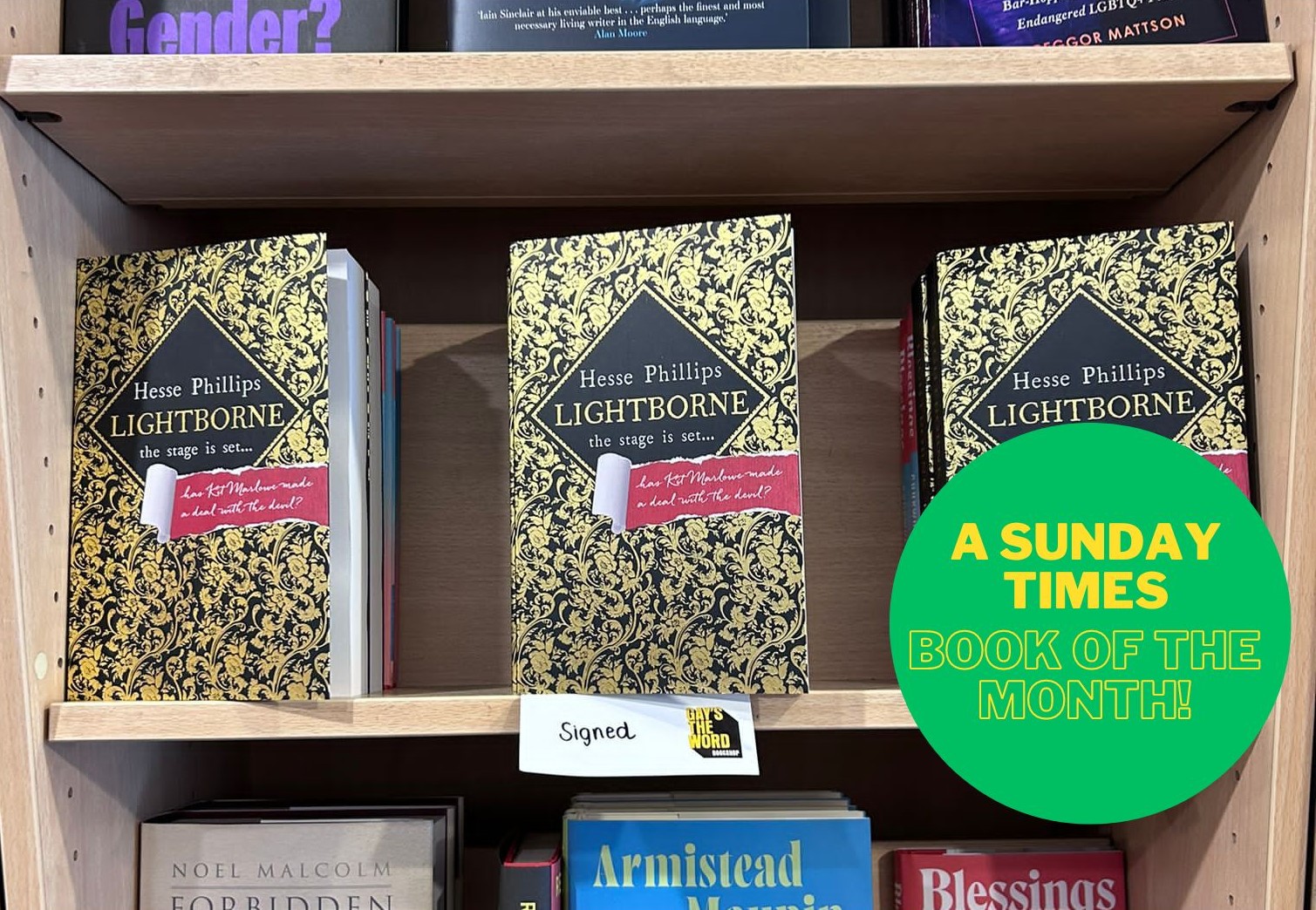
I have only a few words, and most of them are gibberish. Lightborne has been given this brief but amazing review from Nick Rennison, author of 1922: Scenes From A Turbulent Year and Sherlock Holmes: The Unauthorized Biography.

Screenshot of a review on the Sunday Times' website which reads, in part: "Book of the Month: Lightborne by Hesse Phillips. Other works of fiction have been written about the turbulent life and still not fully understood death of the Elizabethan dramatist Christopher Marlowe... Probably none has demonstrated the erudition and the intensity of Hesse Phillips's debut novel, 20 years in the making... Told in vivid, punchy prose, Lightborne is a brilliantly original take on a familiar story."

Obtaining reviews in mainstream papers requires a monumental effort mixed with pure dumb luck, and is a resource many authors are shut out from, whether for lack of connections or industry bias against indie published writers. I feel incredibly fortunate to have managed to worm my way in, thanks entirely to the hard work of my publicist at Atlantic Books.

Good press can certainly help sell books, but this is a fickle business, so we’re still in “wait and see” mode. Reviews from readers are naturally one of the best, if not the best determinant of a book’s success, so to anyone out there who has bought and read the book, please do leave your review on sites like Goodreads, Amazon, and Bookshop.org. (Even if it wasn’t for you – reviews are to help other readers decide whether the book is right for them. So help your fellow readers out!)

As for me, I’m going to take a short break from biting my nails, and throw myself into the best cure for debut author anxiety – working on the Next Book….!

Lightborne Updates: A Book Launch Pilgrimage to Gay’s the Word & The Rose Playhouse

Last week, I traveled to London to see my book off into the world and to revisit a few of the locations from the novel, some of which I hadn’t managed to see in person since the early days of research. Call it a pilgrimage. While there was no particular requirement for me to visit London last week, it felt wrong not to be there when Lightborne finally hit the shelves in the city that had inspired me for the past 20 years.

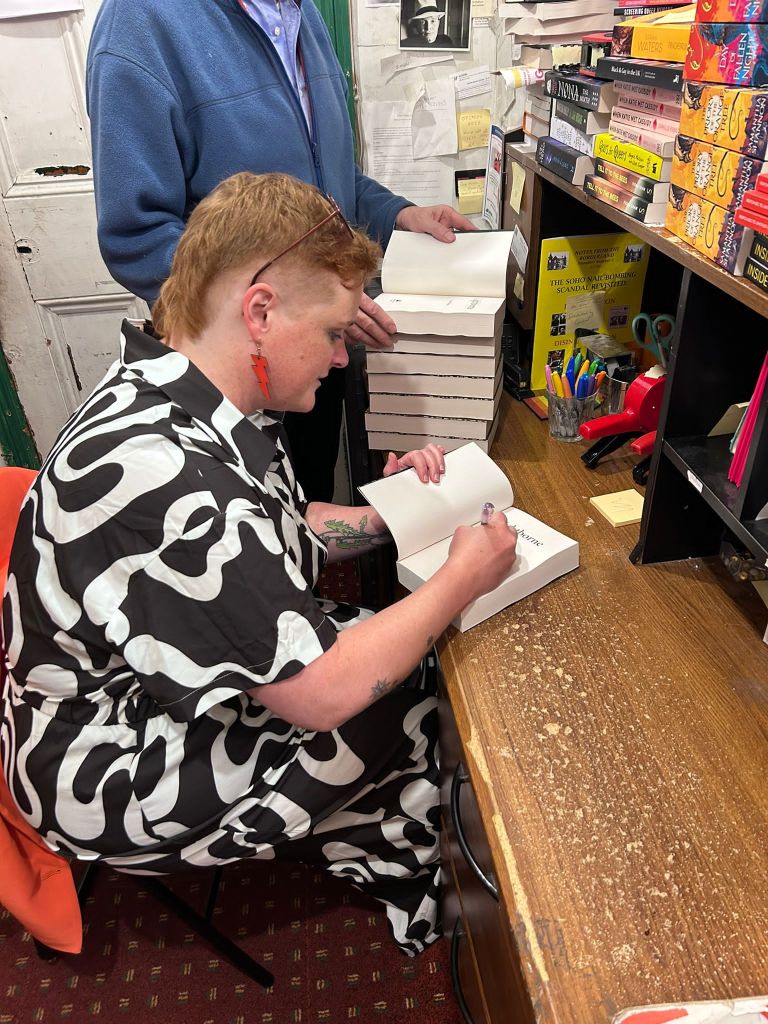
Luckily for me, I have a wonderful publishing team at Atlantic Books, who seemed to know exactly how to celebrate the Big Day. After giving me the full star treatment at their offices in Bloomsbury, they swept me off to the legendary and venerable Gay’s the Word, the UK’s oldest queer bookshop, for a signing and some photos.

Me with Jim MacSweeney, Manager of Gay’s the Word since 1989, looking as if he’s about to ask me what I’m doing standing in front of his shop. You can just see Lightborne by my right elbow! Photo by Laura O’Donnell.

I can’t begin to express how exciting it was to step behind the desk at Gay’s the Word, a staple in London’s queer community for 40 years – nor, for that matter, can I tell you what went through my head when I first saw Jim and Uli putting Lightborne on the shelves. There was such a whirlwind of emotions that the only moment I remember with true clarity is when I sat down to do my signing and noticed a picture of queer artist, author, AIDS activist and personal hero David Wojnarowicz looking down on me from the wall above. There came a singularly strange, out-of-body sensation, as if I were watching myself from across the room.

Photo by Laura O’Donnell.

It’s one thing to write about history, quite another to touch it. To enter it, even, for the briefest of moments. Gay’s the Word is one of those places made all the more sacred by having survived so many attempts to destroy it, much like the queer community it serves. Opened on the brink of the AIDS crisis, raided under “obscenity” laws, threatened with closure, its tenacity in the face of hardship and ignorance is every bit as inspirational as the lives of people like Wojnarowicz and his contemporaries Keith Haring, Candy Darling, Angie Xtravaganza, Peter Hujar, Marsha P. Johnson and Sylvia Rivera – every bit as inspirational as a life like Kit Marlowe’s, queer before “queer” was even a thing. I don’t know whether it’s possible to top the feeling of knowing that I have my own little corner in such a space, for however long it lasts.

They took RuPaul’s House of Hidden Meanings off the shelves for this photo-op, but I’m not bragging. Photo by Laura O’Donnell.

As part of promotional efforts, while in London I also had to take myself and my very patient wife on a tour of locations from the novel in order to record some short videos, which I will hopefully post in the future. Despite the destruction wreaked on London by the Great Fire of 1666 and the Blitz, you can still visit numerous places that existed during Marlowe’s lifetime, from the Church of St. Helen’s, Bishopsgate to Southwark Cathedral, not to mention Marlowe’s final resting place in the yard of St. Nicholas’s Church, Deptford – a living archive to mine for gold.

Not all have survived exactly as Marlowe might have remembered them, but sometimes the traces left behind feel still realer than brick and mortar, straddling the line between story and substance. Just down the street from Shakespeare’s Globe on Bankside lies an ordinary looking office block with an extraordinary secret in the cellar – the ruins of the Rose Playhouse, the setting of Lightborne’s opening scene:

The curtains part, cutting a gash of daylight through the backstage gloom. Beyond, the Rose Playhouse appears, a vortex of timber and plaster and densely packed humanity that reels upwards, three stories, to a dilated eye of cloud-streaked sky.

The Rose, brainchild of entrepreneurs Philip Henslowe and John Chomeley, was the earliest of London’s theatres to take on the now iconic, polygonal form later echoed by the Swan and the Globe. It opened in 1587 and existed just into the 17th century, hosting the first performances of most of Marlowe’s plays and many of Shakespeare’s. Its performance and financial records, scrupulously recorded in a small leatherbound book by manager Henslowe, comprise some of the most important documentary evidence of theatrical activity during the Elizabethan period. Perhaps most famously, the Rose was recreated for the Oscar winning film Shakespeare In Love.

An artist’s reconstruction of the Rose with a cross-section exposed. By William Dudley.

After lying buried in the Bankside mud for four centuries, the Rose came to light again in 1988 when building works exposed its remarkably well-preserved foundations. But although the playhouse’s discovery was initially met with a flurry of excitement from theatre makers and devotees, writers, archeologists and historians, the Rose has long lain in hibernation while funds are raised to resume the excavations cut short in 1989. In the meantime, the remains of Shakespeare and Marlowe’s first theatre remain mostly dormant, lovingly cared for by a team of volunteers and archeologists, subsisting on charitable donations and high-profile benefactors such as Dame Judi Dench and Sir Ian McKellen. Last Saturday, for the first time in ten years, I was able to see it again.

The Rose as it appears today. Photographer unknown.

It may not look like much. Due to their centuries spent buried in the Thames’ anerobic mud, the Rose’s foundations must now be kept underwater to forestall decay. Thus, what you see when you enter the former dig site is a pit of raw earth enclosing a dark, shallow pool. Beneath the water’s unnervingly still surface, strings of red light outline the footings of the stage and the yard, throwing an eerie glow onto the steel beams that crush down from overhead. It is cold inside, damp-smelling and dim, lending the space a grave-like atmosphere.

But far from diminishing the Rose’s power, the sepulchral surroundings have a strange way of imbuing it with all the hushed, unearthly hauntedness of an ancient site of pilgrimage. Contrast the chilly silence with the roar of the crowds that came centuries ago, and you can’t help but imagine yourself in the company of many thousands of restive ghosts – maybe Kit Marlowe’s among them.

My hope, of course, is for the Rose to come alive again, however affecting it may be in its current state. Previous excavations carried out on the site were performed hastily and under constant threat of foreclosure by developers, meaning that there’s still much left to uncover. In addition, plans are underway on The Rose Revealed Project, a proposed visitor’s centre, performance space and museum which will preserve the Rose for generations to come. Though there’s an enormous, money-shaped hurdle still to climb, I’m hopeful that those plans will come to fruition – and I sincerely hope all this might inspire someone out there to support the project.

Today, the Rose Playhouse sleeps again, awaiting its next day in the spotlight. A signed copy of Lightborne sits in the front window of Gay’s the Word, gleaming spectacularly gold in the afternoon sun. (May it find a loving home!) And all I can do is wait and see.

Lightborne Updates: A Big Box of Books

Last Friday I received the most exciting bookmail any author could ask for: a box full of shiny (very shiny) new copies of my debut novel, hot off the press! They even have that “new book smell,” which, IYKYK.

Look at that GOLD!

With my planned trip to London for pub-day fast approaching, just about every friend I talk to asks me whether things are starting to feel “real” yet. What I’ve discovered throughout this whole publishing process is that the goalposts for “real” keep moving the closer you come to the big day. Seeing the manuscript become a digital ARC felt “real,” then holding the physical ARC in my hands felt even “realer”; after that came the final cover design, then the corrected digital proof, and now I sit here with a copy of Lightborne next to me – the same as will soon appear on bookshelves across the UK, Ireland, even as far away as Australia.

It can’t possibly get any “realer” than that, can it? Have we not, at last, reached “maximum realness,” as a drag queen somewhere is probably also wondering right now?

I count on nothing, as far as that is concerned. A year ago, in my naivete, I might have believed that walking into my book launch would be the peak of this whole experience, but now I’m no longer certain there will be such a thing as a peak. (Or a launch, for that matter!) We writers like to impose the rules by which our little worlds are governed onto the “real” world, in the hope that we might feel just a little more in control of our lives, but the shape of a publishing journey is not a single curve building towards climax, probably more like a series of waves of varying lengths. There’s an addictive element to it – the highs are very high, the lows abysmally low. And you never really know when one is going to hit.

For now, amidst so much uncertainty, I’m doing my best to focus on the milestones I can count on happening: the next time I hand a friend or a family member their very own copy of the book and blushingly insist, “You don’t have to read it”; the first time I get to listen to the entire audiobook, and hear award-winning narrator Will M Watt bring Kit Marlowe, Ingram Frizer and Robin Poley to life. The first time I walk into a bookshop and see Lightborne for sale – an experience I’ll be lucky enough to share with my wife, and my parents, who are traveling all the way from Pittsburgh.

For now, please enjoy this extremely amateur unboxing video, in which I finally get to hold Lightborne for the first time – another beginning in a long series of beginnings.

The GOOOOOLLLLLDDDD!

Lightborne Updates: USA Launch Date & Cover Reveal

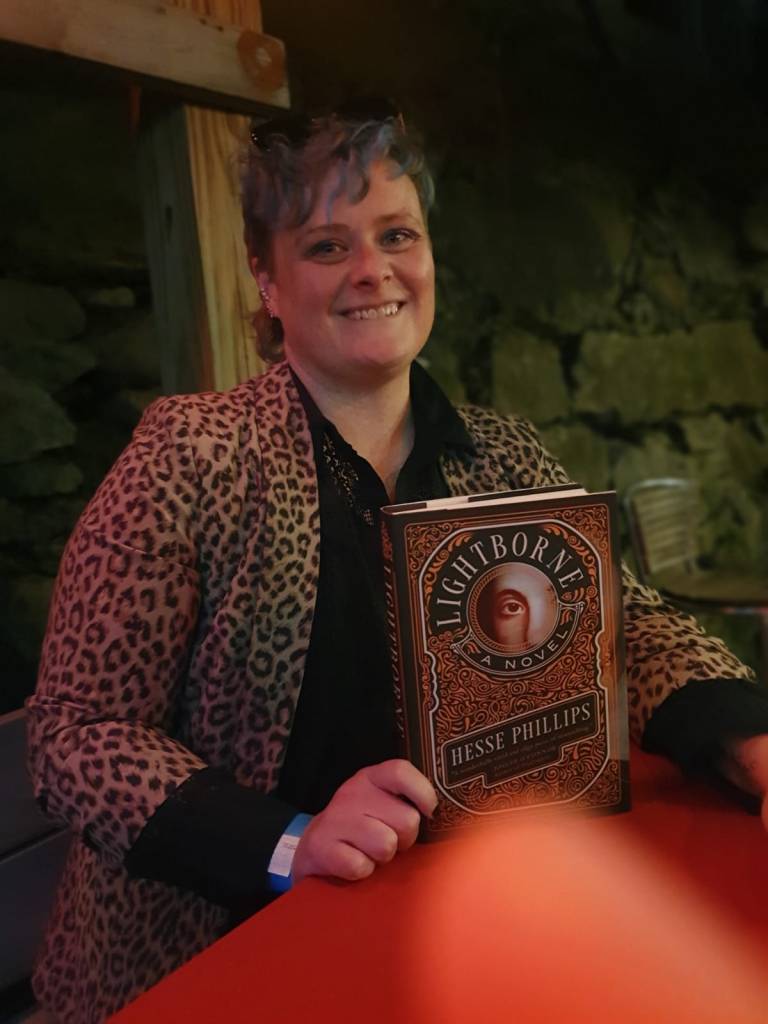
It’s finally happening: after many months of tireless work from my agent and rights manager, Lightborne has officially found a home in my home country with Pegasus Books! While it’s available to pre-order in the US now, you can look for it in bookstores from October 22, 2024.

As soon as my agent gave me the good news, I realized there was something very familiar about the name Pegasus. Like many of my anecdotes, it all starts with my dad and his ever-expanding collection of books.

Cast your eyes across the innumerable spines packed higgledy-piggledy into Dad’s groaning, sagging bookcases, and two things will surely stand out to you: one, that nearly every book has something to do with history, and two, that the Pegasus logo appears over and over again. Turns out, my dad is one of their most dedicated customers. He likes to describe himself as a history buff – though “fanatic” might be a more accurate word – and for just about every notable person, important event, place or people you can think of, there’s a book or two in Pegasus’ catalogue. On any given weekend morning, you may find old Dad planted in the history section of one of his local bookstores, flipping through some massive tome about a medieval Venetian cartographer or the life of Hannibal or the beef between Andrew Mellon and Winston Churchill. Only rarely does he walk out with his wallet unscathed. I’m fairly sure that some of the booksellers in southwestern Pennsylvania are only keeping the lights on thanks to his patronage.

I also have a few Pegasus titles on my shelves, like the thoroughly enjoyable and informative A Journey Through Tudor England by Susannah Lipscomb, Paul Strathern’s indispensable The Other Renaissance, and Living Like A Tudor by Amy Licence, which paints a vivid sensory portrait of the time period I anachronistically refer to as “mine.” Pegasus also publishes a brilliant selection of fiction titles by trail-blazing authors like Andrea J. Buchanan, Henriette Lazardis, Neil Jordan, Elizabeth Freemantle, and J.R. Thorpe, all of whom are redefining the historical genre.

It’s humbling and exciting to see my own name listed alongside luminaries like these. But naturally, nothing brings me more pleasure than to imagine Dad walking into one of his favorite bookstores on a Saturday morning and seeing a copy of Lightborne there on the shelf, in its gorgeous new American jacket.

A stunner, isn’t she? I’ve really lucked out with my cover designs!

(Dad, if you’re reading this, when the time comes: DON’T BUY IT. You’ll be getting a free copy!)

And now – for now – it’s back to gearing up for the UK launch on 2nd May. There will be an event scheduled in London to celebrate Lightborne’s birthday. More details to come!

Lightborne Updates: Cover Sneak Peek!

Before we get into the thing you’re actually here for, let me start this one off by saying, if you’re not listening to the 7AM Novelist Podcast with Michelle Hoover, then start now – not just because yours truly makes the occasional appearance on the show, but because I do so in excellent company. This latest season features an all-star cast, including Anjali Duva, Ron Maclean, Nancy Crochiere, Sara Johnson Allen, Marjan Kamali, Joanna Rakoff, Emily Ross, Andrea Meyer, Virginia Pye, Henriette Lazaridis, Colwill Brown, Crystal King, Chris Boucher, Dawn Tripp, Hank Phillippi Ryan, Mark Cecil, Jenna Blum, Jane Roper, Ethan Gilsdorf, Whitney Scharer, Shalene Gupta, Louise Miller, and many more, all ready to help struggling writers work through whatever’s holding them back from getting words on the page.

Recently there were two back-to-back episodes dealing with the stressful process of publishing your first book, as Aube Rey Lescure hopped on to discuss the launch of her debut River East River West, and Kasey LeBlanc, Christine Murphy, and Aaron Hamburger came on to talk about the travails of starting book 2. Listening as someone who can relate all too well to the topics at hand, I found my mental state veering wildly between excited and despairing, inspired and terrified.

Let’s be real: publishing a book is the thing we writers tell ourselves will finally make our lives fall into place, fix our self-esteem issues, vindicate our hard work, even solve lifelong crises of identity. For over a decade, it was the thing I felt I had to do, if only to justify the time and money I’d sunk into writing my soon-to-debut novel, Lightborne. And of course, I am thrilled beyond belief that it is finally happening. But I’m also learning that publication will fix absolutely none of the above problems. It will, in fact, create a few new ones.

Now that debut authors are speaking more openly about the mental health struggles they face in the lead-up to pub day, what emerges is the clear need for us to support one another. The tawdry, soul-crushing business of self-promotion can feel desperately lonely; the burgeoning public exposure can make you paranoid and crash whatever modicum of self-esteem you’d built-up since surviving high school. The dark, primal urge to dig yourself a burrow and hide in it starts to take over.

But this is why community is so essential to the debuting author. It may come via social media, or through writing groups and classes, or – just maybe – through fellow listeners of a writing podcast. I’m very fortunate to know many of the panelists on the 7AM Novelist through the legendary Boston writing center, Grub Street, where I participated in the Novel Incubator Program some [cough cough] years ago. But one of the great things about the 7AM Novelist is how it allows writers from all around the world to make connections. Seeing ideas exchanged and friendships forming in the chat box during every live episode recording truly warms this withered old heart.

So I very much hope anyone reading this will be sure to check out the show and support the author panelists: google them, subscribe to their newsletters, buy their books! This season is particularly exciting because every episode deals with questions submitted by listeners – even though I’m on again tomorrow, Jan 11th, I still don’t know what topic we’re going to get. So if you have a sticky issue to work out with your WIP, your writing practice, or career, please do go to the podcast page and submit your answer to the question, “What’s holding you back?” Maybe I’ll even get a chance to help you through it.

And now that you’ve scrolled all the way down here, you may collect your reward: a first look at Lightborne’s lush, evocative final cover!

Via Atlantic Books

As you can see, the cover will build on the proof design, using the same black and gold damask pattern and a simply gorgeous font based on 16th century typography. I’ve been informed that the pattern will, in fact, be stamped in gold foil – so in person, it’s going to be stunning!

Preorders are rolling out, so please check with your local booksellers. For those who use NetGalley, ARCs will be available soon.

Research Diary #1: Spies, Schemers, and Straight-up Bullsh*t

I may be technically “done” with LIGHTBORNE, my first novel, but it seems like the research just isn’t done with me. After years – too many years – spent scanning documents for familiar names, I am primed to pick them out from just about anywhere. Every now and then, an old ghost steps out of the shadows, and the hair stands up on the back of my neck.

Today, the old ghost’s name was Nicholas Skeres – one of the three men who were present when my protagonist, Christopher Marlowe, was murdered in 1593. Just as the motives behind Marlowe’s death carry an air of mystery, all three of the chief witnesses/accomplices/perpetrators are enigmas in one way or another, which naturally I have exploited the hell out of for narrative purposes. Robert “Robin” Poley was a spy with a frighteningly dark history; Ingram Frizer, who wielded the fatal weapon, was a servant who worked for, of all people, Marlowe’s friend and patron.

Within that shady crew, Nick Skeres was always the one I felt I didn’t need to worry about. His youth as a con-artist, cutpurse and thief is well documented, and his later work as a lackey for important people, like the Earl of Essex, seems clear enough. In all likelihood, he was probably a pretty nasty character. Look him up in Charles Nicholl’s THE RECKONING, an admittedly more than slightly problematic investigation into Marlowe’s death, and you get the confident assertion that he was “Walsingham’s man” – in other words, a government spy. Look him up in other biographies by David Riggs, Park Honan, Constance Brown Kuriyama, F.S. Boas, all the way back to Ethel Seaton, who first identified Skeres’ name in connection with espionage way back in 1929, and you find the same conclusion.

So, why is Nick Skeres suddenly weighing on my mind?

Well, while doing some research for book #2, I happened to run across a reference to “Skyrres” in a letter connected to the Babington Plot. The Plot features heavily in LIGHTBORNE – a convoluted conspiracy which drew in Catholic priests and sympathizers from all across England and beyond, ostensibly spearheaded by the young, impressionable, and loaded Anthony Babington (although it is far more likely that Babington was merely a patsy). The goal was, in a nutshell [*inhales*], to jailbreak Mary, Queen of Scots, transport her to the Continent, hook up with the French Catholic and Spanish armies and lead an attack against England, eventually overthrowing Elizabeth I, installing Mary in her place and restoring the official state religion to Catholicism.

The scheme felt harebrained from the start, and Elizabeth’s spies, under the aegis of Sir Francis Walsingham, her “Spymaster,” were all too happy to let the would-be plotters walk themselves straight into their clutches… which, spoiler alert, they totally did.

In the weeks that led up to the Plot’s final, tragic unravelling, Babington and his friends were frequently on the move between bases in or around London. In August of 1586, right before Walsingham finally sprang his trap, his secretary, Francis Milles, wrote to him about people whom he’d seen hanging around the Catholic safehouse where Babington was believed to be hiding out:

Alt Text: Screenshot from The Troubles of Our Catholic Forefathers as Told by Themselves, 1872. A highlighted section reads, “Bab., Donne, Skyrres [?], and some others both men and women of this crew I have discovered this day with my own eyes, and therefore seeing Bab. is not departed, I hope for the better success of this service.”

Until a few weeks ago, I’d never read Milles’ letter myself, but I’d read about it. If “Skyrres” was our Skeres, then he wouldn’t have been the only one present at Marlowe’s death to have also been embroiled in the Babington Plot. Robin Poley was, in fact, Walsingham’s chief instrument in taking Babington down. What I find interesting here is the way that Milles talks about Skeres: as one of Babington’s “crew,” seen with his “own eyes,” and taken as proof that Babington is “not departed” – in other words, also present at the house, though unseen.

Milles’ letter in no way treats Skeres as separate from the other conspirators, like “Donne,” i.e. John Dunne, who was soon after convicted of treason and hanged along with Babington. If Skeres is mentioned “without further comment,” as Nicholl says, then so are they. If anything, Milles’ letter suggests that, whatever our Nick’s reasons for being amongst Babington’s “crew,” they might not have been so cut-and-dry as previously assumed.

Was Skeres a double-agent, not entirely trusted by either side? Or was he, perhaps, an apostate – a Catholic sympathizer who would soon betray his own cause?

Whatever the case, if Nicholas Skeres was in the employ of Sir Francis Walsingham in 1586, then Francis Milles, as Walsingham’s personal secretary, should damn well have known about it. The letter, to my eyes at least, suggests that Milles had another understanding about him entirely.

Skeres virtually disappears from the record for three whole years following this sighting by Milles. That might not be a red flag in itself, as paper-trails frequently go astray in this period, and the aftermath of the Babington Plot was every bit as chaotic as its advent. When our Nick resurfaces, he is working as a messenger for both Walsingham and the Earl of Essex, meaning that he is firmly entrenched in government employment. Did he serve faithfully? Who can say. As it happens, Skeres would eventually be arrested in connection with the Essex Rebellion – another attempt to overthrow Queen Elizabeth – and probably ended his life in prison.

How is any of this relevant to the murder of Christopher Marlowe – the one we actually care about?

Well, the uncertainty surrounding Marlowe’s death has really been something of a plague on Marlowe studies. It’s the mystery everyone wants to talk about but no one really wants to solve – because if we solve it, then we won’t get to speculate anymore. After so many hundreds of years, answering the problem would hardly feel like justice, but rather more like killing poor Kit Marlowe all over again.

Most of the biographers I mentioned above ascribe to some version of the theory that Marlowe’s murder was a grand conspiracy, orchestrated by the government or some other powers-that-be.1 The thing is, though the circumstances of Marlowe’s death are in fact pretty suspicious, there’s no “smoking gun” that proves it was a hit-job. There are, I think, reasons to believe his murder was swept under the rug, but that does not necessarily mean it was planned from on-high. All it means is that someone was protecting the people likely to suffer consequences from it: Poley, Frizer, and Skeres. The people who were actually there, the room where it happened.

A notorious spy. A servant of Marlowe’s friend. And a man long presumed to be a government spy, whose motives, loyalties, and ambitions may be far murkier than previously assumed.

If that’s who Nick Skeres really was – and Milles’ letter certainly makes a case for it – then our picture of the scene of the crime shifts towards something potentially more personal, and far messier, than a state-ordered assassination. Why were these particular people there? What was Marlowe’s connection to them? What did they want with him?

This is all perhaps just a very (very) long way of saying that the work goes on. I’ve already written my version of Nick Skeres, who is every bit as shady as you’d expect. But the novel I’ve written is not about proselytizing my version of “what really happened.” I’m not so interested in that. Fiction is about asking questions for which there are, ideally, no clear answers. Even historical fiction, despite having one foot in fact, takes events or lives that were momentous and singular to those who lived them, and – rather heartlessly – scavenges them for parts. The dead, long gone, exist only in fragments from which we storytellers glean what we may, and (like conspiracy-theorists) straight-up bullshit the rest.

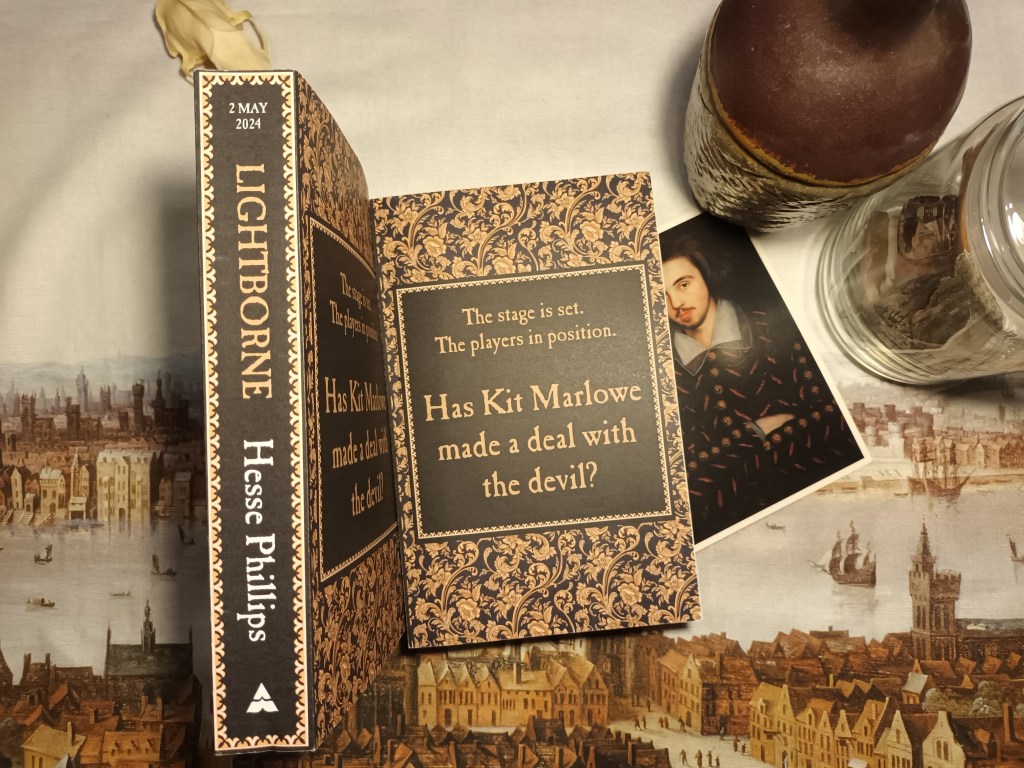
Color photo of a pair of books decorated in black and gold damask print lying on top of Wenceslas Hollar's Panorama of early modern London. One book is shown face-up, the other displays the spine, which reads "2 May 2024 LIGHTBORNE Hesse Phillips." The cover on the other book features a black square framing the tagline, "The stage is set. The players are in position. Has Kit Marlowe made a deal with the Devil?" Peeking out from under neath the face-up book is a postcard of Christopher Marlowe's alleged portrait.
Photo by Hesse Phillips. Yes, it was fun.

Oh yes – in case you missed it, LIGHTBORNE is an ARC now, and looks very fetching in gold, if I do say so. I’m told that copies will be available on NetGalley soon!

Read more about LIGHTBORNE here.

Featured image: Fede Galizia, Portrait of Paolo Morigia (detail), Public Domain, Wikimedia Commons

  1. Brown Kuriyama is an outlier here for her “no-nonsense” approach, i.e., taking all of the documents and testimony associated with Marlowe’s murder completely at face-value, for better or for worse. ↩︎

Lightborne Updates: ARCs are in, and so is Impostor Syndrome

Last week I had the immense privilege of visiting my publisher Atlantic Books’ offices in person. Little did I know when I was making aimless circles around Bloomsbury, hopelessly lost, that once I got there I would be greeted by printed, jacketed, ready-to-go ARCs of my debut novel – a whole pile of them awaiting my woefully unpracticed signature.

Photo by Laura O’Donnell

I’d been convinced that the ARCs were still weeks away, if not months. Being able to pick up a copy, flip through the pages, and see what I’d thus far known only as a Word document looking very much like a real book put me into some kind of fugue state. I barely remember signing the copies, only that my signature degenerated steeply from one copy to the next. By the time I got to the last one it looked like a toddler had scribbled all over the page.

Of course I’m still excited and riding high from the experience, although an astonishing amount of terror has since crept in. Things are moving quicker than I’d expected, which means my little window of peace and privacy is closing, and not only must I come to terms with the fact that the need to self-promote is inevitable, but it is also imminent. As in, I clearly should have started doing it weeks ago.

I think many writers break into a cold sweat at the thought of having to put themselves “out there,” whether it stems from a simple dislike of the spotlight or the crippling, unshakable belief that we are not worthy enough or smart enough or good enough, and sooner or later the world will catch on and punish us for daring to take up space. The latter is certainly true for me. The law of impostor syndrome is that the voice of self-doubt will always grow louder and stronger when presented with mounting evidence that it’s really full of shit. (Much like people who are full of shit.) The closer I come to any kind of success, the easier it is for me to convince myself I’m not deserving of it.

The most constructive way I’ve found of dealing with impostor syndrome so far is to think of it as a necessary stage in the process of working towards a goal, and moreover, a sign that things are, in fact, going pretty well. This doesn’t silence the voice of self doubt, but it does put it at a slight remove. Fortunately, I’m riding a train over whose path I have zero control, which means I have no choice but to keep moving forward. It’s surprisingly easy to be braver about taking certain steps once the option of turning back is gone.

Besides, the scenery really is lovely. Look at this, LOOK AT THIS!

Color photo of a pair of books decorated in black and gold damask print lying on top of Wenceslas Hollar's Panorama of early modern London. One book is shown face-up, the other displays the spine, which reads "2 May 2024 LIGHTBORNE Hesse Phillips." The cover on the other book features a black square framing the tagline, "The stage is set. The players are in position. Has Kit Marlowe made a deal with the Devil?" Peeking out from under neath the face-up book is a postcard of Christopher Marlowe's alleged portrait.
Of course I did a photo shoot with my book.

Lightborne Updates: Proofs, Proofs, Proofs!

We’re just about into that incredibly exciting stage where things start getting printed on paper – meaning that I’ve recently received the most important pdf file of my entire existence so far, and have spent the past week going over it with a fine-toothed comb. It feels weirdly unceremonious to see my proof sitting open in a Chrome tab along with email and about 50 other tabs worth of research for my next book, as if it were just another JSTOR article that I stopped skimming last week and forgot about.

Fortunately, it is gorgeous, as you can see from the image above. I’m thoroughly impressed with my publisher’s choice in fonts, all of which are wonderfully evocative of Elizabethan-era typefaces. And then there’s the uncanny resemblance between the header font and the tattoo on my right forearm:

Yup, that’s me, in my bathroom, because let’s face it, it’s the only room in the house with good lighting. You can probably tell from my face that I’d just spent two hours getting stabbed with tiny needles.

I got myself the tattoo last year to celebrate signing my deal with Atlantic. A more superstitious person than myself might take the resemblance as some kind of omen. Lente currite noctis equi (“run slowly, horses of the night”) is a phrase that originally appeared in Ovid’s Amores, a series of quite randy love poems which my protagonist, Christopher Marlowe, translated into English as a student at Cambridge. It also, and perhaps more famously, appears in Marlowe’s own play Doctor Faustus, used by the titular character as a magical incantation in effort to halt time in its tracks. Notably, the incantation does not work – Faustus can’t escape his deadline with the Devil, who promptly shows up and drags him screaming into hell.

So, uh, not sure whether that’s a good omen or a bad one, but it is at least a lovely coincidence.

From here, the next stage is to print ARCs (advanced reader copies), which will hopefully lead to some nice endorsements from people far more interesting and successful in life than myself. After that, we’ll begin work on the final text for publication in May, at which point my book will truly have grown up and moved out of the house for good. For now, it’s thrilling to see it all dressed up in a spiffy new suit, looking very much like a “real” book, albeit in digital form.

Things are definitely heating up, so hopefully I’ll have more news to share soon!

Lightborne Updates: Mess Becomes Book

I’ve just handed-in my first batch of revisions to my wonderful editor at Atlantic Books, and I suddenly find myself with nothing at all to do, book-related, for the next few weeks. This is the process, as I’ve found it: lots of short bursts of grinding work that’ll keep you either manic or paralyzed with anxiety, until, suddenly, it’s all over. Now, to wait.

The road to publication begins with so much fanfare, so much excitement, that the subsequent long periods of seeming inertia can easily drive you batty. You feel as if you’ve lost momentum, or you’ve been forgotten about, or (worse) you have forgotten to do something, and the silence closing in is all your fault. But as I sit here writing this, there’s a whole machinery at work on my book, behind the scenes: editing, cover-design, publicity, rights-management, and more. For me, it’s all peaks and valleys, but for the publisher, it’s a slow, steady ascent towards Launch Day, when the real rollercoaster begins.

After all the excitement of signing my contract at the end of last year, life became relatively quiet. So quiet, in fact, that I found myself with time enough to start working on the next book, if for no other reason than simply to keep busy. Now that we are just past one year out from publication (in spring 2024), things are finally picking up again. I’ve had two weeks to work on changes to the manuscript, which might possibly have been the most stressful two weeks of my writing life. I kept having visions of that day every writer should look forward to: opening a great big box full of fresh, gorgeously bound copies of my debut novel, only to look inside one and immediately find a sentence I loathe staring back at me, set in stone.

Fortunately, my last opportunity to fine-tune has not yet come and gone – and the last round of edits will have the watchful eye of a copyeditor involved, so the responsibility of catching all those overwrought metaphors and wonky adverbs will not fall to me alone. Lightborne remains, however, my baby, something about which my editor was very clear: the goal is to end up with a book that makes us both happy. Having both seen and heard horror-stories about inflexible editors, I know am very lucky to have one who actually trusts me. (Now, whether or not she should…)

So, for the next few weeks, I will be trying to forget about Lightborne for a little while so that my editor can do her job in peace. But once this pause ends, I’ll likely be facing down the most intense weeks of work I’ve ever spent on this book. (And I’ve spent, um, A LOT of weeks on it.) Soon, hopefully, there will be a cover to look forward to, followed by more edits, final edits, printing and distributing ARCs, convincing nice people to say nice things we can put on the cover, convincing nice people to say nice things on TikTok… And in the midst of all that there will be little ol’ me, who barely knows how to tweet and uses Instagram mainly to share pictures of my dogs, doing the WB Frog dance and looking forward to my next nap. Maybe I should just enjoy the silence.

Featured image: A sample of Lightborne’s protagonist, Christopher Marlowe’s handwriting (Wikimedia Commons)

Eulogy for an Unpublished Novel

This post originally appeared on Dead Darlings 28/2/2023.

Let’s start with the good news before we get to the complicated feelings: my debut novel Lightborne is coming out next year. And I am ecstatic!

Lightborne is a historical novel about Christopher Marlowe, an Elizabethan playwright and contemporary of Shakespeare who died violently and young, under somewhat mysterious circumstances. Rumored to have been a government spy, famously brash and outspoken, the author of the first play in English to feature an explicitly queer relationship between men – I fell in love with Marlowe the first time I discovered him, at thirteen or fourteen, and from that point on it was only a matter of time before I tried to write a book about him.

I could not possibly have known, when I finally got started in my senior year of college, that I would spend the better part of the next twenty years writing about Marlowe.

The thing is, I misspent my youth writing “novels” – practice novels, I think of them now – one after another, often only to chuck them in a drawer after just three or four drafts. Lightborne, however, was different. Over two decades – half my life, really – I compiled hundreds of hours’ worth of research, wrote and scrapped something like five different novels about Marlowe, made forty-plus revisions to Lightborne, and slogged through rejections in the triple digits. To say Lightborne was “a labor of love,” as I’ve been saying repeatedly ever since the good news became public, feels like understatement.

I had plenty of opportunities, and every reason, to stop. Put it in the drawer. Work on something else. So why didn’t I?

Love did have something to do with it. I loved Lightborne, and I loved writing it. I loved “my boys,” as I often refer to the three main characters, despite having done a great deal to torment them. For years on end, I’ve agonized over these (mostly) made-up people’s lives, at my desk, on the couch, wide awake at 4am, lying on a beach, wandering around the supermarket… They say, “A writer never stops writing,” and that is devastatingly true. All other thoughts become intrusions, as does life. Only love makes you that stupid.

But it was also labor, with all the pain that implies. I’ve lived so long now with the anguish, not of disappointment or failure, but of hope – terrible, all-consuming, sadistic hope – that I don’t quite know what to do without it. A writer never stops writing – and part of that is convincing yourself that it will all be worth it one day: that one day, finally, you will stop.

So this is the end. After two decades, I’ve stopped writing Lightborne. This is a celebration, but it’s also a eulogy: for the work, for the hope, for the task I just had to complete, which began as all eulogies do, with death.

Twenty years ago, this October – a few months before my first attempt to write a novel about Christopher Marlowe – my friend died. At the time, I was already working on an undergraduate thesis about Marlowe’s play Edward II, and the queer canon, and the task of finding ourselves among the dead. Then my friend died. Soon after, my thesis began spilling over into a novel on the side – nothing at all like Lightborne as it stands now, except perhaps in two key ways: that it was about a young, queer man who dies far too soon; who, in life, was widely loved but misunderstood, and sometimes vilified. And, it was about bearing responsibility for his death.

I dedicated even that first messy, embarrassing draft to my dead friend. “In memory of.” Through all those years, for each new draft or entirely new version of the story, the first thing I would do upon opening a blank document was copy/paste that dedication. Looking at it, I could imagine the words printed in a book, with some stranger out there holding it in their hands, reading my dead friend’s name. If nothing else, the dedication page was a way of holding onto the original impulse that brought me to tell this story – to always be writing, but to always be writing towards an end.

The thing about the dead is, they are never satisfied. Never appeased. For us, they exist in a state of arrest, with the last thought, the last gesture, the last sensation frozen in time. I think one of the reasons why we write is to capture every fleeting thought or action as if it were the last, to nail the seconds to the wall so we might pore over them from every angle: catalogue every detail, ask every question, draw a circle around every mystery. Of course, the final stage of writing is to let all of that go and give the story to whomever wants it, for them to envision and interpret as they see fit. Which I suppose is a kind of resurrection, a kind of life.

That’s the joy, amidst all this excitement and terror and uncertainty: the joy of knowing there will be life for this story beyond my little brain, there will be life for my boys. One day – surely sooner than it seems to me now – a stranger will open a book that says Lightborne on the cover, and their eyes will glance briefly over the name on the dedication, “In memory of”: multiple names now.

And then they will turn the page.

Lightborne will be published in the spring of 2024 by Atlantic Books UK.

Image: “St. Jerome Writing” (detail) by Caravaggio, Wikimedia Commons

More Posts…