Research Diaries #2: Hell is empty & all the devils are here.

Content Warning: this post discusses historical cases of violence against women, including r*pe.

Hi. This is me poking my head out of my writing cave, wanting to talk about a work-in-progress for a minute – perhaps an incredibly foolhardy thing to do, because after all, there are no guarantees that any work-in-progress will ever come to aught. It’s Schrodinger’s book, as it stands. But with any luck – and a lot more work – perhaps it will one day step out of the box, alive.

For now, at least, I’m calling it The Devils of Denham Manor.

Like my first book, Lightborne, it is based on a true story of a crime which has gone unresolved for centuries. The case was well-documented in its time, though nearly forgotten today. At the heart of “The Devils” lies a sex scandal, which unfolded at the remote country estate of Denham Manor over the winter of 1585-6. For some eight months, an underground group of Catholic priests forced three teenaged girls to feign demonic possession before paying audiences of Catholic sympathizers and the morbidly curious. The priests’ stated purpose, in a nutshell, was to “prove the truth of” their faith through demonstrations of the supernatural powers it bestowed on them. Powers such as the ability to exorcise of “all the devils of hell.” They also undoubtedly made a lot of money.

By the early 17th century, the Denham “demoniacs”, and the names of their supposed resident demons, were so infamous that Shakespeare quite cheekily dropped them a reference in a famous scene of King Lear:

Bless thee, good man’s son, from
the foul fiend! Five fiends have been in poor Tom at once: of
lust, as Obidicut; Hobbididence, prince of dumbness; Mahu, of
stealing; Modo, of murder; Flibbertigibbet, of mopping and
mowing, who since possesses chambermaids and waiting women.
1

Just two years earlier, a book recording the women’s ordeal at Denham Manor had been published to enormous success: an instant bestseller, you could say. Such was due in part to the book’s sensationalist and often comic tone, lingering on the salacious details of three girls held captive, “used and abused,” by a group of older men. If the women did not become household names, their “demons” certainly did: Modo, Maho, Flibbertigibbet, Hobbidicut, Hobberdidance.

As so often happens in the aftermath of a scandal, many contemporaries – evidently, Shakespeare among them – sought to turn the whole episode into a joke, and the women into collaborators in their own abuse. Some of the events that went on at Denham were indeed ridiculous, and the exorcisms themselves sometimes had the audience in stitches rather than cold sweats. There were dirty jokes, grotesque dances, songs, and ribald jabs at the Protestant Queen Elizabeth and her ministers. But reading the testimonies of the victims paints a very different and far darker picture.

The youngest victim in the Denham case, a chambermaid called Sarah Williams, was only fourteen or fifteen when her exorcisms began. As an adult reflecting on her experiences, Sarah claimed that her captors frequently enhanced her performances through the use of intoxicants, plus physical and psychological torture. While Sarah herself never explicitly alleged sexual abuse – for, of course, the legal language to make such an accusation did not exist at the time – her recollections of the “exorcisms” to which she was, remember, publicly subjected, quite clearly describe acts of sadism, sexual aggression, and even rape.

I want to spare you the details. Broadly speaking, Sarah’s exorcisms involved a range of bodily violations, from the forced ingestion of “potions” and inhalation of “fumes,” to the “Laying-on of Hands,” in which a priest fondles, pinches, or even wounds the possessed, supposedly in order to “chase” the devil through her body. Most horrifically, Sarah alleged that the priests of Denham would often squirt caustic liquids or insert objects – including human bones, or relics – into “her priviest part.”2

The first page of Sarah Williams’ testimony, published in A Declaration of Egregious Popish Impostures by Samuel Harsnett, 1602. (Internet Archive)

Sarah’s story may be 400 years old, but it feels like a wound that might easily have been opened only yesterday. With the Epstein Files still dominating the news cycle, not to mention online discourse; the mass-rape Pelicot Case still unresolved; the egregious institutional failures at the heart of the UK “grooming gangs” scandal leaving survivors feeling abandoned; the fact that a convicted sexual abuser now holds one of the highest positions of power on the planet… The list goes on. If 2017 was the Year of MeToo, then you might rightly call 2025 the Year of the Rapist.

One wonders whether much really has changed since Sarah was abused before a crowd of willing (and paying) spectators in 1586, or since she described her abuse to a panel of lawyers and churchmen in 1603. Then as now, rape largely went unreported and unpunished. Although Elizabethan legal experts often classified rape as second only to murder, earlier laws determined rape to be more a matter of property loss for a woman’s male relatives than a serious offence against the body of a woman.3 (I don’t say “bodily autonomy,” because the concept did not exist, less so when pertaining to women and children.) The few rape cases that did make it to court rarely resulted in convictions against the rapist, and even occasionally resulted in the accuser being penalized for slander, adultery, or indeed “fornication.”

Moreover, according to medieval statutes dating back to the 13th century, a woman who had been raped was obligated to make a spectacle of her own anguish if she had any intention of seeking justice:

She ought to go straight away and with Hue and Cry complaine to the good men of the next towne, shewing her wrong, her garments torne, and any effusion of blood[.]4

In other words, she had to present herself as “the perfect victim” – an all too familiar scenario in today’s discourse. She had to object loudly and early, be visibly distraught, disheveled, and damaged; she had to show contrition for “her part” in the crime and “seek for Everlasting Night,” as one poet put it.5 She could, by no means, become pregnant, as pregnancy was then believed to only result from consensual sex. Her life and her world came to a screeching halt.

Perhaps this is why accusations of rape were so rare, amounting to just 274 in the 142-year period from 1558 to 1700. Out of those 274 cases, a mere 45 resulted in convictions.6 For comparison, it is estimated that some 900,000 people over 16 were sexually assaulted in England and Wales in 2024. From June 2023 to June 2024, 69,184 rapes were reported to UK police, of which a mere 49% resulted in a conviction. That’s nearly 70,000 prosecutions in one year, versus just 274 over a period of more than a century.

But Sarah Williams and her fellow “devil-girls” of Denham Manor were not among those 274 litigants. For the Elizabethan authorities, rape ranked low amongst the crimes of their abusers, several of whom were tried and executed for attempted regicide. In fact, after the exorcists’ ring was broken up, Sarah, as well as her sister Frideswood “Fid” Williams and another girl, Anne Smith, all endured months in prison for their presumed complicity in treason. Upon release, all three spent the next seventeen years of their lives either laying low or in and out of trouble with the law, begging for audiences with religious and political figures or avoiding them like the plague, torn between a desire for safety and a need for justice, a need to be heard. To be believed.

I’m sure this is why, when I stumbled upon Sarah’s story while researching something unrelated, I felt immediately compelled to tell it.

Unusually for her day, Sarah’s record of abuse survives, mainly because the powers-that-be found it politically expedient to sensationalize it. By 1602, when Sarah, Fid, and Anne received their summons, Queen Elizabeth’s health was failing, and the heir apparent to the throne, James VI of Scotland, had shown leniency towards Catholics in the past. For those who hoped England would remain Protestant after the queen’s death, a wild story about three innocent girls tortured and raped by a gang of Catholic priests was everything they could have hoped for: a way to push sanguine English Catholics back into the shadows, and make certain the incoming James would know his place.

For that reason, some scholars have discredited the women’s testimonies over the centuries, proclaiming them to be only another clever piece of anti-Catholic Elizabethan propaganda.7 But details of the exorcisms had been reported in earlier depositions given by both Sarah and her sister. Who are we to believe? Men for whom such testimonies, if proven true, would be disastrous, or women for whom the giving of that testimony was itself a disaster – a sacrifice of their privacy, security, and peace?

For over 400 years, Sarah’s story has existed only as her inquisitors saw fit to record it, not in her voice, but in the third-person. The tragedy in this is that Sarah’s abusers at Denham had also denied her a voice, claiming that any sound she uttered or move she made came not from her, but from the devil inside her. In one instance, as Sarah implored one of the priests to stop the exorcisms, he

cast his head aside, and looking fully upon her face under her hat, said, ‘What, is this Sarah or the devil that speaks these words? No, no, it is not Sarah, but the devil.’ And then [Sarah], perceiving that she could have no relief at his hands, fell a-weeping, which weeping also he said was the weeping of the evil spirit.8

This is another form of rape, I think, of the kind that leaves no marks. But then, every rape of the body is also a rape of the mind, the soul. It is a form of possession: the demon that takes up residence, and robs the host of all credibility, empathy, and humanity. Telling the story is a flawed form of exorcism, as anyone who’s ever had to tell such a story knows: incomplete and arguably performative in its own way, so desperate to be witnessed, to be believed. But it’s something.

I hope I can do Sarah, Fid, and Anne some justice, for whatever that’s worth.

  1. William Shakespeare, King Lear, IV:1, 2312-9. ↩︎
  2. Descriptions of Sarah’s torture can be found in Samuel Harsnett, A Declaration of Egregious Popish Impostures, 1603, pp. 78, 110, 120, 175, 181-3, 185. ↩︎
  3. Julia Rudolph, “Rape and Resistance: Women and Consent in Seventeenth-Century English Legal and Political Thought.” Journal of British Studies, vol. 39, no. 2, 2000, pp. 157–84. ↩︎
  4. Nicholas Brady, The Lawes Resolution of Women’s Rights, 1632, p. 392, quoted in Bashar, p. 35. ↩︎
  5. Nicholas Brady, The Rape, Or The Innocent Imposters, 1692. ↩︎
  6. Bashar, p. 35. ↩︎
  7. See F.W. Brownlow, Shakespeare, Harsnett and the Devils of Denham Manor, University of Delaware Press, 1993. ↩︎
  8. Modern English transcription by Kathleen R. Sands, in Demonic Possession in Elizabethan England, Praeger Press, 2004, p. 104. ↩︎

Lightborne Updates: UK Trade Paperback OUT NOW!

Today is filled with all the usual excitement, expectation, and nail-biting dread of every milestone I’ve faced thus far in this weird business of being a published author. However, today also marks a bittersweet end of the road in my publishing journey. Unless I pull a Pachinko within the next year or two, this will be the last UK pub day Lightborne ever gets.

I loved this book. I worked on it through my 20s and 30s, and into my 40s. It was a way of life for so long that tearing myself away from it took nearly as much discipline as writing the damn thing. Now I’ve moved on, and it already feels distant at times, but the lessons I learned in writing it will hopefully stick with me forever.

I’ve been living a weird double-life over the past two years, embarking on my next book while my first was making its international debut by slow stages. In the beginning, transitioning away from a book I knew so well I could set the characters free in the maze of my head and simply sit back and “observe” them was painful at times. After two years, I still don’t know my new cast of characters that well, although I am getting closer. It’s a strange feeling to be back in a part of the writing process which I last experienced so long ago it’s only a distant memory for me, leading me to second-guess myself – to think I’m doing it wrong. Connecting with other writers is keeping me grounded, but I already can’t wait to be in the 15th or 20th revision again, at the point where “mess becomes book.”

Those are some of my most treasured memories of Lightborne, even now. While publication is exciting and vindicating, it’s also a lengthy process of letting go. And while I still love “my boys” – even the wicked ones (looking at you, Poley) – I will never again experience that sense of mutual habitation that came with writing their story. This is what people mean, I suppose, when they talk about being visited by the Muse: a collaboration between me and the imaginary beings I’ve created, acting not independently of me (obviously) but in ways I can’t entirely explain. People also call writing a lonely profession, but when the writing is going well, it’s anything but.

So I’m a bit sad, but very excited to keep working, keep writing, and celebrate not the last, but the first of many last, glorious voyages of my debut into the world, with hope that it will find readers who will love it and need it as much as I did.

Safe travels, boys. 💙

The Historical (Fiction) is Political

On the eve of the US presidential election, this historical fiction writer has some thoughts.

CW: Racism, medical abuse, SA


I keep thinking about the several weeks this past summer, just before Joe Biden announced his intention to drop out of the US presidential race, when social media became absolutely flooded with appeals for a return to “precedented” times. Even now, type the word “precedented” into any search bar, and you’ll get thousands of hits, all expressing the same mixture of exhaustion and dread: Free us from nonstop whiplash. Give us boring and predictable.

I understand the sentiment. Our particular historical moment feels uniquely dire. But every time one of these posts pops up in my feed, I can’t help but think that all times have been both precedented and unprecedented, that we exist just as our ancestors did and our descendants will, putting one foot in front of the other as we trudge the treadmill of history. The shape of our times, and of our little lives within them, will inevitably be decided by those who outlive us – a hazard of being situated on the inside rather than the outside of a story.

Were we capable of peeking into future history books, what we’d read about the early 21st century would likely surprise and bewilder us. Possibly, we’d barely recognize ourselves – as would our ancestors, were they privy to our contemporary take(s) on them. Just as myths and folklore evolve over eons – as old tales are rewritten, lost, and rediscovered – history changes wildly based on who is telling the story, and when, and for what purpose. Whether times are precedented or unprecedented is not a matter of fact, but point-of-view.

Still, we, the players on that stage, are not helpless. Our work is in the making of those future historians – in the shaping of that point-of-view. Here and now, we decide what truths will be self-evident in the decades and (hopefully) centuries to come.


Take J. Marion Sims, for example: medical doctor, known as “the Father of Gynecology,” immortalized in statues, medical schools, and public buildings all over the United States. For most of the 130+ years since his death, Sims was lauded as a champion of women, having revolutionized a profoundly neglected field and led the vanguard in techniques ranging from fistula repair to anesthesia. It’s only within the last few decades that Sims’ use of enslaved Black women and girls as test subjects for his agonizing experimental procedures – performed without anesthesia, due to his belief (which many in the medical field still absurdly hold today) that Black people cannot feel pain – began to overshadow his previously spotless legacy.

J. Marion Sims statue located in Columbia, South Carolina. Wikimedia Commons.

The reason why it took so long is that prior to the 1990s, Sims was mainly written about by white men, occasionally white women, for whom Sims’ well documented anti-abolitionist stance, Confederate sympathies, and medical (and possibly sexual) abuse of enslaved women and girls simply made him “a man of his times.”

It took Black women scholars like Durrenda Ojanuga and Harriet Washington to shine a light on the harrowing stories of girls like Anarcha, a thirteen-year-old fistula patient on whom Sims operated without sedation more than thirty times, often before an audience comprised of both medical students and morbidly curious looky-loos. But even prior to these scholars’ work, Anarcha was not some deeply buried secret in Sim’s story. In his memoirs and diaries, Sims himself had painstakingly – and proudly – documented his own mistreatment of Anarcha and other young Black women.

A self-evident truth in the worldview of Sims, and many – too many – who came after him, was that Black lives mattered less. All Black researchers did was simply ask that Anarcha be given full consideration in the story – that she be treated as a human being, not merely a tool for the “hero” to make use of on his journey to immortality. Nowadays, the women and girls who suffered under Sims’ knife are more frequently depicted as the main characters of their own story, appearing in documentaries, plays, paintings, and even, at last, a monument installed in Montgomery, Alabama in 2021, dedicated to “The Mothers of Gynecology.”

Here’s the point: the history we learn about Sims now, in 2024, is immensely different from what was taught just 30 years ago. The past, obviously, did not change. The way we see and understand the past changed, in large part thanks to a wider diversity of voices involved in the researching and shaping of history, and culture in general. Such has led to a slow shift in the way humanity views itself: a long overdue upheaval of who fully “counts” as human in the Western world.

The infuriating truth of the matter is, we are still only at the very beginning of that revolution in thought. The powerful and privileged still look much the same as they did 30 years ago, 130 years ago, 230 years ago, only a tiny minority of whom have plucked up the raw ore of the idea that humanity is a trait equally and innately shared by all human beings, none more or less deserving than any other, and are puzzling over what to do with it. How does this idea fit into their worldview? What’s in it for them?


[Historical fiction] brings you up against events and mentalities that, should you choose to describe them, would bring you to the borders of what your readers could bear. The danger you have to negotiate is not the dimpled coyness of the past – it is its obscenity.

Hilary Mantel, The Guardian, 2009

I can’t be the only historical fiction writer who is also a disillusioned former academic. In a sense, all history is historical fiction, in that all historians make decisions about what to highlight and what to suppress. But there’s a spectrum between “truth” and “straight-up bullshit.” Whether you’re writing literature or academic history depends on where in the spectrum you land, or at least aim to land, which itself depends (rather a lot more than some would like to think) on who you are and what you believe.

Even the most impartial and considerate historian can rarely ever hope to get much further than halfway from bullshit. Read too deeply into almost any subject and you’ll soon discover that “experts” are frustratingly fallible people, prone to contradicting themselves, repeating falsehoods, confusing conjecture for empirical fact, encoding bias into praxis, cherry-picking their sources, etc., etc. It certainly doesn’t help that the field of History has been so long dominated by men first, white men second, and wealthy white men third – demographics generally adverse to challenging one another in any way likely to disturb the overall homogeneity of their precious worldview.

Title page of Thomas Bowdler’s infamous The Family Shakespeare (1818), a heavily expurgated version of Shakespeare’s plays which omitted “words and expressions… which cannot with propriety be read aloud in a family.” Wikimedia Commons.

The Victorians did immeasurable damage in their time, committing just about every academic fallacy under the sun, shoehorning all the terrible and beautiful chaos of human history into prissy parables about the virtues of piety and obedience. It’s frankly criminal that much of the Elizabethan history I studied in school came secondhand from those Bowdlerizing little creeps, forcing me to waste many hours in simply peeling back layer after layer of bias and bullshit in order to reach a kernel of truth, if any had managed to survive. And yet, the Victorians were only “men of their times,” working in the grand tradition of a field developed in service to the moral and martial instruction of aristocratic young boys. “Close your book, Master Algernon, and tell me: what was Xerxes greatest mistake at Salamis?”

Don’t get me wrong – I loved studying history (theatre history, specifically), but decided to write historical fiction instead because I saw a potential in literature to do what scholarship could not: to somehow transcend the narrative imposed by generations of Ivory Tower greybeards and recover the fugitive now-ness of the past, at the point when it was still present. The raw, churning, messy humanity of it all.

Maybe the potential is there, but achieving it is a pipe-dream. Firstly, because books are meant to be enjoyed. For the sake of the modern reader’s comfort (and sanity), the only way to bridge the gap between, say, 1593, when my novel Lightborne is set, and 2024 is to bring 2024 to 1593, and not the other way around. Characters might speak in an approximation of period dialect; certain events might have to be simplified or ignored; the broad concerns of a person alive in that specific time and place will have to be selected based on their relevance to the story and their relatability to the modern reader. In historical fiction, the “now-ness” of the past is an illusion, refracted through the now-ness of, well, now.

Secondly, as I tried to illustrate above with the case of Sims and Anarcha, historical truth is political. Unfortunately, we novelists are as human as anyone else, each of us with our own little agenda, which is often secret even from ourselves. Nowadays we say that “the personal is political,” meaning we are obliged to examine our biases, and correct them to the best of our ability; meaning also that, for some of us, our personhood, our mere existence, is politicized whether we like it or not. Quite naturally, this effects how we write, and what we write about.

Some writers might aim for a neutral view of humanity – a so-called “universality” – but I’m afraid there’s no such thing. Just as true political centrism is a myth, a “neutral” view of humanity presupposes that there is a single, standard, immutable shape, size, color, and kind of human being. Nearly always, this true “neutral” human is presented to us as white, heterosexual, cisgendered, male, Christian, and “middle-class” (another myth).1 When authors and literary critics employ terms like “universal” to describe stories or characters, they are often (perhaps unknowingly) doing the work of white supremacy.

Those awful Victorians owe much of their awfulness to the fact that they lived in a time and place where the definition of humanity was about as narrow as it gets. Worse, as historians, their profession obliged them to be ruthless guardians of those borders. Prior to the egregious intellectual and cultural wrongs inflicted by early anthropology and psychology – not to mention eugenics, whose poisonous influence on the western world cannot be understated – history was the scholarly field most responsible for shaping the way humans viewed themselves. Therefore, it bears enormous responsibility for our still-blinkered view of the past as a string of white men’s accomplishments, in a world utterly devoid of queer, Black, non-European, non-Christian, disabled, and/or women’s ingenuity, innovation, or simple relevance.

Essentially, every human story is political – because politics determine, firstly, who gets to be human.

So much of human history is selecting what to remember, deifying or reifying some aspects and forgetting others. I’m not suggesting the past haunts us, but until one comes to terms with it, the past will be a haunting – something you can’t shake.

Toni Morrison, interview with BRICK, 2003

Two months ago, many of us were shocked and horrified by images of hundreds of books piled high in dumpsters at the New College of Florida, the former contents of its recently dissolved Gender and Diversity Center. But few of us who had been following the US book bans closely, or who know our history, were surprised to see the inevitable fruits of the right-wing war on free speech and free thought. As Matthew Gabriele and David M. Perry point out in their excellent article, incidents of mass book removal, disposal, and/or destruction go back far enough to demonstrate a chilling pattern:

Would-be tyrants have been destroying books for centuries, and once you start destroying books, it’s usually not long until you treat groups of people the same way.

As the infamous Nazi burning of the library at Magnus Hirschfeld’s Institute of Sexology made terrifyingly clear, it is a remarkably short step between burning books and burning people.2  And yet, for all that the extreme right’s rhetoric has grown increasingly violent and dehumanizing over the past few weeks, major media outlets such as The New York Times are seemingly twisting themselves into ever more Gordian linguistic knots in effort to normalize the, excuse the phrase, utter batshittery of what is being said and done. Meanwhile, even historically “apolitical” types are looking over their shoulders, wondering, Are we at the point of no return yet? Has it gone that far?

Reader, I guarantee you: in 1933, people were asking themselves the same question.

The presumptive architects of an American autocracy have made their plans freely available to read online. Those of us who like to know what our enemies are plotting can now recite highlights from the Project 2025 playbook point-by-point. The apparent goal is to “take back” the United States to some illusory, simpler time, when humanity was uncomplicated and unalloyed, when white was white and black was black and never the twain should meet – a vision not far from that of those accursed Victorian moralists. But the “perfect,” homogenous nation of obedient, pious and patriotic white, Christian, patriarchal households for which the right desperately longs can only be imposed through violence. Humanity was never thus, and never will be. America was never thus, and never will be.3

By banning LGBTQ+ books and the teaching of Critical Race Theory (which is simply uncensored US History), the right is testing our endurance for violence. For the destruction of books, and the denial of the right to an education, are indeed acts of violence. In the right’s perfect world, we will be told what to accept as “truth,” and forbidden to question it. There will be no historical fiction, only fictional history.


… he who has been treated as the devil, recognizes the devil when they meet.

James Baldwin, The Devil Finds Work

It’s no accident that history and literature are often among the first targets of tyrants. Throughout the tumultuous Tudor era, in which my novel Lightborne is set, theatres, schools and universities became political and sometimes literal battlegrounds as each new religious binge or purge rocked England’s foundations. With the country swinging from Protestant to Catholic to Protestant again, artists and educators frequently found themselves caught in the crosshairs for failing to obey the current dogma, whatever it happened to be. Some conformed, but others suffered horrendous fates. Lightborne is, of course, about one of the most famous dissenters of that age: queer poet, possible spy, and accused heretic, Christopher Marlowe.

Marlowe is now often known for the goriness of his plays, but what truly defines him as a writer was his obsession with power: how it was obtained, defended, employed as a hammer against ordinary people; how power, in its fierce need for ceaseless expansion, could crush whole civilizations in its path. Contrary to the ruling doctrine of his day that power was a gift endowed by God upon those most deserving, Marlowe’s plays suggested, rather, that power was a deadly weapon, won not through one’s innate virtue but through greed, megalomania, venality, and bloodshed.

Under the rule of Elizabeth I, who, as both Head of State and Head of the Church, demanded cultish devotion from her subjects, this was an extremely dangerous position to take, and one that may very well have cost Marlowe his life. Perhaps it was his experiences in espionage that “radicalized” him, as we might put it today; or perhaps it was simply his life as a queer man working in the rough-and-tumble world of the Elizabethan theatre – not the glamorous lifestyle we might think of now, but a precarious, marginal existence, likened in its day to sex work. Either way, Marlowe, like so many who came both before and after him, would have often found himself forced to choose between living freely, or simply living another day.

I dearly hope that one day, we’ll no longer have to concern ourselves with the same fears our ancestors faced 400 years ago. I hope for a future with fewer impossible choices in the name of basic survival.

But that hope feels more tenuous by the day. The Tudor monarchs and Donald Trump may bear little resemblance to one another at the surface, but both arise out of the same vicious impulses: to crush dissent without mercy, to villainize the vulnerable, to pander to grotesque wealth, to self-style as demigods, to reward violence and cruelty, to criminalize critical thought, to censor art and education, to undermine fact, to enforce religious conformity, and to make brutal examples of any who oppose them. Different yet equally terrifying tyrants, with different yet equally ridiculous hair.

Now, in our minute and perishing present, we risk becoming the intellectual property of bigots and autocrats, who will ensure the future remembers us as best suits their narrative. For many, this means losing access to our own humanity, a distinction which far too many human beings are still denied. To be Black or brown, queer or trans, an immigrant, non-Christian, disabled, working-class, unhoused, or certainly, Palestinian – to be in any way distant from historical power and privilege – is to be rendered into historical fiction while you are still alive, written out of your own story and into the shadows of some grand, artificial narrative, at best as villains and bogeymen, at worst as silence, as the blank spaces between words.

What greater threat is there to humanity than the desire to erase our history, our curiosity, our creativity, our defiance, our resilience, our joy? What greater evil is there than dehumanization?

And what are we going to do about it, while we still can?


  1. If you’ll forgive me nerding-out here for a sec, the notion of class universality in literature goes way back as well. Take Everyman, a play printed in 1530 but possibly much older. As the title suggests, audiences are meant to interpret the main character as a universal representation of “man,” although in the play he is clearly depicted as a person of wealth and resources – much unlike the vast majority of people alive in in the 16th century, who existed in a state of indentured servitude. ↩︎
  2. I’m echoing Heinrich Heine here, whose book Almansor was among those burned, and contained the words, “Where they burn books, they’ll burn people too.”  ↩︎
  3. “No,” you’ll say, “‘America’ is in fact a nation built upon the blood and bones of colonized and enslaved peoples” – but of course, those people were here, and still are, and are more than their suffering. We can care about justice for the dead without being apathetic to the living. ↩︎

“Hey Hesse, how are the copy edits going?”

If nothing else, I am learning a lot about my worst habits as a writer, and I suppose this knowledge ought to come in handy down the road. The first editorial phase was instructive on a global scale, subjecting characters, plot and overall themes to forensic examination. I came away from it feeling like I’d just gotten a free MFA in creative writing. The copy editing stage, however, will humble you up in a heartbeat.

What impresses me the most about this part of the process is the indefatigable patience of copy editors, who can turn over a page of prose the way a seasoned detective turns over a crime scene. Invariably, if something is out of place, they will find it. At the moment, I’m so highly attuned to the incorrect usage of hyphens that I agonized for a good several minutes over whether or not to hyphenate “highly attuned.” As you can see, I gave up.

Sighs, for that matter, are starting to give me eye-twitches. I can’t let out an audible breath without wondering whether I should just go back and delete it altogether; no exhales for me, only inhales from now on (passes out).

Well, as my extremely generous copy editor has reminded me, all writers have their tics. Even the great Cormac McCarthy, as this Electric Literature article reminds us, had a “smiling” compulsion (though naturally he sometimes managed to make gold out of it).

I suppose the copy editing stage is a little like seeing a doctor – embarrassing but necessary for your health. And in my case, I feel confident that my work is in good hands. Now to try as hard as I can to retain all of the insights I’ve received for the next big thing.

Although I still have no idea how to use hyphens. Did I promise to learn? Yes. Will I?…

Eulogy for an Unpublished Novel

This post originally appeared on Dead Darlings 28/2/2023.

Let’s start with the good news before we get to the complicated feelings: my debut novel Lightborne is coming out next year. And I am ecstatic!

Lightborne is a historical novel about Christopher Marlowe, an Elizabethan playwright and contemporary of Shakespeare who died violently and young, under somewhat mysterious circumstances. Rumored to have been a government spy, famously brash and outspoken, the author of the first play in English to feature an explicitly queer relationship between men – I fell in love with Marlowe the first time I discovered him, at thirteen or fourteen, and from that point on it was only a matter of time before I tried to write a book about him.

I could not possibly have known, when I finally got started in my senior year of college, that I would spend the better part of the next twenty years writing about Marlowe.

The thing is, I misspent my youth writing “novels” – practice novels, I think of them now – one after another, often only to chuck them in a drawer after just three or four drafts. Lightborne, however, was different. Over two decades – half my life, really – I compiled hundreds of hours’ worth of research, wrote and scrapped something like five different novels about Marlowe, made forty-plus revisions to Lightborne, and slogged through rejections in the triple digits. To say Lightborne was “a labor of love,” as I’ve been saying repeatedly ever since the good news became public, feels like understatement.

I had plenty of opportunities, and every reason, to stop. Put it in the drawer. Work on something else. So why didn’t I?

Love did have something to do with it. I loved Lightborne, and I loved writing it. I loved “my boys,” as I often refer to the three main characters, despite having done a great deal to torment them. For years on end, I’ve agonized over these (mostly) made-up people’s lives, at my desk, on the couch, wide awake at 4am, lying on a beach, wandering around the supermarket… They say, “A writer never stops writing,” and that is devastatingly true. All other thoughts become intrusions, as does life. Only love makes you that stupid.

But it was also labor, with all the pain that implies. I’ve lived so long now with the anguish, not of disappointment or failure, but of hope – terrible, all-consuming, sadistic hope – that I don’t quite know what to do without it. A writer never stops writing – and part of that is convincing yourself that it will all be worth it one day: that one day, finally, you will stop.

So this is the end. After two decades, I’ve stopped writing Lightborne. This is a celebration, but it’s also a eulogy: for the work, for the hope, for the task I just had to complete, which began as all eulogies do, with death.

Twenty years ago, this October – a few months before my first attempt to write a novel about Christopher Marlowe – my friend died. At the time, I was already working on an undergraduate thesis about Marlowe’s play Edward II, and the queer canon, and the task of finding ourselves among the dead. Then my friend died. Soon after, my thesis began spilling over into a novel on the side – nothing at all like Lightborne as it stands now, except perhaps in two key ways: that it was about a young, queer man who dies far too soon; who, in life, was widely loved but misunderstood, and sometimes vilified. And, it was about bearing responsibility for his death.

I dedicated even that first messy, embarrassing draft to my dead friend. “In memory of.” Through all those years, for each new draft or entirely new version of the story, the first thing I would do upon opening a blank document was copy/paste that dedication. Looking at it, I could imagine the words printed in a book, with some stranger out there holding it in their hands, reading my dead friend’s name. If nothing else, the dedication page was a way of holding onto the original impulse that brought me to tell this story – to always be writing, but to always be writing towards an end.

The thing about the dead is, they are never satisfied. Never appeased. For us, they exist in a state of arrest, with the last thought, the last gesture, the last sensation frozen in time. I think one of the reasons why we write is to capture every fleeting thought or action as if it were the last, to nail the seconds to the wall so we might pore over them from every angle: catalogue every detail, ask every question, draw a circle around every mystery. Of course, the final stage of writing is to let all of that go and give the story to whomever wants it, for them to envision and interpret as they see fit. Which I suppose is a kind of resurrection, a kind of life.

That’s the joy, amidst all this excitement and terror and uncertainty: the joy of knowing there will be life for this story beyond my little brain, there will be life for my boys. One day – surely sooner than it seems to me now – a stranger will open a book that says Lightborne on the cover, and their eyes will glance briefly over the name on the dedication, “In memory of”: multiple names now.

And then they will turn the page.

Lightborne will be published in the spring of 2024 by Atlantic Books UK.

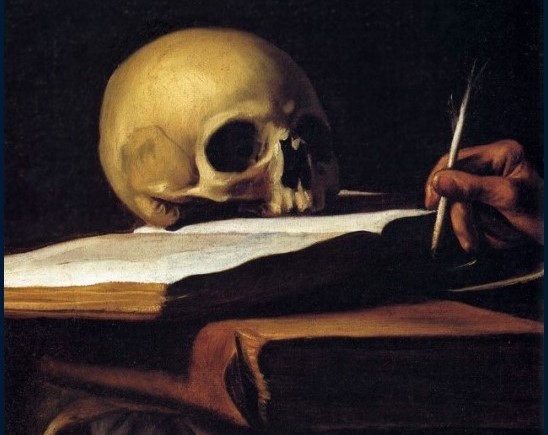
Image: “St. Jerome Writing” (detail) by Caravaggio, Wikimedia Commons

More Posts…

Unstable Ground: How Setting Makes the Story

Yesterday I made my podcast debut on Michelle Hoover’s brilliant, informative, possibly life-changing “7AM Novelist” series – a 50-day writing challenge designed to give new and experienced writers the tools they’ll need to write a solid first draft. Michelle was my instructor at Grub Street Boston, through the Novel Incubator and the Novel Generator, so I can’t recommend her podcast highly enough to anyone who dreams of writing a book.

I was on along with Louise Berliner, author of Texas Guinan: Queen of the Nightclubs, to talk about how to handle setting and time period in your early pages. As often happens when you only have half an hour to talk about a topic, I signed-off positively bursting with still more to say, so I’m doing what I suppose any one of us would do in that situation: blogging about it.

From Michael Drayton’s Poly-Olbion (detail), Folger Shakespeare Library

Our conversation started from Louise’s wonderful idea of setting as a “container,” which characters bump up against throughout the story – a site of conflict, struggle, and most importantly of all, drama. Often, writers will make the mistake of thinking of their setting as more or less static, a blank set onto which their characters are air-dropped. But whether you’re writing historical, sci-fi/ fantasy, gothic horror, or contemporary literary fiction, the “setting” in a novel should be dynamic, a hybrid of both time and place that moves and is moved by the characters.

We’ve all heard of or read books that treat setting like a character, but what exactly does that mean? How is it achieved? All novels begin with what some writers refer to as the “Unstable Ground” situation – a nomenclature which, by no accident, suggests setting. In the opening pages, we find ourselves amongst certain people on a particular day, one where something big will be set in motion. Whatever happens, it doesn’t just happen in any time or place, but on this day and no other, in this very spot and no other.

Take Virginia Woolf’s Mrs. Dalloway, for example, which takes place on one particular day. “Mrs. Dalloway said she would buy the flowers herself,” is one of the most iconic opening lines in all of literature. Over the next few pages, we learn that Mrs. Dalloway is part of a culture that is desperately trying to return to a setting that no longer exists, i.e., pre-WWI Britain. As she moves through what could easily be a perfectly ordinary day – buying flowers, sewing a dress, taking a nap, throwing a party – her story becomes entangled with the ghosts of war. Her search for the comforts of the ordinary is constantly interrupted by reminders of all that she and her country have lost, in the form of supporting characters like the shell-shocked veteran Septimus Smith, whose visions of the battlefield create a sense of constant instability in the landscape of London.

Mrs. Dalloway and Septimus Smith represent the opposing forces that come together to create dynamic settings: status quo versus change. Or, the “unstoppable force” meeting an “immoveable object,” if you prefer. Each character is embattled within themselves just as they are against the world: wanting to move on by going backwards, which is, of course, impossible. Spoiler alert: it costs Septimus his life.

Woolf’s setting for Mrs. Dalloway was her own present day. For historical fiction, setting takes on an even larger presence, firstly because it is always unfamiliar to the reader. Every author will interpret history differently, choosing to emphasize certain details over others, offering different answers to historical mysteries, or characterizing historical figures differently. Each year, about a dozen novels based on the life of Anne Boleyn come out, and yet no two feature exactly the same take on their protagonist.

Historical fiction is where the “setting as container” notion really comes into play. This is partly because, as modern writers, we are ourselves frequently in conflict with the era that we are trying to bring to life. Hilary Mantel likened this task to “chasing ghosts” – although in her words, the ghosts often chase us back. It is through these conflicts between the author and the past that we often find our way to the characters’ conflicts with their own time. In my case, Lightborne is about queer men living in an era fraught with dangers for anyone stepping outside the status quo, and so their conflict with the setting is quite literal. Many books of historical fiction feature protagonists who don’t exactly “fit” into the world around them, and thus offer ever-fertile ground for stories about outsiders.

Historical fiction and sci-fi/ fantasy books also often come with a map somewhere in the opening pages. This is partly because the settings are so unfamiliar to average readers, but it’s also a consequence of just how important the settings are to these stories. The landscape of Middle Earth or the streets of medieval London shape who the characters are and who they are becoming, while also being shaped by the characters throughout the course of the novel. The maps represent both time and place.

There is no escape from the hours and the days. Neither from tomorrow, nor from yesterday. There is no escape from yesterday because yesterday has deformed us, or been deformed by us.

Samuel Beckett, Proust and Three Dialogues with George Duthuit

I think this is a good quote to keep in mind when working on setting. Every novel begins with Unstable Ground – the time and place when the story is propelled into being by circumstances that exist even before page one. After that, the ground continues to shift – time and place “deform” the characters as they pass through it, and are “deformed” by their passage. As the ground shifts, details will emerge, pathways will be uncovered, exits will be blocked. The setting is alive – and has a big role to play.

Of course there’s still plenty more to say about setting. WAY more than I can fit here. Another post, perhaps?

More Posts…

“Interesting places”

According to my bio, I’ve written one book.

But if you actually bother to go through all the myriad files within files squirreled away in the recesses of my laptop, it amounts to something more like four or five books. Four or five books, some weighing-in at over 400 pages, just to whittle it all down to ONE.

This is not as unusual as you might imagine. Depending on what kind of writer you are, what kind of book you’re writing, and what kind of support is available to you, the sum total of words you generate towards completing a novel might be thousands or hundreds of thousands more than the finished product. Sometimes you fall down rabbit-holes, and sometimes…

Sometimes you have to go a long distance out of the way in order to come back a short distance correctly.

Edward Albee
Werner Holmberg, Landscape from Leppälahti in Kuru, Unfinished, Wikimedia Commons

Throughout the process of writing Lightborne, I wrote a hefty historical fiction novel centered on William Shakespeare; tossed it out, then wrote something quite ambitious, a novel which alternated between the 16th, 17th, and 21st centuries; trashed that, then wrote another novel, alternating between just two time-periods this time – and oh yes let’s not forget the TWO MORE hist-fic novels I wrote after that, by which time Shakespeare had long since disappeared from the book (except in a blink-and-you’ll-miss-it cameo), and Christopher Marlowe was the main character. This isn’t even counting the numerous revisions that each of those earlier novels went through before being unceremoniously scrapped and scavenged for parts.

So what was it that finally got me to “done?”

Depends on how you define “done.” The thing about writing a book is that the goalposts are always moving. Even as I write this, I know my book will likely go through still more changes before it (fingers crossed) ends up on a shelf at Waterstones or Barnes & Noble, as even a publication deal is rarely the end of revising. Another quote springs to mind:

A painting is never finished. It simply stops in interesting places.

Paul Gardner
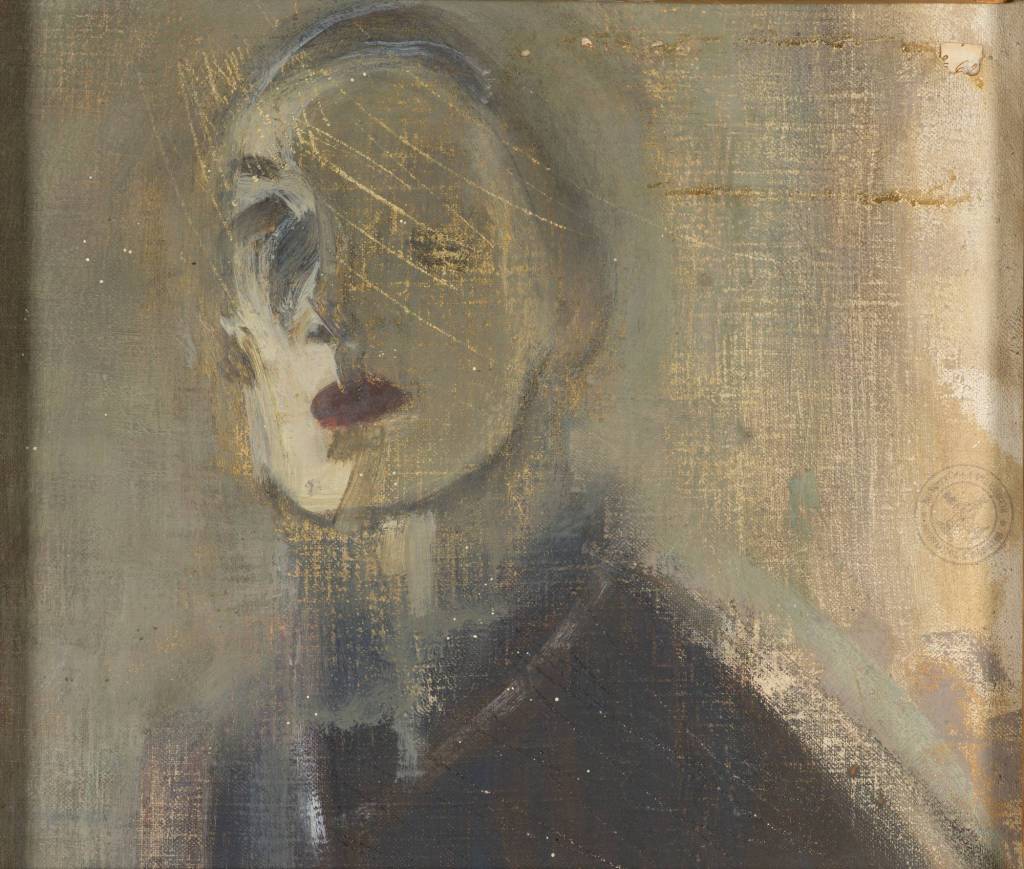
Helene Schjerfbeck, Unfinished and Defaced Self-Portrait, Wikimedia Commons

Painting and literature may seem like very different mediums, but all art shares some DNA in the process of its creation. Anyone trying to make art goes through a trial of false starts, erasures, making, and remaking. In all art there is is a discovery process, where at times you think you know where you are going only to find yourself going in circles, or occasionally, ending up in interesting places you’d no idea were there.

I often use maps as a metaphor for the writing process, because in my experience there are many roads through a novel, with many possible endings. As in real life, the most interesting places are almost never found at the end of a single, straight path, with no diversions, bushwhacking, or backtracking involved. The way through the landscape sometimes requires going all the way back to zero, and then setting out again.

I never would have gotten this far if it hadn’t been for good beta-readers, workshop partners, and instructors showing me that there was more beyond the horizon I had previously set for myself. Draft after draft, I kept arriving at interesting places only to discover even more interesting places a little further down the road. The “finished” novel, as it stands, doesn’t cover even half the territory I mapped out over all those related but different books, all those out-of-the-way journeys I had to take in order to come back to the right place by the right route. But, like a painting, my book eventually found a view to put in its frame – not the whole view, but an interesting one.

My favorite novels always feel like this: landscape paintings with more going on over the horizon, or in the distant city, or the harbor, or even in the sky. The reader will never see it all, never know it all, but the fact of it being there, just outside the frame, makes all the difference.

Pieter Bruegel the Elder, Landscape with the Fall of Icarus, Wikipedia

More Posts…

The Long and Winding Road

It took me nearly twenty years and at least twice as many drafts to write my first novel Lightborne, which, at the time of writing this, is finally out on submission. Point-of-fact, it isn’t really my first novel, but my twelfth or thirteenth, if you count all of the now-embarrassingly adolescent “novels” I churned out from years 14 to 23 while my peers were out doing fun things, such as, I dunno, hanging-out in malls. What I mean to say is, my journey to this point in my writing career, such as it is, brought me down a long and winding road, possibly longer and windier than average. But there’s an end in sight for me at last. Or possibly a beginning.

In those early years, I shuddered at the thought of anyone else reading my work, as much as I yearned to be a “real writer.” But the road didn’t lead me much of anywhere until I finally got myself some travelling companions. Whatever I’ve learned about novel-writing comes not from solitary hours bent over a desk, but from other people: reading other writers, and sharing my work with other writers. In many cases, these writers were people like me, who had started out writing for themselves long before it ever occurred to them to write for anyone else. Workshops, writing classes, even just having a “writer-buddy” who will support you through the tough times, and keep you on track – all of these things can make the difference between having a book in a drawer and a book that’s ready to submit.

What made the biggest difference, for me anyway, were beta-readers. Beta-readers are fellow writers who will read and critique your full manuscript in exchange for you returning the favor, and they are among my favorite people on Earth. Without the sharp feedback of other writers, I’d still be wandering around the vast wastes of aimless rewriting (Draft 46, Draft 46.2, Draft 46.3, Draft 46.3.1… You get the idea.) Before I submitted my novel to the Irish Writers Centre Novel Fair, through which I met my agent, it was a handful of beta-readers who whipped my book into shape: people who were readers of my genre (literary-historical fiction), who knew something about writing themselves, and whose opinions I trusted.

I have been a beta-reader as many times as I’ve worked with one. That too has been an education: in writing craft, of course, but also in humility, which we writers need to have in scads. When offering criticism or feedback on someone else’s novel (their BABY, for God’s sake!) it was essential for me to learn to silence that little voice that says “I could do this better.” No, I can’t. That story belongs to the author, not to me. Feedback should never be proscriptive, because it’s always based in a subjective interpretation of what the author is trying to get across. Every reader’s interpretation will be a little different. The author’s goal is to create a world that feels open to the inhabitation of outsiders – a time, place, or person that anyone can exist in comfortably for a while.

It took me ages to figure out that the problem with my novel was that it was not welcoming to outsiders. The characters I knew and loved seemed like complete strangers when other people described them to me; the plot-points that I thought ran smoothly were, to others, complicated or obscure. This was devastating to hear at first, but gradually, a new and marvelous excitement kicked in. Now, I could go back into my little world armed with the knowledge necessary to bring readers along with me. This was my opportunity to get to know my characters and my story deeper, to experiment and explore. In time, a new roadmap took shape – rough at first, as are all maps into uncharted territory. But I could see multiple paths ahead.

My experiences with beta-readers absolutely made me a better writer. And it made my book not just a better book, but my book, my vision: a world with open doors, one which nearly anybody can step into, and live.

More Posts…