

Lightborne Updates: UK Paperback Sneak Peek

I can’t help but want to talk about perhaps too many things in this post, as I know many of us are still reeling after last week. Perhaps shocked and blindsided, perhaps proven right in the worst way possible, perhaps teetering just above despair. Anyone celebrating is invited to leave at this point. Anyone lashing out, lighting fires, throwing blame at those more vulnerable than themselves, screeching “I told you so” as they rub salt into others’ open wounds, is invited to seek therapy.

It feels very strange and not a little delusional to be talking about my book at a time like this. Not that it doesn’t feel strange to talk about the future at all, given how little we can say for certain about it, other than that things look bleak. They certainly look bleak if, like me, you are a queer author who writes queer books. As I discussed at length in my previous blog post, we could easily be entering a dark age in terms of art and literature, an age in which books like mine will become hotly contested objects. But it’s one thing to worry about whether or not your book might still be legal in your home country a year from now, quite another to worry whether you, as a human being, will also be legal: your marriage, your passport, your family, your friends, your livelihood, your joy, your resistance, your thoughts, your dreams.

However, as a number of other queer authors have also pointed out, there’s no sense whatsoever in backing down before the fight has even truly begun. We are already tired, especially those of us who have been targeted before, but I hope we are far from giving up. Now is a time for those of us who can afford to be loud to scream with all our might.

Knowing my history as a queer person is a double-edged sword, because I’ve seen my community in its darkest hour, but I’ve also seen us emerge from that darkness, again and again. Whatever is coming, we have every right to feel dread in the pits of our stomachs, but also every reason to believe we will find ways to survive it. As Marlowe says in Lightborne, “to live is a form of vengeance, when so many have sought to destroy you.”

As long as humanity lives, we live. I’m sure it drives those who hate us crazy.

All that said, I’m extremely lucky to have exciting things to look forward to in 2025, among them the paperback launch of Lightborne in the UK. Come what may, in March there will be a whole new edition of the book out in the world, with a stunning new cover to rival the old one.

And now, without further ado:

Courtesy of Atlantic Books

We still have the beautiful gold accents that gave the original cover such a bold presence on the shelf, but now with a much darker, moodier atmosphere, and even a subtle appearance from Kit Marlowe himself. I chose this design among several options – it wasn’t easy, as they were all impressive – but I loved this one for that rich blue tapestry background, and the vintage feel of the design.

The back cover, I should add, is equally gorgeous:
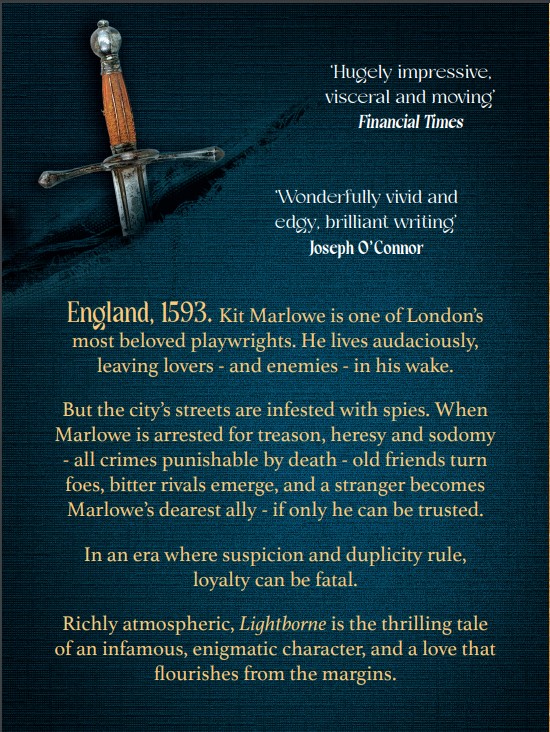
Courtesy of Atlantic Books.

Those who have read the book already will surely recognize Frizer’s knife peeking out! I fought for that knife, I will say, and I’m so glad I did. Authors – this is me advising you to fight for things you want on the cover. You might not get them, but you’ll have no regrets.

I’m beyond excited to see the paperback in its full glory, as I hope readers will be as well. Whatever dangers are barreling down at us from the future, I hope we’re able to find reasons to stay excited and engaged. After all, the world desperately needs that from us. Our anger and outrage is necessary, but so is our hope, our creativity, our joy.

It might mean the difference between simply getting through whatever comes next, and doing the work that desperately needs to be done: of building a better world than the one we started with.
Eulogy for an Unpublished Novel

This post originally appeared on Dead Darlings 28/2/2023.

Let’s start with the good news before we get to the complicated feelings: my debut novel Lightborne is coming out next year. And I am ecstatic!

Lightborne is a historical novel about Christopher Marlowe, an Elizabethan playwright and contemporary of Shakespeare who died violently and young, under somewhat mysterious circumstances. Rumored to have been a government spy, famously brash and outspoken, the author of the first play in English to feature an explicitly queer relationship between men – I fell in love with Marlowe the first time I discovered him, at thirteen or fourteen, and from that point on it was only a matter of time before I tried to write a book about him.

I could not possibly have known, when I finally got started in my senior year of college, that I would spend the better part of the next twenty years writing about Marlowe.

The thing is, I misspent my youth writing “novels” – practice novels, I think of them now – one after another, often only to chuck them in a drawer after just three or four drafts. Lightborne, however, was different. Over two decades – half my life, really – I compiled hundreds of hours’ worth of research, wrote and scrapped something like five different novels about Marlowe, made forty-plus revisions to Lightborne, and slogged through rejections in the triple digits. To say Lightborne was “a labor of love,” as I’ve been saying repeatedly ever since the good news became public, feels like understatement.

I had plenty of opportunities, and every reason, to stop. Put it in the drawer. Work on something else. So why didn’t I?

Love did have something to do with it. I loved Lightborne, and I loved writing it. I loved “my boys,” as I often refer to the three main characters, despite having done a great deal to torment them. For years on end, I’ve agonized over these (mostly) made-up people’s lives, at my desk, on the couch, wide awake at 4am, lying on a beach, wandering around the supermarket… They say, “A writer never stops writing,” and that is devastatingly true. All other thoughts become intrusions, as does life. Only love makes you that stupid.

But it was also labor, with all the pain that implies. I’ve lived so long now with the anguish, not of disappointment or failure, but of hope – terrible, all-consuming, sadistic hope – that I don’t quite know what to do without it. A writer never stops writing – and part of that is convincing yourself that it will all be worth it one day: that one day, finally, you will stop.

So this is the end. After two decades, I’ve stopped writing Lightborne. This is a celebration, but it’s also a eulogy: for the work, for the hope, for the task I just had to complete, which began as all eulogies do, with death.

Twenty years ago, this October – a few months before my first attempt to write a novel about Christopher Marlowe – my friend died. At the time, I was already working on an undergraduate thesis about Marlowe’s play Edward II, and the queer canon, and the task of finding ourselves among the dead. Then my friend died. Soon after, my thesis began spilling over into a novel on the side – nothing at all like Lightborne as it stands now, except perhaps in two key ways: that it was about a young, queer man who dies far too soon; who, in life, was widely loved but misunderstood, and sometimes vilified. And, it was about bearing responsibility for his death.

I dedicated even that first messy, embarrassing draft to my dead friend. “In memory of.” Through all those years, for each new draft or entirely new version of the story, the first thing I would do upon opening a blank document was copy/paste that dedication. Looking at it, I could imagine the words printed in a book, with some stranger out there holding it in their hands, reading my dead friend’s name. If nothing else, the dedication page was a way of holding onto the original impulse that brought me to tell this story – to always be writing, but to always be writing towards an end.

The thing about the dead is, they are never satisfied. Never appeased. For us, they exist in a state of arrest, with the last thought, the last gesture, the last sensation frozen in time. I think one of the reasons why we write is to capture every fleeting thought or action as if it were the last, to nail the seconds to the wall so we might pore over them from every angle: catalogue every detail, ask every question, draw a circle around every mystery. Of course, the final stage of writing is to let all of that go and give the story to whomever wants it, for them to envision and interpret as they see fit. Which I suppose is a kind of resurrection, a kind of life.

That’s the joy, amidst all this excitement and terror and uncertainty: the joy of knowing there will be life for this story beyond my little brain, there will be life for my boys. One day – surely sooner than it seems to me now – a stranger will open a book that says Lightborne on the cover, and their eyes will glance briefly over the name on the dedication, “In memory of”: multiple names now.

And then they will turn the page.

Lightborne will be published in the spring of 2024 by Atlantic Books UK.

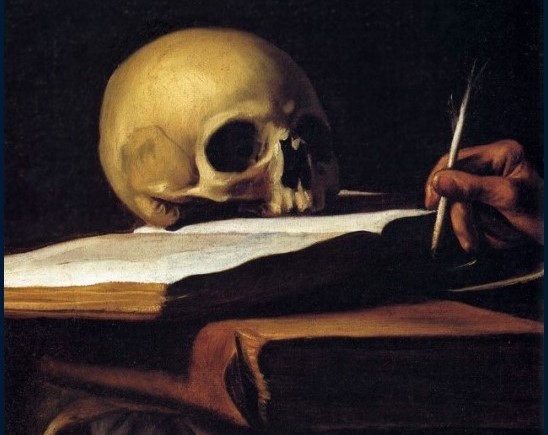
Image: “St. Jerome Writing” (detail) by Caravaggio, Wikimedia Commons

More Posts…