What I owe the International Debut Novel Competition

Let’s say you’re a writer – as-yet unpublished, but that doesn’t matter; you’ve absolutely earned your stripes. You would move heaven and earth to get time at your desk. You’ve attended the workshops, you’ve sought out the advice of beta readers over multiple drafts, you revise obsessively, if not aggressively. Moreover, you are never not writing, technically, because you write in your head while you walk the dog, grocery shop, drive to and from work. You talk to your characters in your sleep, and worry sometimes you might know them better than you know yourself.

If any of this sounds like you, then now is a very good time to check out the Irish Writer Centre’s International Debut Novel Competition.

Three years ago, this was me. And, if I’m being honest, it’s still me. The only material difference is that I’ve now finally published that book which was eating me alive, and have moved on to being eaten alive by another. Please don’t send help; I’m quite happy like this. If my head wasn’t currently in the mouth of a manuscript I wouldn’t know what to do with myself.

But in September of 2021, I was on the verge of letting it all go. After over a decade at work on my novel, Lightborne, I had nothing to show but a teetering pile of rejections – all told, close to 200, a perfectly respectable number at which to throw in the towel.

I had heard about the International Debut Novel Competition (then known as the Novel Fair) through the Irish writing community grapevine, despite being an American living in Spain. I knew the deadline was approaching and had been dragging my feet on submitting, sure I wouldn’t be chosen anyway. After nigh on 200 rejections, why on earth should I expect a “yes”?

Eventually, I submitted on a whim, telling myself this was it – if I didn’t get in, I’d take it as the universe’s way of telling me to give up.

And let me tell you, by the time acceptances went out, I had given up. In fact, I’d forgotten about the whole thing, and nearly missed my chance altogether when my acceptance letter ended up in spam (CHECK YOUR SPAM, PEOPLE!) Fortunately, I was able to get in touch with the IWC in the nick of time.

But things didn’t end there, because the International Debut Novel Competition is like no other. In fact, I’d just signed up for the ultimate novel-pitching boot camp.

At the heart of the competition are the two Pitch Days, held remotely or onsite at the IWC’s glorious location in central Dublin, wherein we little unpublished hopefuls (twelve of us, at the time) met individually with agents and editors, and, well, did our best to sell them our books. Going into it, I had read press write-ups describing Pitch Days as “Dragon’s Den for writers,” which had done nothing for my nerves. But rather than stone-faced bigwigs just salivating for a chance to dash someone’s dreams, the agents and editors we met with were universally kind, friendly, and genuinely interested in our projects. Even those who were not appropriate for my particular book asked insightful questions and patiently answered my naive inquiries. I learned more about the publishing world in those two days than I had in 10 years.

Let’s say I didn’t strike gold at the Pitch Days – a possibility for which I mentally prepared myself, even as things seemed to be going quite well. An agent offer or publishing deal are after all not guaranteed by participating in the competition. What would I have gotten out of it then?

In a word: confidence. Halfway through the first Pitch Day, well before I received my first manuscript request, I already felt like a rockstar. Moreover, I now had tools I’d never even known I needed as a writer. Pathways I had never thought to try before, or didn’t even know existed, had opened up before me. Yes, in the end I was lucky enough to meet my amazing agent during those days, but even if I hadn’t, I would have come away leagues ahead of where I’d started.

I also came away with lifelong connections to other writers, and to the wonderful Irish Writers Centre itself. Despite living in another country, I know I can find support and resources through the IWC – and, whenever I do make it to Dublin, an open door and friendly faces.

This is all a long-winded way of saying that, as a writer, I owe the International Debut Novel Competition a LOT. Maybe everything, I dunno.

Since I participated in 2022, I’ve seen old writing connections from back home in the States enter and win, I’ve seen writers who thought of themselves as mere hobbyists discover they’ve got a hit on their hands, I’ve seen writers who had no luck on Pitch Days end up internationally published anyway. No matter what, winning the International Debut Novel Competition is not the end of the road, but only a beginning. And what a beginning it is!

Submissions to the International Debut Novel Competition close THIS SUNDAY, September 14th, 2025.

All relevant info, including past winners, submission guidelines, and tips on how to prepare your application (even the dreaded synopsis) may be found on the Irish Writers Centre’s website.

Featured Image courtesy of the Irish Writers Centre.

Lightborne Updates: Cover Sneak Peek!

Before we get into the thing you’re actually here for, let me start this one off by saying, if you’re not listening to the 7AM Novelist Podcast with Michelle Hoover, then start now – not just because yours truly makes the occasional appearance on the show, but because I do so in excellent company. This latest season features an all-star cast, including Anjali Duva, Ron Maclean, Nancy Crochiere, Sara Johnson Allen, Marjan Kamali, Joanna Rakoff, Emily Ross, Andrea Meyer, Virginia Pye, Henriette Lazaridis, Colwill Brown, Crystal King, Chris Boucher, Dawn Tripp, Hank Phillippi Ryan, Mark Cecil, Jenna Blum, Jane Roper, Ethan Gilsdorf, Whitney Scharer, Shalene Gupta, Louise Miller, and many more, all ready to help struggling writers work through whatever’s holding them back from getting words on the page.

Recently there were two back-to-back episodes dealing with the stressful process of publishing your first book, as Aube Rey Lescure hopped on to discuss the launch of her debut River East River West, and Kasey LeBlanc, Christine Murphy, and Aaron Hamburger came on to talk about the travails of starting book 2. Listening as someone who can relate all too well to the topics at hand, I found my mental state veering wildly between excited and despairing, inspired and terrified.

Let’s be real: publishing a book is the thing we writers tell ourselves will finally make our lives fall into place, fix our self-esteem issues, vindicate our hard work, even solve lifelong crises of identity. For over a decade, it was the thing I felt I had to do, if only to justify the time and money I’d sunk into writing my soon-to-debut novel, Lightborne. And of course, I am thrilled beyond belief that it is finally happening. But I’m also learning that publication will fix absolutely none of the above problems. It will, in fact, create a few new ones.

Now that debut authors are speaking more openly about the mental health struggles they face in the lead-up to pub day, what emerges is the clear need for us to support one another. The tawdry, soul-crushing business of self-promotion can feel desperately lonely; the burgeoning public exposure can make you paranoid and crash whatever modicum of self-esteem you’d built-up since surviving high school. The dark, primal urge to dig yourself a burrow and hide in it starts to take over.

But this is why community is so essential to the debuting author. It may come via social media, or through writing groups and classes, or – just maybe – through fellow listeners of a writing podcast. I’m very fortunate to know many of the panelists on the 7AM Novelist through the legendary Boston writing center, Grub Street, where I participated in the Novel Incubator Program some [cough cough] years ago. But one of the great things about the 7AM Novelist is how it allows writers from all around the world to make connections. Seeing ideas exchanged and friendships forming in the chat box during every live episode recording truly warms this withered old heart.

So I very much hope anyone reading this will be sure to check out the show and support the author panelists: google them, subscribe to their newsletters, buy their books! This season is particularly exciting because every episode deals with questions submitted by listeners – even though I’m on again tomorrow, Jan 11th, I still don’t know what topic we’re going to get. So if you have a sticky issue to work out with your WIP, your writing practice, or career, please do go to the podcast page and submit your answer to the question, “What’s holding you back?” Maybe I’ll even get a chance to help you through it.

And now that you’ve scrolled all the way down here, you may collect your reward: a first look at Lightborne’s lush, evocative final cover!

Via Atlantic Books

As you can see, the cover will build on the proof design, using the same black and gold damask pattern and a simply gorgeous font based on 16th century typography. I’ve been informed that the pattern will, in fact, be stamped in gold foil – so in person, it’s going to be stunning!

Preorders are rolling out, so please check with your local booksellers. For those who use NetGalley, ARCs will be available soon.

Lightborne Updates: ARCs are in, and so is Impostor Syndrome

Last week I had the immense privilege of visiting my publisher Atlantic Books’ offices in person. Little did I know when I was making aimless circles around Bloomsbury, hopelessly lost, that once I got there I would be greeted by printed, jacketed, ready-to-go ARCs of my debut novel – a whole pile of them awaiting my woefully unpracticed signature.

Photo by Laura O’Donnell

I’d been convinced that the ARCs were still weeks away, if not months. Being able to pick up a copy, flip through the pages, and see what I’d thus far known only as a Word document looking very much like a real book put me into some kind of fugue state. I barely remember signing the copies, only that my signature degenerated steeply from one copy to the next. By the time I got to the last one it looked like a toddler had scribbled all over the page.

Of course I’m still excited and riding high from the experience, although an astonishing amount of terror has since crept in. Things are moving quicker than I’d expected, which means my little window of peace and privacy is closing, and not only must I come to terms with the fact that the need to self-promote is inevitable, but it is also imminent. As in, I clearly should have started doing it weeks ago.

I think many writers break into a cold sweat at the thought of having to put themselves “out there,” whether it stems from a simple dislike of the spotlight or the crippling, unshakable belief that we are not worthy enough or smart enough or good enough, and sooner or later the world will catch on and punish us for daring to take up space. The latter is certainly true for me. The law of impostor syndrome is that the voice of self-doubt will always grow louder and stronger when presented with mounting evidence that it’s really full of shit. (Much like people who are full of shit.) The closer I come to any kind of success, the easier it is for me to convince myself I’m not deserving of it.

The most constructive way I’ve found of dealing with impostor syndrome so far is to think of it as a necessary stage in the process of working towards a goal, and moreover, a sign that things are, in fact, going pretty well. This doesn’t silence the voice of self doubt, but it does put it at a slight remove. Fortunately, I’m riding a train over whose path I have zero control, which means I have no choice but to keep moving forward. It’s surprisingly easy to be braver about taking certain steps once the option of turning back is gone.

Besides, the scenery really is lovely. Look at this, LOOK AT THIS!

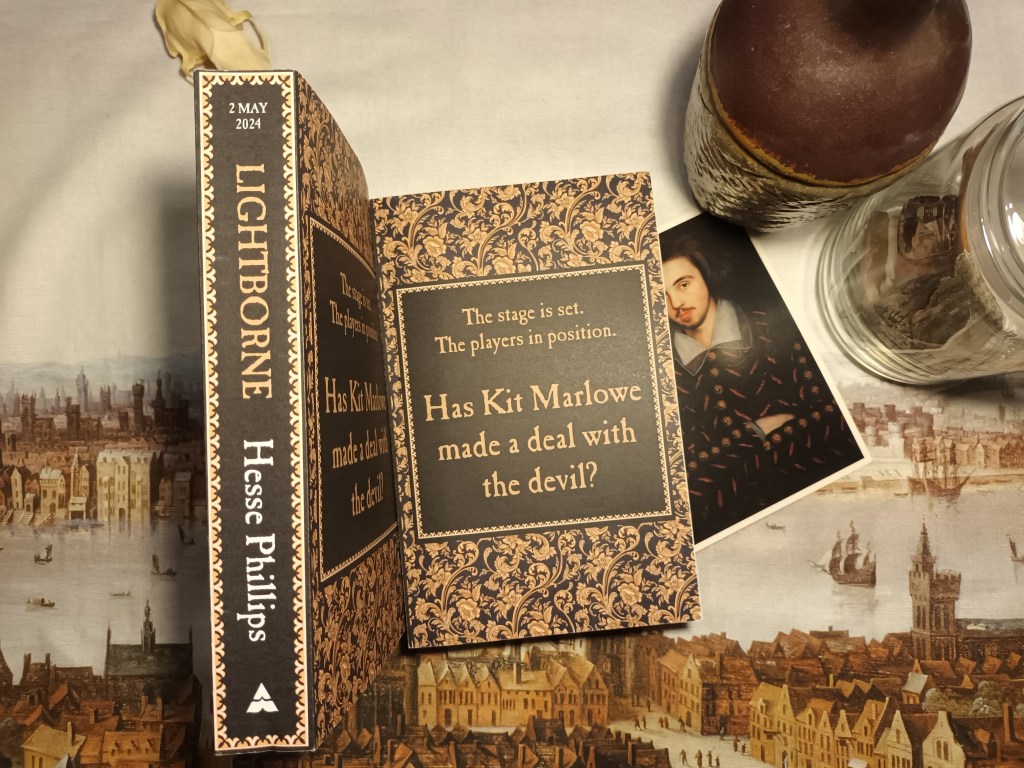
Color photo of a pair of books decorated in black and gold damask print lying on top of Wenceslas Hollar's Panorama of early modern London. One book is shown face-up, the other displays the spine, which reads "2 May 2024 LIGHTBORNE Hesse Phillips." The cover on the other book features a black square framing the tagline, "The stage is set. The players are in position. Has Kit Marlowe made a deal with the Devil?" Peeking out from under neath the face-up book is a postcard of Christopher Marlowe's alleged portrait.
Of course I did a photo shoot with my book.

Lightborne Updates: Proofs, Proofs, Proofs!

We’re just about into that incredibly exciting stage where things start getting printed on paper – meaning that I’ve recently received the most important pdf file of my entire existence so far, and have spent the past week going over it with a fine-toothed comb. It feels weirdly unceremonious to see my proof sitting open in a Chrome tab along with email and about 50 other tabs worth of research for my next book, as if it were just another JSTOR article that I stopped skimming last week and forgot about.

Fortunately, it is gorgeous, as you can see from the image above. I’m thoroughly impressed with my publisher’s choice in fonts, all of which are wonderfully evocative of Elizabethan-era typefaces. And then there’s the uncanny resemblance between the header font and the tattoo on my right forearm:

Yup, that’s me, in my bathroom, because let’s face it, it’s the only room in the house with good lighting. You can probably tell from my face that I’d just spent two hours getting stabbed with tiny needles.

I got myself the tattoo last year to celebrate signing my deal with Atlantic. A more superstitious person than myself might take the resemblance as some kind of omen. Lente currite noctis equi (“run slowly, horses of the night”) is a phrase that originally appeared in Ovid’s Amores, a series of quite randy love poems which my protagonist, Christopher Marlowe, translated into English as a student at Cambridge. It also, and perhaps more famously, appears in Marlowe’s own play Doctor Faustus, used by the titular character as a magical incantation in effort to halt time in its tracks. Notably, the incantation does not work – Faustus can’t escape his deadline with the Devil, who promptly shows up and drags him screaming into hell.

So, uh, not sure whether that’s a good omen or a bad one, but it is at least a lovely coincidence.

From here, the next stage is to print ARCs (advanced reader copies), which will hopefully lead to some nice endorsements from people far more interesting and successful in life than myself. After that, we’ll begin work on the final text for publication in May, at which point my book will truly have grown up and moved out of the house for good. For now, it’s thrilling to see it all dressed up in a spiffy new suit, looking very much like a “real” book, albeit in digital form.

Things are definitely heating up, so hopefully I’ll have more news to share soon!

“Hey Hesse, how are the copy edits going?”

If nothing else, I am learning a lot about my worst habits as a writer, and I suppose this knowledge ought to come in handy down the road. The first editorial phase was instructive on a global scale, subjecting characters, plot and overall themes to forensic examination. I came away from it feeling like I’d just gotten a free MFA in creative writing. The copy editing stage, however, will humble you up in a heartbeat.

What impresses me the most about this part of the process is the indefatigable patience of copy editors, who can turn over a page of prose the way a seasoned detective turns over a crime scene. Invariably, if something is out of place, they will find it. At the moment, I’m so highly attuned to the incorrect usage of hyphens that I agonized for a good several minutes over whether or not to hyphenate “highly attuned.” As you can see, I gave up.

Sighs, for that matter, are starting to give me eye-twitches. I can’t let out an audible breath without wondering whether I should just go back and delete it altogether; no exhales for me, only inhales from now on (passes out).

Well, as my extremely generous copy editor has reminded me, all writers have their tics. Even the great Cormac McCarthy, as this Electric Literature article reminds us, had a “smiling” compulsion (though naturally he sometimes managed to make gold out of it).

I suppose the copy editing stage is a little like seeing a doctor – embarrassing but necessary for your health. And in my case, I feel confident that my work is in good hands. Now to try as hard as I can to retain all of the insights I’ve received for the next big thing.

Although I still have no idea how to use hyphens. Did I promise to learn? Yes. Will I?…

Lightborne Updates: Mess Becomes Book

I’ve just handed-in my first batch of revisions to my wonderful editor at Atlantic Books, and I suddenly find myself with nothing at all to do, book-related, for the next few weeks. This is the process, as I’ve found it: lots of short bursts of grinding work that’ll keep you either manic or paralyzed with anxiety, until, suddenly, it’s all over. Now, to wait.

The road to publication begins with so much fanfare, so much excitement, that the subsequent long periods of seeming inertia can easily drive you batty. You feel as if you’ve lost momentum, or you’ve been forgotten about, or (worse) you have forgotten to do something, and the silence closing in is all your fault. But as I sit here writing this, there’s a whole machinery at work on my book, behind the scenes: editing, cover-design, publicity, rights-management, and more. For me, it’s all peaks and valleys, but for the publisher, it’s a slow, steady ascent towards Launch Day, when the real rollercoaster begins.

After all the excitement of signing my contract at the end of last year, life became relatively quiet. So quiet, in fact, that I found myself with time enough to start working on the next book, if for no other reason than simply to keep busy. Now that we are just past one year out from publication (in spring 2024), things are finally picking up again. I’ve had two weeks to work on changes to the manuscript, which might possibly have been the most stressful two weeks of my writing life. I kept having visions of that day every writer should look forward to: opening a great big box full of fresh, gorgeously bound copies of my debut novel, only to look inside one and immediately find a sentence I loathe staring back at me, set in stone.

Fortunately, my last opportunity to fine-tune has not yet come and gone – and the last round of edits will have the watchful eye of a copyeditor involved, so the responsibility of catching all those overwrought metaphors and wonky adverbs will not fall to me alone. Lightborne remains, however, my baby, something about which my editor was very clear: the goal is to end up with a book that makes us both happy. Having both seen and heard horror-stories about inflexible editors, I know am very lucky to have one who actually trusts me. (Now, whether or not she should…)

So, for the next few weeks, I will be trying to forget about Lightborne for a little while so that my editor can do her job in peace. But once this pause ends, I’ll likely be facing down the most intense weeks of work I’ve ever spent on this book. (And I’ve spent, um, A LOT of weeks on it.) Soon, hopefully, there will be a cover to look forward to, followed by more edits, final edits, printing and distributing ARCs, convincing nice people to say nice things we can put on the cover, convincing nice people to say nice things on TikTok… And in the midst of all that there will be little ol’ me, who barely knows how to tweet and uses Instagram mainly to share pictures of my dogs, doing the WB Frog dance and looking forward to my next nap. Maybe I should just enjoy the silence.

Featured image: A sample of Lightborne’s protagonist, Christopher Marlowe’s handwriting (Wikimedia Commons)

The Long and Winding Road

It took me nearly twenty years and at least twice as many drafts to write my first novel Lightborne, which, at the time of writing this, is finally out on submission. Point-of-fact, it isn’t really my first novel, but my twelfth or thirteenth, if you count all of the now-embarrassingly adolescent “novels” I churned out from years 14 to 23 while my peers were out doing fun things, such as, I dunno, hanging-out in malls. What I mean to say is, my journey to this point in my writing career, such as it is, brought me down a long and winding road, possibly longer and windier than average. But there’s an end in sight for me at last. Or possibly a beginning.

In those early years, I shuddered at the thought of anyone else reading my work, as much as I yearned to be a “real writer.” But the road didn’t lead me much of anywhere until I finally got myself some travelling companions. Whatever I’ve learned about novel-writing comes not from solitary hours bent over a desk, but from other people: reading other writers, and sharing my work with other writers. In many cases, these writers were people like me, who had started out writing for themselves long before it ever occurred to them to write for anyone else. Workshops, writing classes, even just having a “writer-buddy” who will support you through the tough times, and keep you on track – all of these things can make the difference between having a book in a drawer and a book that’s ready to submit.

What made the biggest difference, for me anyway, were beta-readers. Beta-readers are fellow writers who will read and critique your full manuscript in exchange for you returning the favor, and they are among my favorite people on Earth. Without the sharp feedback of other writers, I’d still be wandering around the vast wastes of aimless rewriting (Draft 46, Draft 46.2, Draft 46.3, Draft 46.3.1… You get the idea.) Before I submitted my novel to the Irish Writers Centre Novel Fair, through which I met my agent, it was a handful of beta-readers who whipped my book into shape: people who were readers of my genre (literary-historical fiction), who knew something about writing themselves, and whose opinions I trusted.

I have been a beta-reader as many times as I’ve worked with one. That too has been an education: in writing craft, of course, but also in humility, which we writers need to have in scads. When offering criticism or feedback on someone else’s novel (their BABY, for God’s sake!) it was essential for me to learn to silence that little voice that says “I could do this better.” No, I can’t. That story belongs to the author, not to me. Feedback should never be proscriptive, because it’s always based in a subjective interpretation of what the author is trying to get across. Every reader’s interpretation will be a little different. The author’s goal is to create a world that feels open to the inhabitation of outsiders – a time, place, or person that anyone can exist in comfortably for a while.

It took me ages to figure out that the problem with my novel was that it was not welcoming to outsiders. The characters I knew and loved seemed like complete strangers when other people described them to me; the plot-points that I thought ran smoothly were, to others, complicated or obscure. This was devastating to hear at first, but gradually, a new and marvelous excitement kicked in. Now, I could go back into my little world armed with the knowledge necessary to bring readers along with me. This was my opportunity to get to know my characters and my story deeper, to experiment and explore. In time, a new roadmap took shape – rough at first, as are all maps into uncharted territory. But I could see multiple paths ahead.

My experiences with beta-readers absolutely made me a better writer. And it made my book not just a better book, but my book, my vision: a world with open doors, one which nearly anybody can step into, and live.

More Posts…