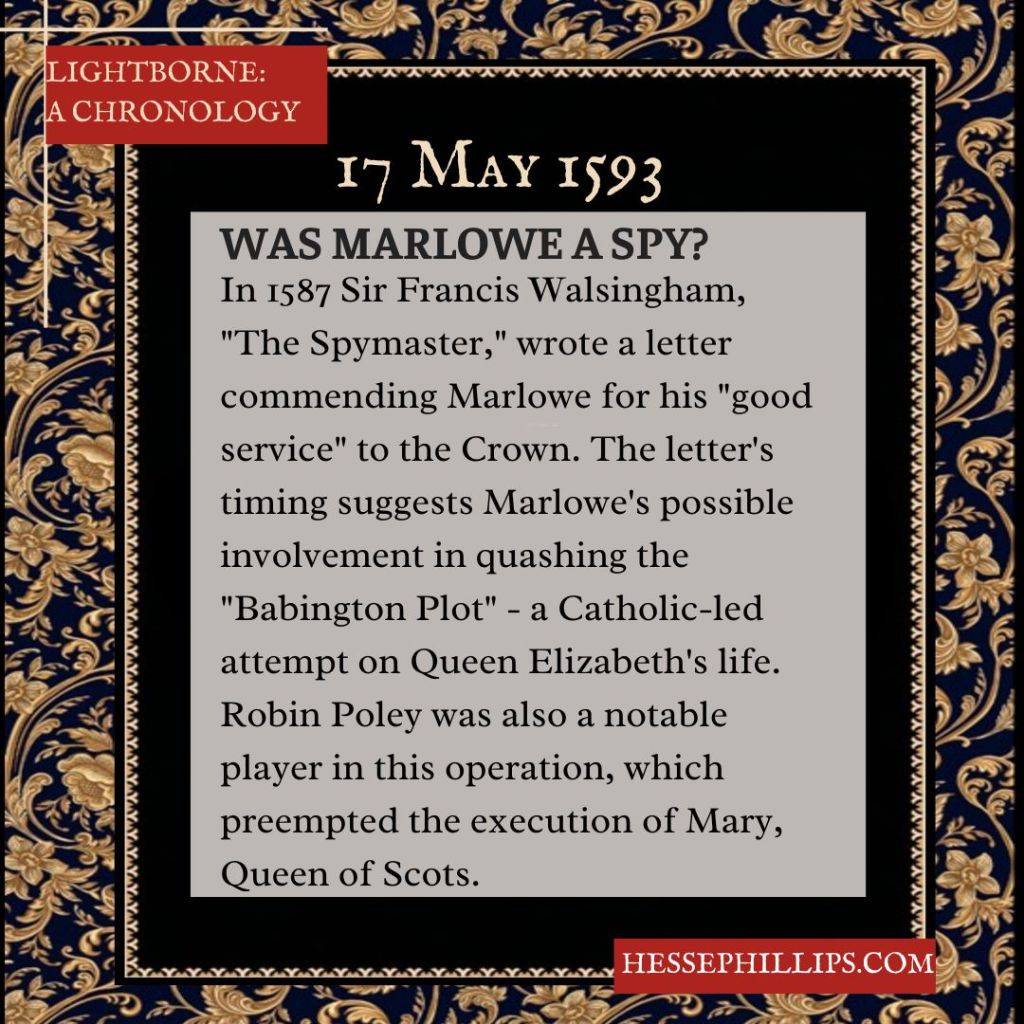
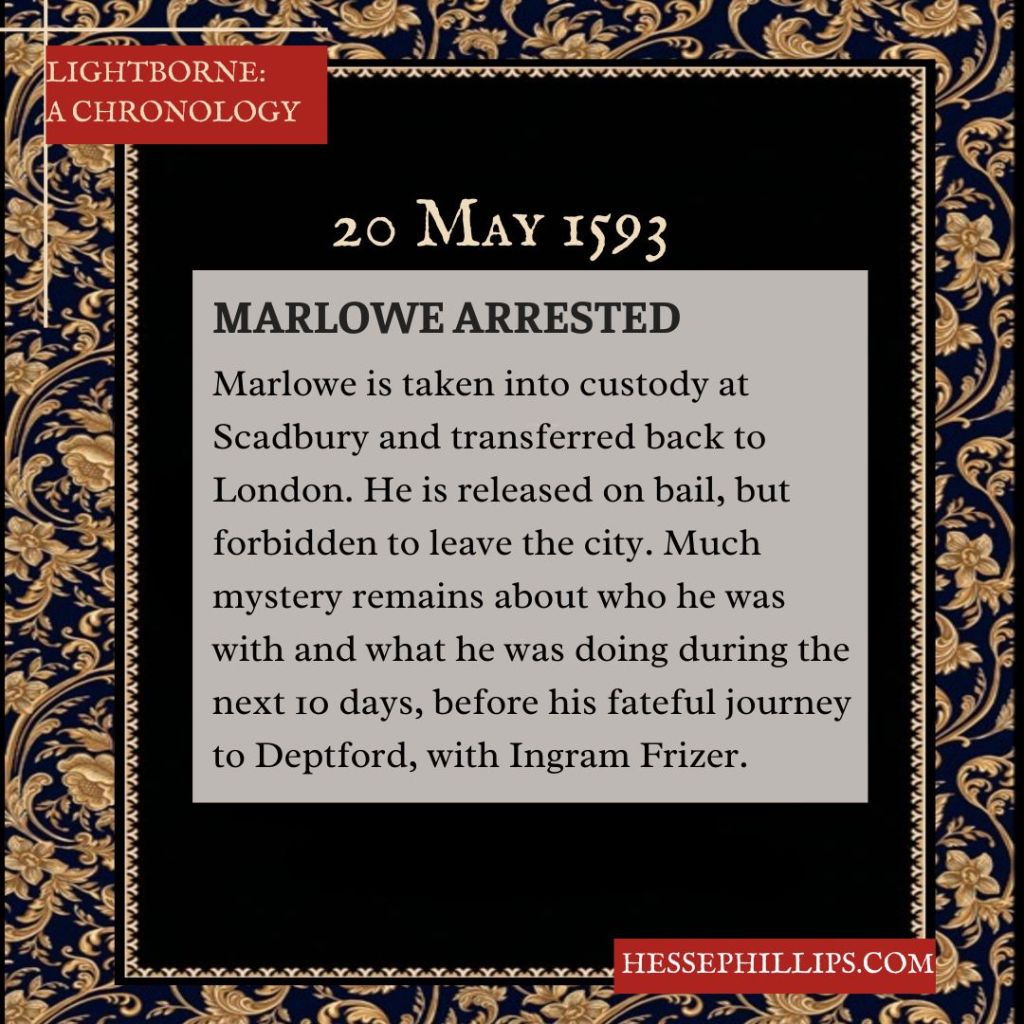
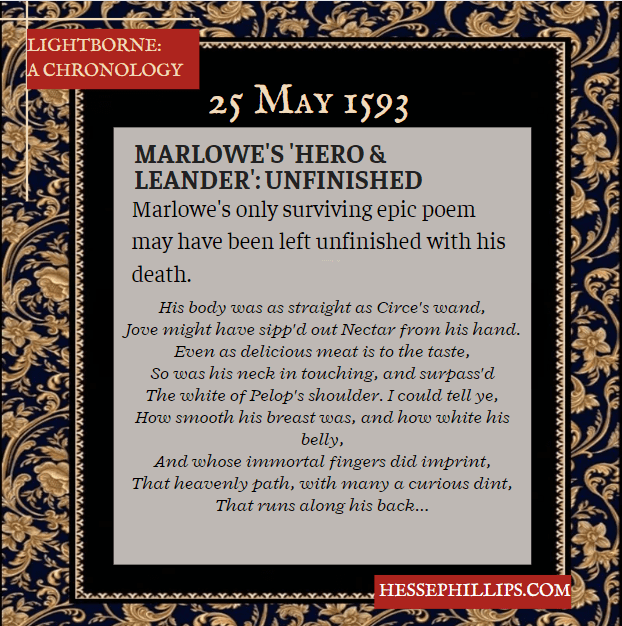
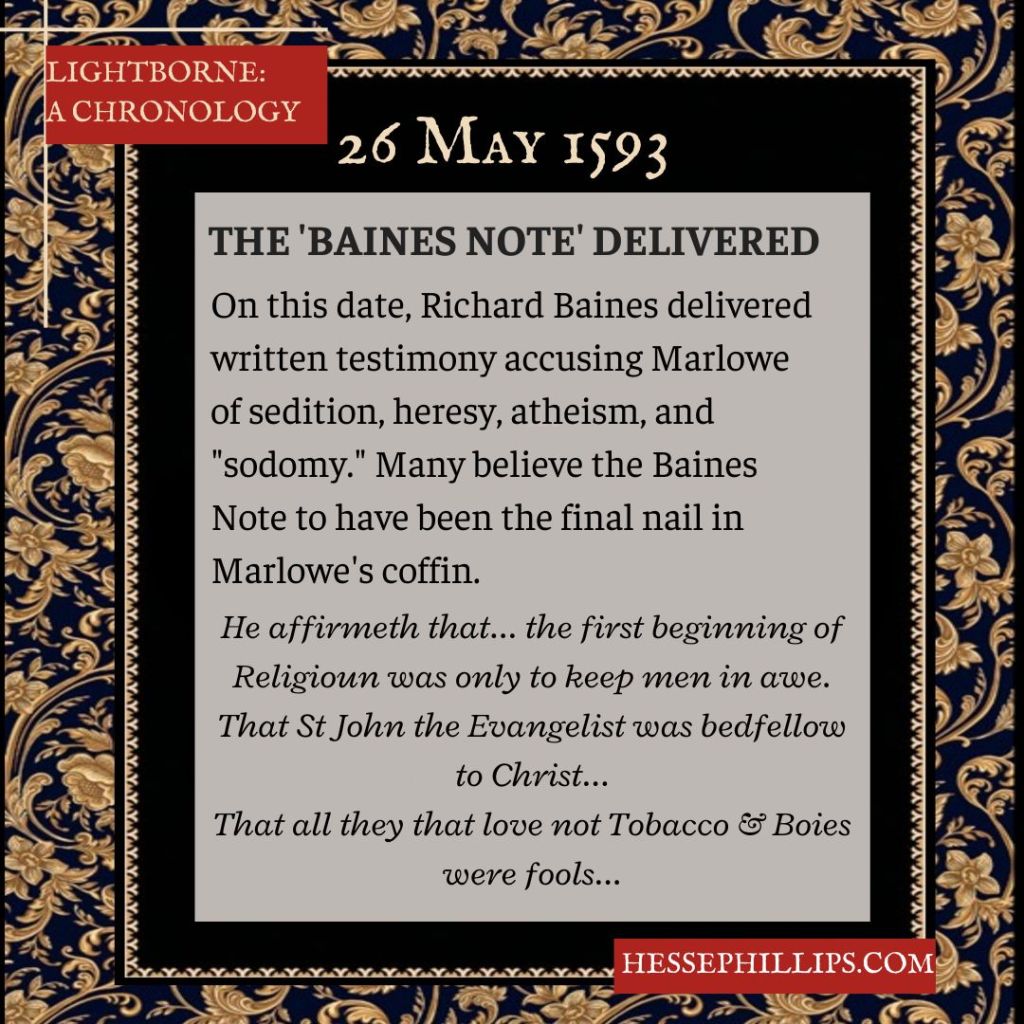
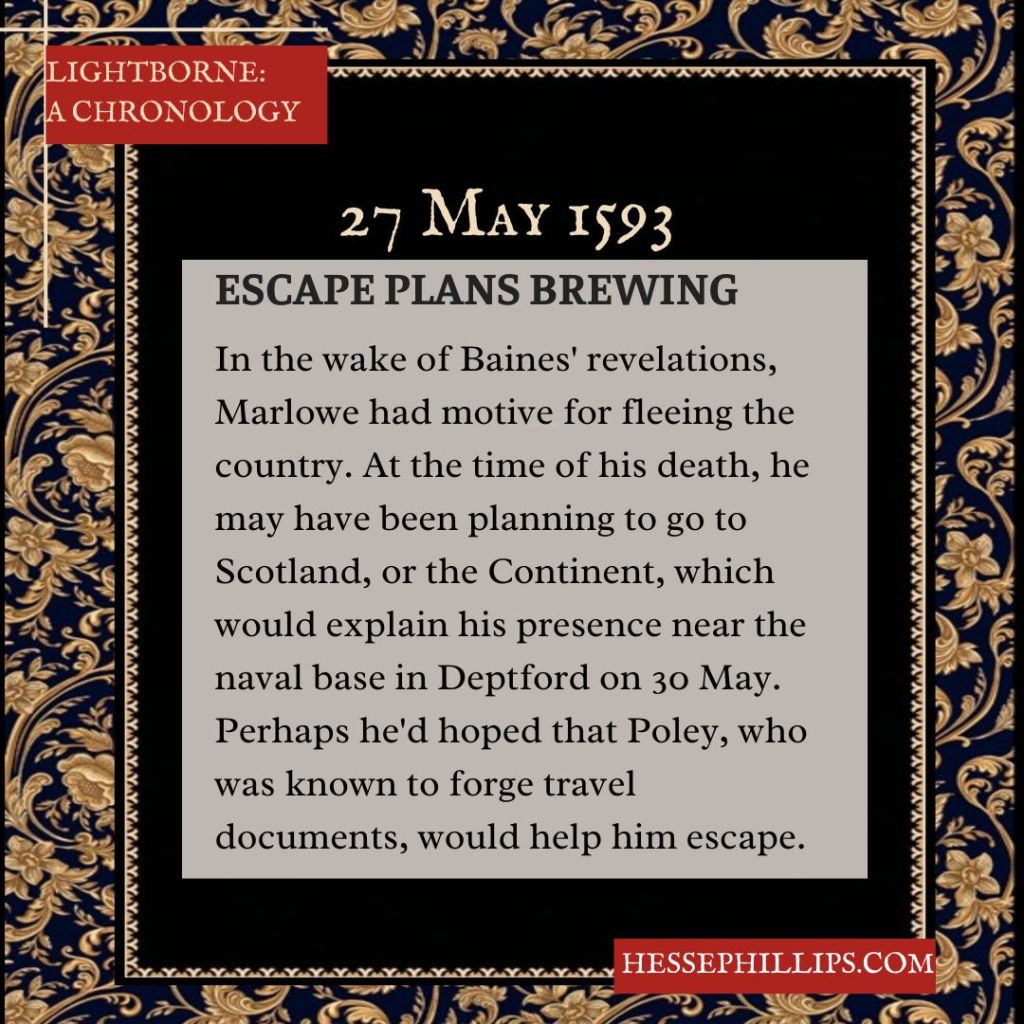
People who follow me on social media are sure to have noticed my daily Lightborne Chronology posts over the past few weeks, where I’ve been sharing historical tidbits alongside excerpts from the novel. We started on the 12th of May 2024, when, 431 years ago in 1593, Christopher Marlowe’s roommate and fellow playwright Thomas Kyd was arrested on suspicion of heresy, jump-starting the events of the book. We end, naturally, on the anniversary of Marlowe’s untimely death in Deptford, on 30th May – with a number of questions left unanswered.
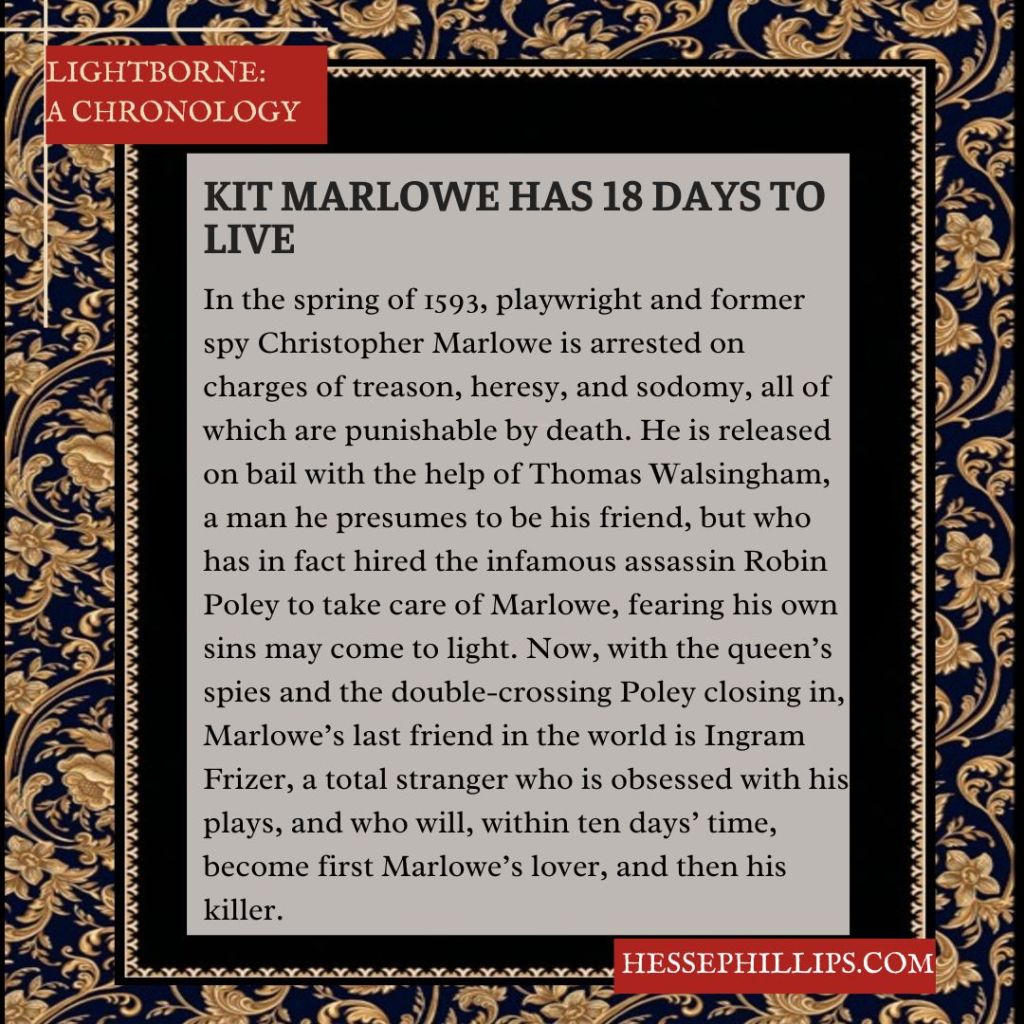
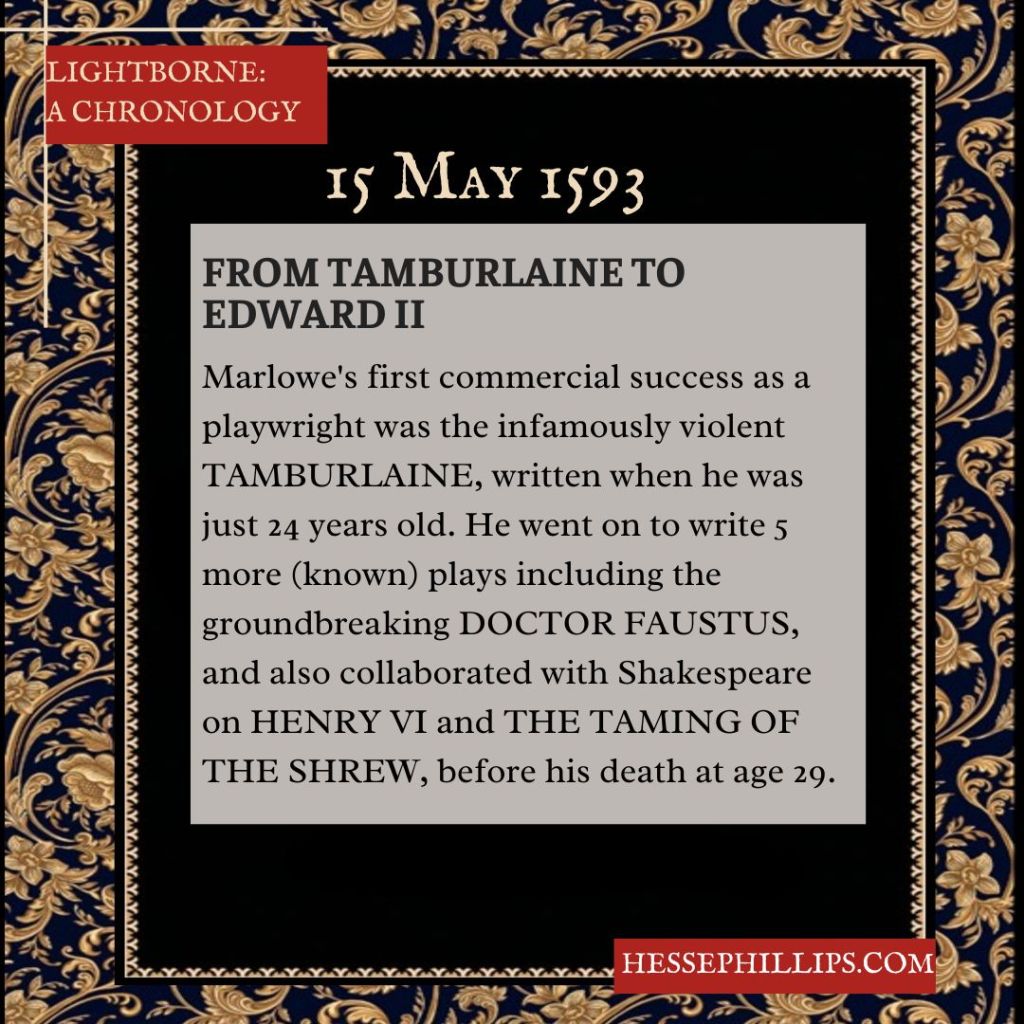
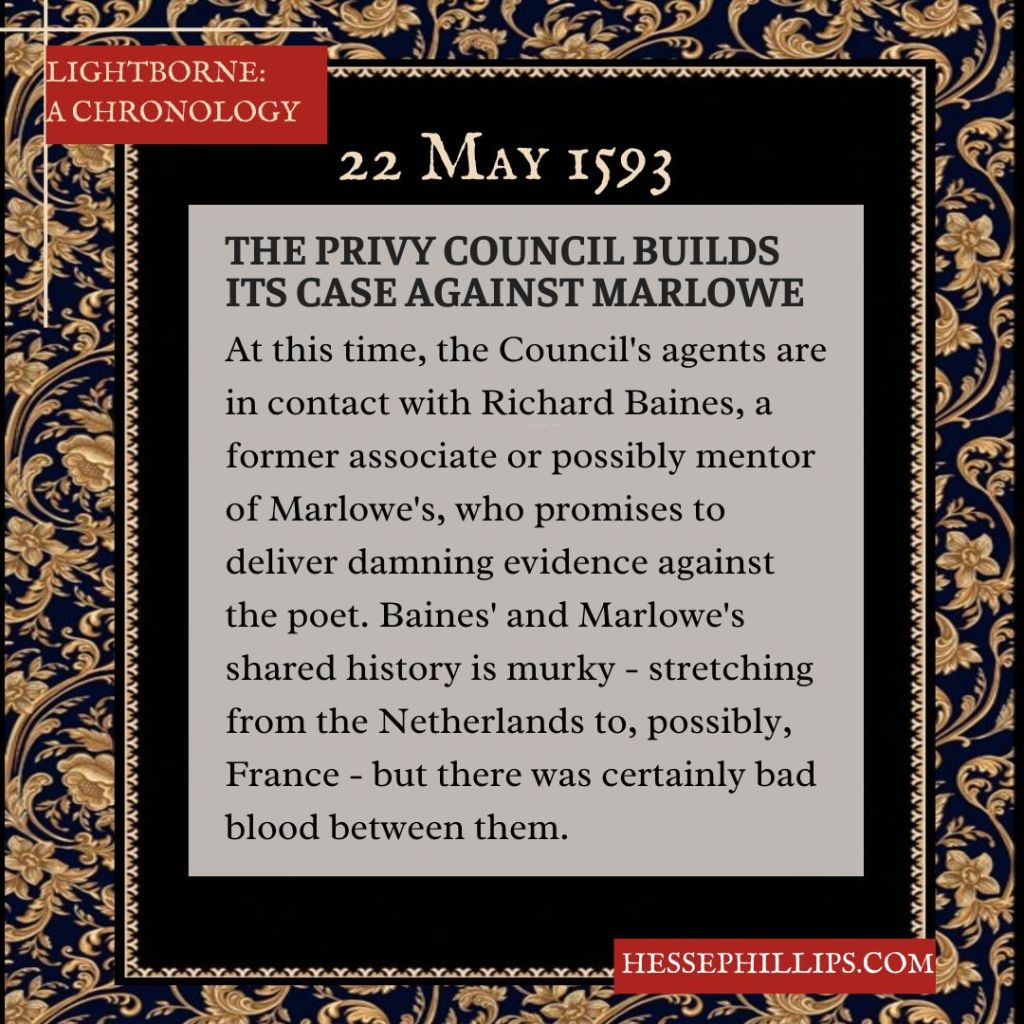
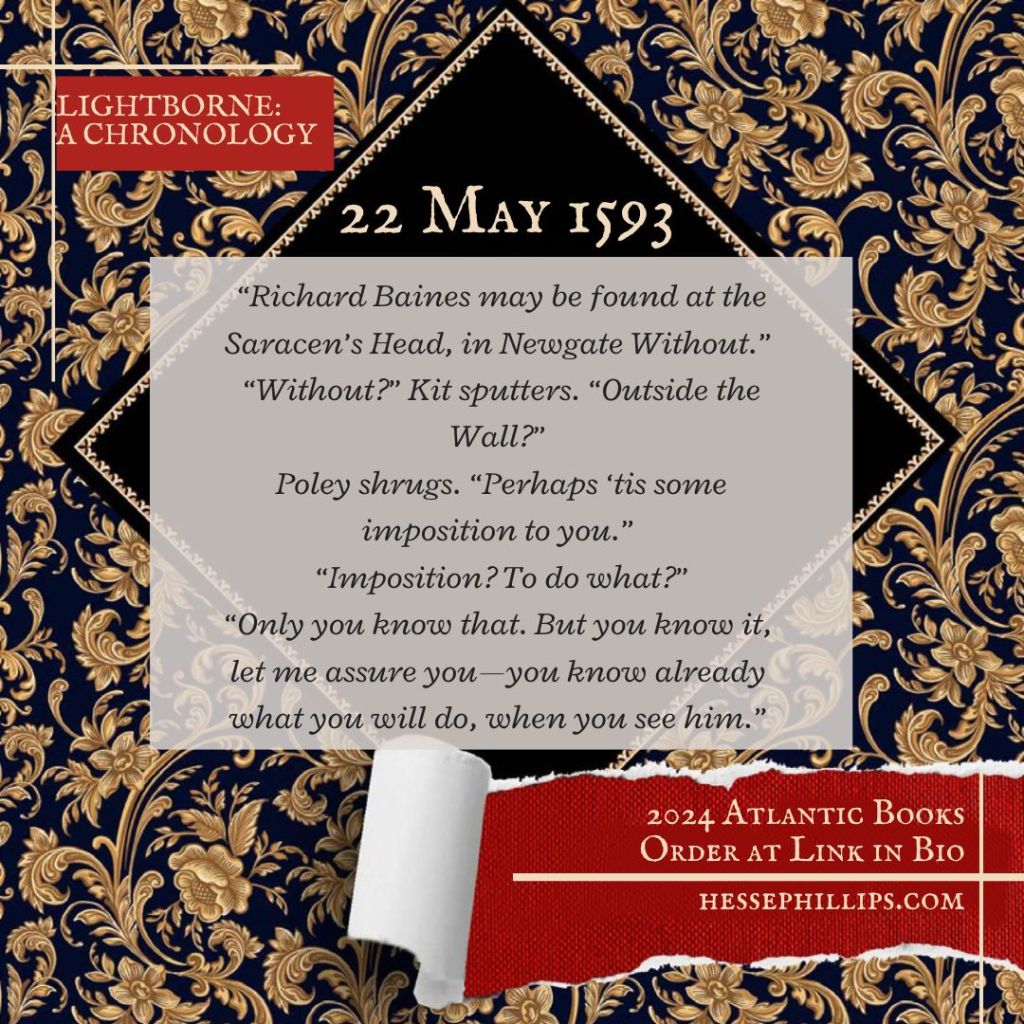
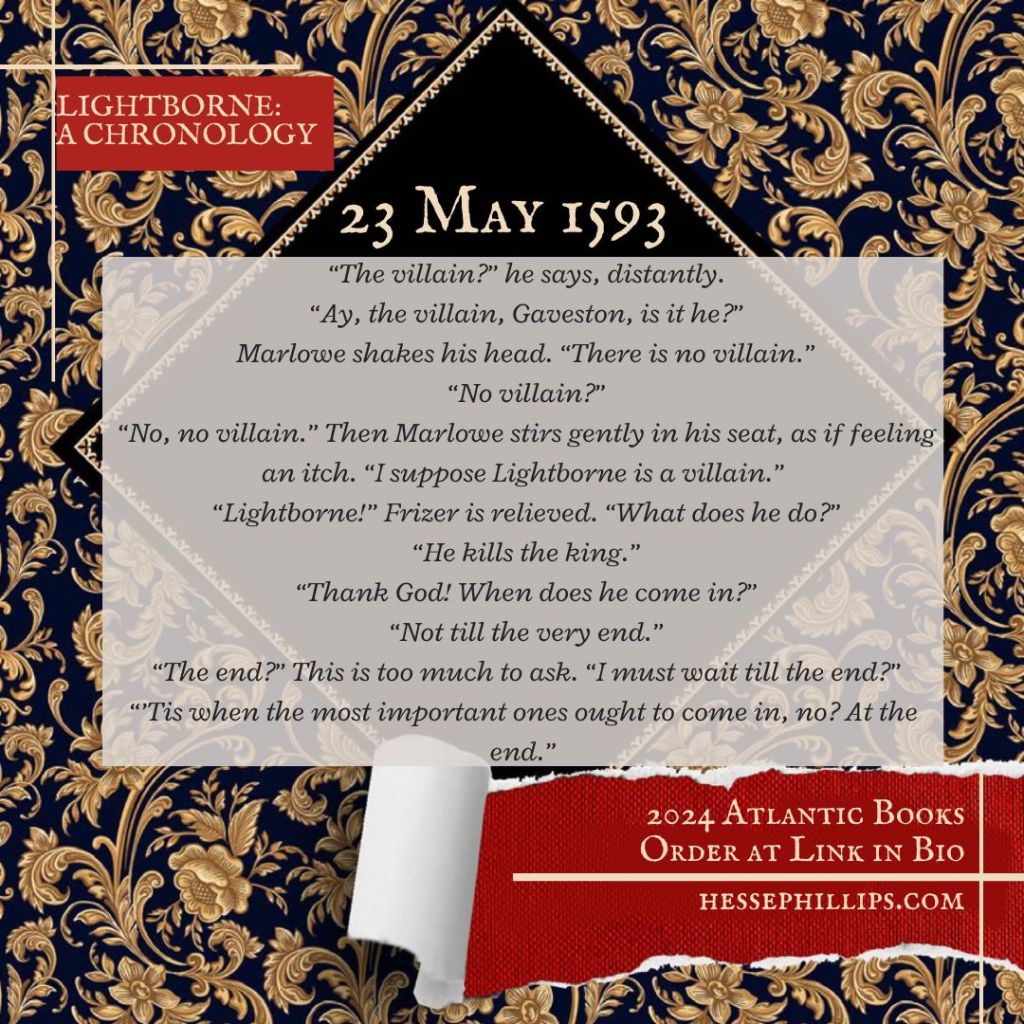
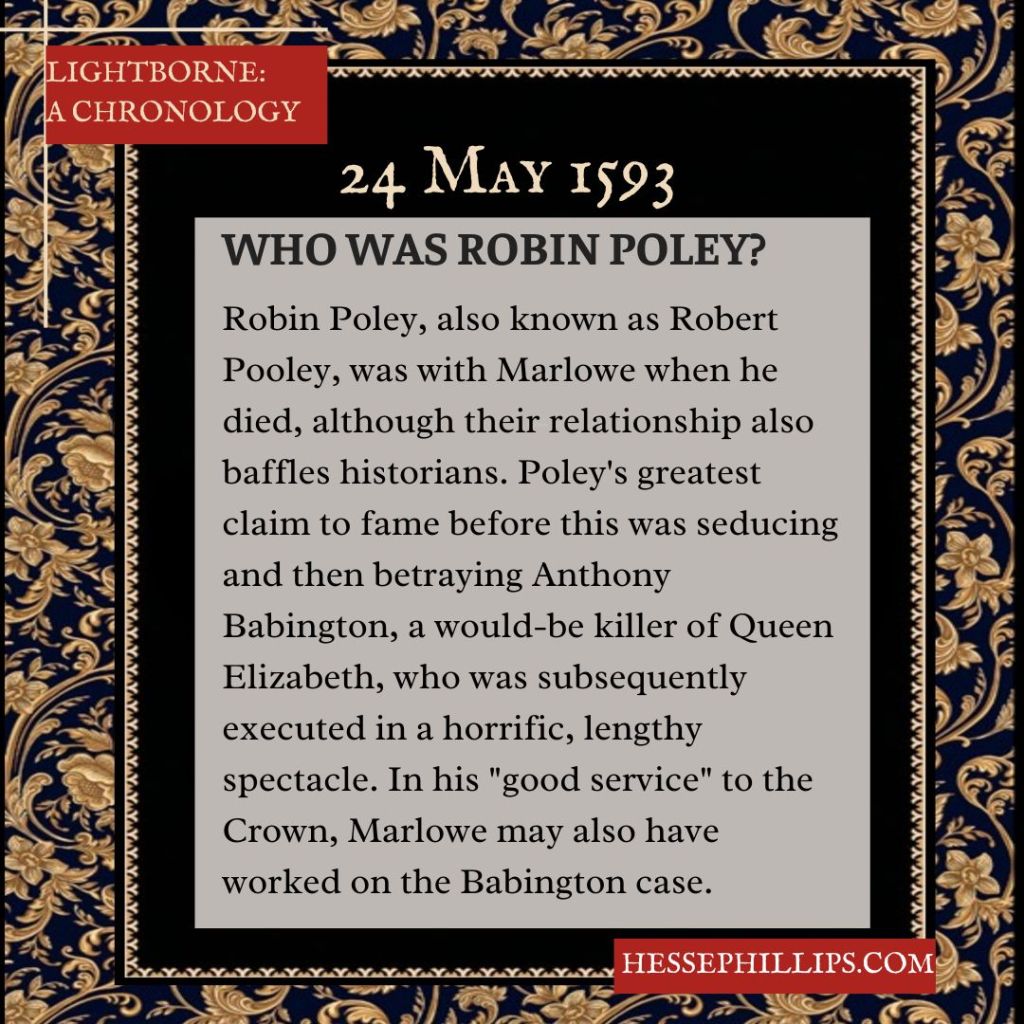
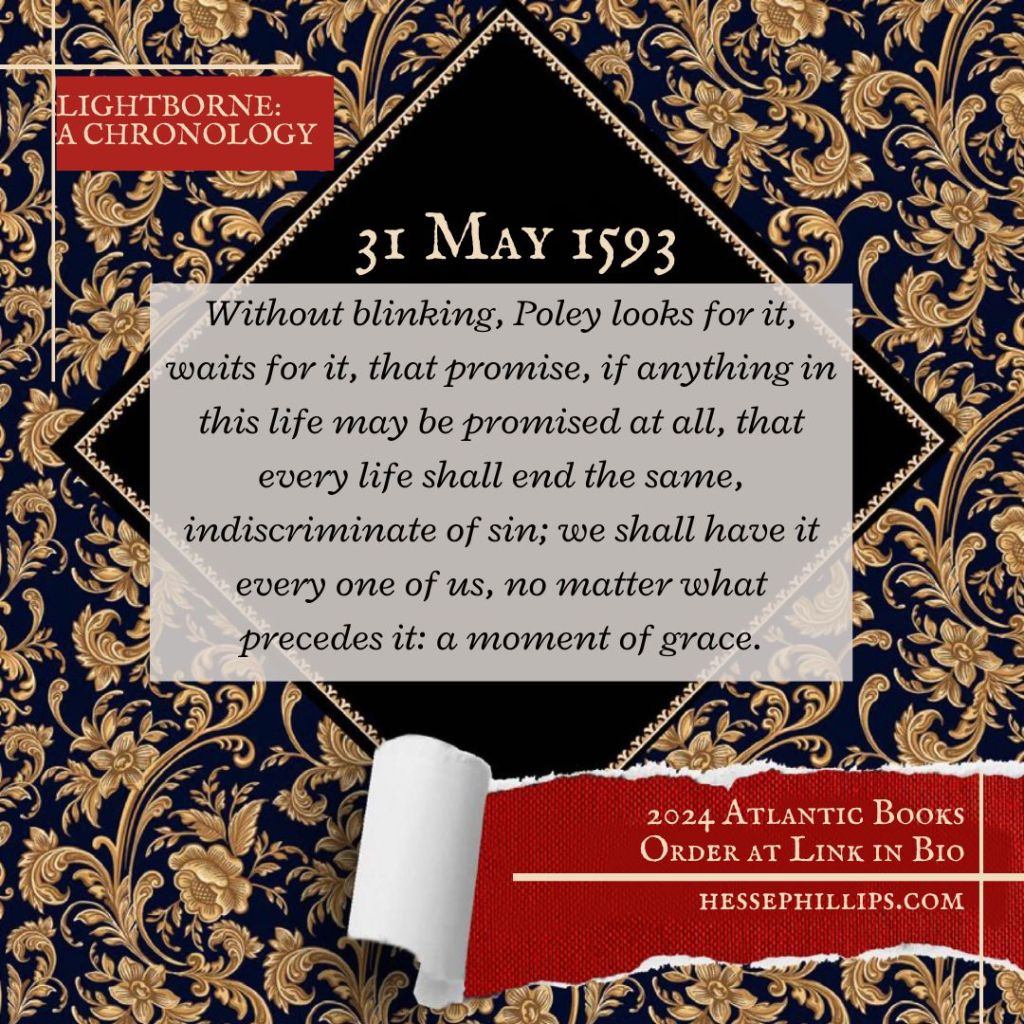
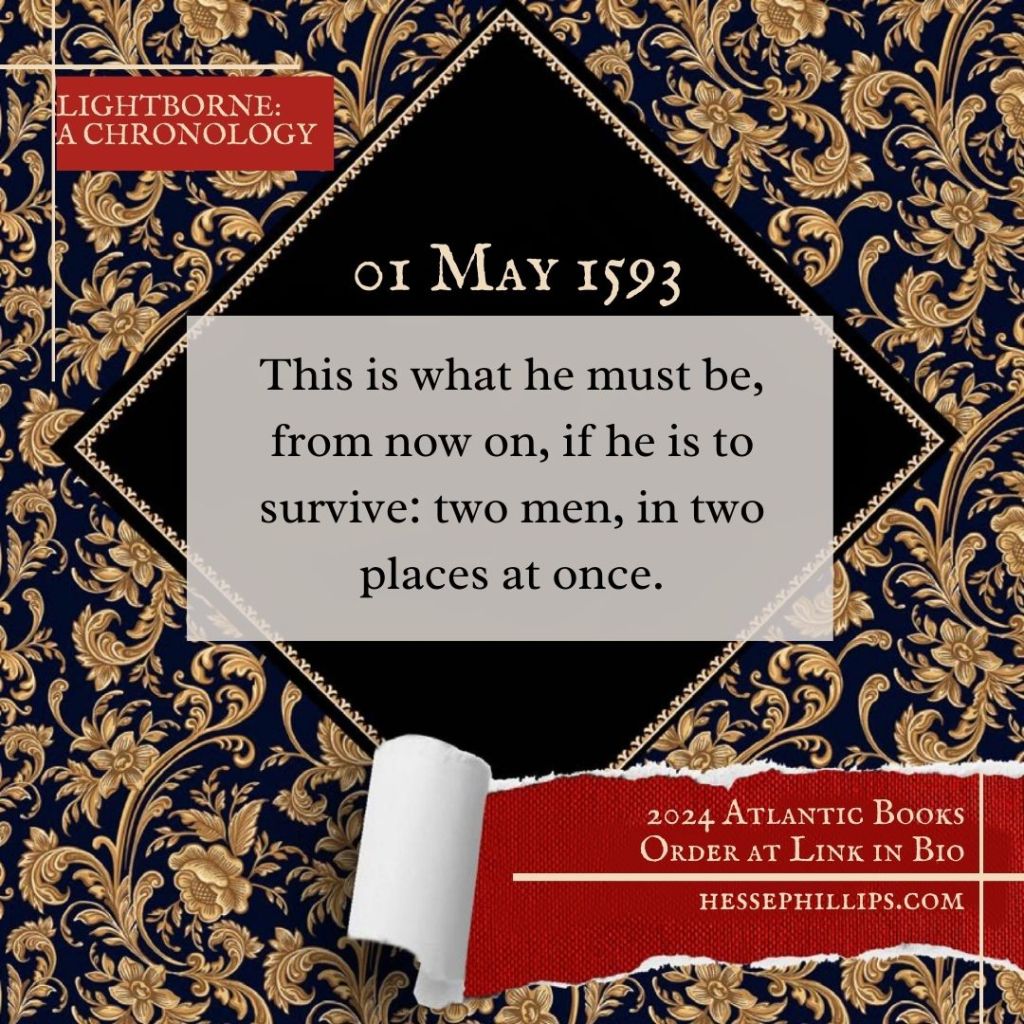
For anyone cool enough to stay off social media (I tip my hat to you), or those who want to revisit the whole series in one convenient place, scroll down and click the arrows on the sides of each image to flip between the slides. Enjoy learning a little bit about Ingram Frizer, Robin Poley, Thomas Walsingham, early modern London, and of course, our protagonist Kit Marlowe, and the enduring mysteries surrounding his life and death that inspired Lightborne.
I may be technically “done” with LIGHTBORNE, my first novel, but it seems like the research just isn’t done with me. After years – too many years – spent scanning documents for familiar names, I am primed to pick them out from just about anywhere. Every now and then, an old ghost steps out of the shadows, and the hair stands up on the back of my neck.
Today, the old ghost’s name was Nicholas Skeres – one of the three men who were present when my protagonist, Christopher Marlowe, was murdered in 1593. Just as the motives behind Marlowe’s death carry an air of mystery, all three of the chief witnesses/accomplices/perpetrators are enigmas in one way or another, which naturally I have exploited the hell out of for narrative purposes. Robert “Robin” Poley was a spy with a frighteningly dark history; Ingram Frizer, who wielded the fatal weapon, was a servant who worked for, of all people, Marlowe’s friend and patron.
Within that shady crew, Nick Skeres was always the one I felt I didn’t need to worry about. His youth as a con-artist, cutpurse and thief is well documented, and his later work as a lackey for important people, like the Earl of Essex, seems clear enough. In all likelihood, he was probably a pretty nasty character. Look him up in Charles Nicholl’s THE RECKONING, an admittedly more than slightly problematic investigation into Marlowe’s death, and you get the confident assertion that he was “Walsingham’s man” – in other words, a government spy. Look him up in other biographies by David Riggs, Park Honan, Constance Brown Kuriyama, F.S. Boas, all the way back to Ethel Seaton, who first identified Skeres’ name in connection with espionage way back in 1929, and you find the same conclusion.
So, why is Nick Skeres suddenly weighing on my mind?
Well, while doing some research for book #2, I happened to run across a reference to “Skyrres” in a letter connected to the Babington Plot. The Plot features heavily in LIGHTBORNE – a convoluted conspiracy which drew in Catholic priests and sympathizers from all across England and beyond, ostensibly spearheaded by the young, impressionable, and loaded Anthony Babington (although it is far more likely that Babington was merely a patsy). The goal was, in a nutshell [*inhales*], to jailbreak Mary, Queen of Scots, transport her to the Continent, hook up with the French Catholic and Spanish armies and lead an attack against England, eventually overthrowing Elizabeth I, installing Mary in her place and restoring the official state religion to Catholicism.
The scheme felt harebrained from the start, and Elizabeth’s spies, under the aegis of Sir Francis Walsingham, her “Spymaster,” were all too happy to let the would-be plotters walk themselves straight into their clutches… which, spoiler alert, they totally did.
In the weeks that led up to the Plot’s final, tragic unravelling, Babington and his friends were frequently on the move between bases in or around London. In August of 1586, right before Walsingham finally sprang his trap, his secretary, Francis Milles, wrote to him about people whom he’d seen hanging around the Catholic safehouse where Babington was believed to be hiding out:
Alt Text: Screenshot from The Troubles of Our Catholic Forefathers as Told by Themselves, 1872. A highlighted section reads, “Bab., Donne, Skyrres [?], and some others both men and women of this crew I have discovered this day with my own eyes, and therefore seeing Bab. is not departed, I hope for the better success of this service.”
Until a few weeks ago, I’d never read Milles’ letter myself, but I’d read about it. If “Skyrres” was our Skeres, then he wouldn’t have been the only one present at Marlowe’s death to have also been embroiled in the Babington Plot. Robin Poley was, in fact, Walsingham’s chief instrument in taking Babington down. What I find interesting here is the way that Milles talks about Skeres: as one of Babington’s “crew,” seen with his “own eyes,” and taken as proof that Babington is “not departed” – in other words, also present at the house, though unseen.
Milles’ letter in no way treats Skeres as separate from the other conspirators, like “Donne,” i.e. John Dunne, who was soon after convicted of treason and hanged along with Babington. If Skeres is mentioned “without further comment,” as Nicholl says, then so are they. If anything, Milles’ letter suggests that, whatever our Nick’s reasons for being amongst Babington’s “crew,” they might not have been so cut-and-dry as previously assumed.
Was Skeres a double-agent, not entirely trusted by either side? Or was he, perhaps, an apostate – a Catholic sympathizer who would soon betray his own cause?
Whatever the case, if Nicholas Skeres was in the employ of Sir Francis Walsingham in 1586, then Francis Milles, as Walsingham’s personal secretary, should damn well have known about it. The letter, to my eyes at least, suggests that Milles had another understanding about him entirely.
Skeres virtually disappears from the record for three whole years following this sighting by Milles. That might not be a red flag in itself, as paper-trails frequently go astray in this period, and the aftermath of the Babington Plot was every bit as chaotic as its advent. When our Nick resurfaces, he is working as a messenger for both Walsingham and the Earl of Essex, meaning that he is firmly entrenched in government employment. Did he serve faithfully? Who can say. As it happens, Skeres would eventually be arrested in connection with the Essex Rebellion – another attempt to overthrow Queen Elizabeth – and probably ended his life in prison.
How is any of this relevant to the murder of Christopher Marlowe – the one we actually care about?
Well, the uncertainty surrounding Marlowe’s death has really been something of a plague on Marlowe studies. It’s the mystery everyone wants to talk about but no one really wants to solve – because if we solve it, then we won’t get to speculate anymore. After so many hundreds of years, answering the problem would hardly feel like justice, but rather more like killing poor Kit Marlowe all over again.
Most of the biographers I mentioned above ascribe to some version of the theory that Marlowe’s murder was a grand conspiracy, orchestrated by the government or some other powers-that-be.1 The thing is, though the circumstances of Marlowe’s death are in fact pretty suspicious, there’s no “smoking gun” that proves it was a hit-job. There are, I think, reasons to believe his murder was swept under the rug, but that does not necessarily mean it was planned from on-high. All it means is that someone was protecting the people likely to suffer consequences from it: Poley, Frizer, and Skeres. The people who were actually there, in the room where it happened.
A notorious spy and rumoured assassin. A servant of Marlowe’s friend. And, a man long presumed to be a government spy, whose motives, loyalties, and ambitions may be far murkier than previously assumed.
If that’s who Nick Skeres really was – and Milles’ letter certainly makes a case for it – then our picture of the scene of the crime shifts towards something potentially more personal, and far messier, than a state-ordered assassination. Why were these particular people there? What was Marlowe’s connection to them? What did they want with him?
This is all perhaps just a very (very) long way of saying that the work goes on. I’ve already written my version of Nick Skeres, who is every bit as shady as you’d expect. But the novel I’ve written is not about proselytizing my version of “what really happened.” I’m not so interested in that. Fiction is about asking questions for which there are, ideally, no clear answers. Even historical fiction, despite having one foot in Fact, takes events or lives that were momentous and singular to those who lived them, and – rather heartlessly – scavenges them for parts. The dead, long gone, exist only in fragments from which we storytellers glean what we may, and (like conspiracy-theorists) straight-up bullshit the rest.
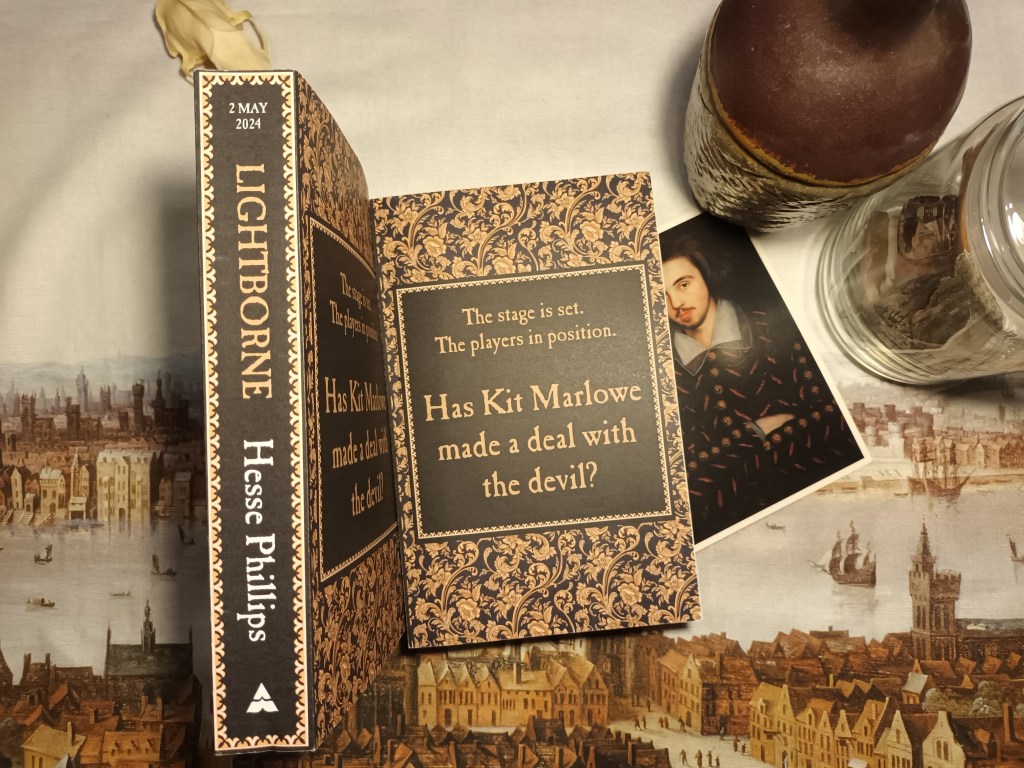
Photo by Hesse Phillips. Yes, it was fun.
Oh yes – in case you missed it, LIGHTBORNE is an ARC now, and looks very fetching in gold, if I do say so. I’m told that copies will be available on NetGalley soon!
Featured image: Fede Galizia, Portrait of Paolo Morigia (detail), Public Domain, Wikimedia Commons
Brown Kuriyama is an outlier here for her “no-nonsense” approach, i.e., taking all of the documents and testimony associated with Marlowe’s murder completely at face-value, for better or for worse. ↩︎





















 HESSE PHILLIPS