The Historical (Fiction) is Political

On the eve of the US presidential election, this historical fiction writer has some thoughts.

CW: Racism, medical abuse, SA


I keep thinking about the several weeks this past summer, just before Joe Biden announced his intention to drop out of the US presidential race, when social media became absolutely flooded with appeals for a return to “precedented” times. Even now, type the word “precedented” into any search bar, and you’ll get thousands of hits, all expressing the same mixture of exhaustion and dread: Free us from nonstop whiplash. Give us boring and predictable.

I understand the sentiment. Our particular historical moment feels uniquely dire. But every time one of these posts pops up in my feed, I can’t help but think that all times have been both precedented and unprecedented, that we exist just as our ancestors did and our descendants will, putting one foot in front of the other as we trudge the treadmill of history. The shape of our times, and of our little lives within them, will inevitably be decided by those who outlive us – a hazard of being situated on the inside rather than the outside of a story.

Were we capable of peeking into future history books, what we’d read about the early 21st century would likely surprise and bewilder us. Possibly, we’d barely recognize ourselves – as would our ancestors, were they privy to our contemporary take(s) on them. Just as myths and folklore evolve over eons – as old tales are rewritten, lost, and rediscovered – history changes wildly based on who is telling the story, and when, and for what purpose. Whether times are precedented or unprecedented is not a matter of fact, but point-of-view.

Still, we, the players on that stage, are not helpless. Our work is in the making of those future historians – in the shaping of that point-of-view. Here and now, we decide what truths will be self-evident in the decades and (hopefully) centuries to come.


Take J. Marion Sims, for example: medical doctor, known as “the Father of Gynecology,” immortalized in statues, medical schools, and public buildings all over the United States. For most of the 130+ years since his death, Sims was lauded as a champion of women, having revolutionized a profoundly neglected field and led the vanguard in techniques ranging from fistula repair to anesthesia. It’s only within the last few decades that Sims’ use of enslaved Black women and girls as test subjects for his agonizing experimental procedures – performed without anesthesia, due to his belief (which many in the medical field still absurdly hold today) that Black people cannot feel pain – began to overshadow his previously spotless legacy.

J. Marion Sims statue located in Columbia, South Carolina. Wikimedia Commons.

The reason why it took so long is that prior to the 1990s, Sims was mainly written about by white men, occasionally white women, for whom Sims’ well documented anti-abolitionist stance, Confederate sympathies, and medical (and possibly sexual) abuse of enslaved women and girls simply made him “a man of his times.”

It took Black women scholars like Durrenda Ojanuga and Harriet Washington to shine a light on the harrowing stories of girls like Anarcha, a thirteen-year-old fistula patient on whom Sims operated without sedation more than thirty times, often before an audience comprised of both medical students and morbidly curious looky-loos. But even prior to these scholars’ work, Anarcha was not some deeply buried secret in Sim’s story. In his memoirs and diaries, Sims himself had painstakingly – and proudly – documented his own mistreatment of Anarcha and other young Black women.

A self-evident truth in the worldview of Sims, and many – too many – who came after him, was that Black lives mattered less. All Black researchers did was simply ask that Anarcha be given full consideration in the story – that she be treated as a human being, not merely a tool for the “hero” to make use of on his journey to immortality. Nowadays, the women and girls who suffered under Sims’ knife are more frequently depicted as the main characters of their own story, appearing in documentaries, plays, paintings, and even, at last, a monument installed in Montgomery, Alabama in 2021, dedicated to “The Mothers of Gynecology.”

Here’s the point: the history we learn about Sims now, in 2024, is immensely different from what was taught just 30 years ago. The past, obviously, did not change. The way we see and understand the past changed, in large part thanks to a wider diversity of voices involved in the researching and shaping of history, and culture in general. Such has led to a slow shift in the way humanity views itself: a long overdue upheaval of who fully “counts” as human in the Western world.

The infuriating truth of the matter is, we are still only at the very beginning of that revolution in thought. The powerful and privileged still look much the same as they did 30 years ago, 130 years ago, 230 years ago, only a tiny minority of whom have plucked up the raw ore of the idea that humanity is a trait equally and innately shared by all human beings, none more or less deserving than any other, and are puzzling over what to do with it. How does this idea fit into their worldview? What’s in it for them?


[Historical fiction] brings you up against events and mentalities that, should you choose to describe them, would bring you to the borders of what your readers could bear. The danger you have to negotiate is not the dimpled coyness of the past – it is its obscenity.

Hilary Mantel, The Guardian, 2009

I can’t be the only historical fiction writer who is also a disillusioned former academic. In a sense, all history is historical fiction, in that all historians make decisions about what to highlight and what to suppress. But there’s a spectrum between “truth” and “straight-up bullshit.” Whether you’re writing literature or academic history depends on where in the spectrum you land, or at least aim to land, which itself depends (rather a lot more than some would like to think) on who you are and what you believe.

Even the most impartial and considerate historian can rarely ever hope to get much further than halfway from bullshit. Read too deeply into almost any subject and you’ll soon discover that “experts” are frustratingly fallible people, prone to contradicting themselves, repeating falsehoods, confusing conjecture for empirical fact, encoding bias into praxis, cherry-picking their sources, etc., etc. It certainly doesn’t help that the field of History has been so long dominated by men first, white men second, and wealthy white men third – demographics generally adverse to challenging one another in any way likely to disturb the overall homogeneity of their precious worldview.

Title page of Thomas Bowdler’s infamous The Family Shakespeare (1818), a heavily expurgated version of Shakespeare’s plays which omitted “words and expressions… which cannot with propriety be read aloud in a family.” Wikimedia Commons.

The Victorians did immeasurable damage in their time, committing just about every academic fallacy under the sun, shoehorning all the terrible and beautiful chaos of human history into prissy parables about the virtues of piety and obedience. It’s frankly criminal that much of the Elizabethan history I studied in school came secondhand from those Bowdlerizing little creeps, forcing me to waste many hours in simply peeling back layer after layer of bias and bullshit in order to reach a kernel of truth, if any had managed to survive. And yet, the Victorians were only “men of their times,” working in the grand tradition of a field developed in service to the moral and martial instruction of aristocratic young boys. “Close your book, Master Algernon, and tell me: what was Xerxes greatest mistake at Salamis?”

Don’t get me wrong – I loved studying history (theatre history, specifically), but decided to write historical fiction instead because I saw a potential in literature to do what scholarship could not: to somehow transcend the narrative imposed by generations of Ivory Tower greybeards and recover the fugitive now-ness of the past, at the point when it was still present. The raw, churning, messy humanity of it all.

Maybe the potential is there, but achieving it is a pipe-dream. Firstly, because books are meant to be enjoyed. For the sake of the modern reader’s comfort (and sanity), the only way to bridge the gap between, say, 1593, when my novel Lightborne is set, and 2024 is to bring 2024 to 1593, and not the other way around. Characters might speak in an approximation of period dialect; certain events might have to be simplified or ignored; the broad concerns of a person alive in that specific time and place will have to be selected based on their relevance to the story and their relatability to the modern reader. In historical fiction, the “now-ness” of the past is an illusion, refracted through the now-ness of, well, now.

Secondly, as I tried to illustrate above with the case of Sims and Anarcha, historical truth is political. Unfortunately, we novelists are as human as anyone else, each of us with our own little agenda, which is often secret even from ourselves. Nowadays we say that “the personal is political,” meaning we are obliged to examine our biases, and correct them to the best of our ability; meaning also that, for some of us, our personhood, our mere existence, is politicized whether we like it or not. Quite naturally, this effects how we write, and what we write about.

Some writers might aim for a neutral view of humanity – a so-called “universality” – but I’m afraid there’s no such thing. Just as true political centrism is a myth, a “neutral” view of humanity presupposes that there is a single, standard, immutable shape, size, color, and kind of human being. Nearly always, this true “neutral” human is presented to us as white, heterosexual, cisgendered, male, Christian, and “middle-class” (another myth).1 When authors and literary critics employ terms like “universal” to describe stories or characters, they are often (perhaps unknowingly) doing the work of white supremacy.

Those awful Victorians owe much of their awfulness to the fact that they lived in a time and place where the definition of humanity was about as narrow as it gets. Worse, as historians, their profession obliged them to be ruthless guardians of those borders. Prior to the egregious intellectual and cultural wrongs inflicted by early anthropology and psychology – not to mention eugenics, whose poisonous influence on the western world cannot be understated – history was the scholarly field most responsible for shaping the way humans viewed themselves. Therefore, it bears enormous responsibility for our still-blinkered view of the past as a string of white men’s accomplishments, in a world utterly devoid of queer, Black, non-European, non-Christian, disabled, and/or women’s ingenuity, innovation, or simple relevance.

Essentially, every human story is political – because politics determine, firstly, who gets to be human.

So much of human history is selecting what to remember, deifying or reifying some aspects and forgetting others. I’m not suggesting the past haunts us, but until one comes to terms with it, the past will be a haunting – something you can’t shake.

Toni Morrison, interview with BRICK, 2003

Two months ago, many of us were shocked and horrified by images of hundreds of books piled high in dumpsters at the New College of Florida, the former contents of its recently dissolved Gender and Diversity Center. But few of us who had been following the US book bans closely, or who know our history, were surprised to see the inevitable fruits of the right-wing war on free speech and free thought. As Matthew Gabriele and David M. Perry point out in their excellent article, incidents of mass book removal, disposal, and/or destruction go back far enough to demonstrate a chilling pattern:

Would-be tyrants have been destroying books for centuries, and once you start destroying books, it’s usually not long until you treat groups of people the same way.

As the infamous Nazi burning of the library at Magnus Hirschfeld’s Institute of Sexology made terrifyingly clear, it is a remarkably short step between burning books and burning people.2  And yet, for all that the extreme right’s rhetoric has grown increasingly violent and dehumanizing over the past few weeks, major media outlets such as The New York Times are seemingly twisting themselves into ever more Gordian linguistic knots in effort to normalize the, excuse the phrase, utter batshittery of what is being said and done. Meanwhile, even historically “apolitical” types are looking over their shoulders, wondering, Are we at the point of no return yet? Has it gone that far?

Reader, I guarantee you: in 1933, people were asking themselves the same question.

The presumptive architects of an American autocracy have made their plans freely available to read online. Those of us who like to know what our enemies are plotting can now recite highlights from the Project 2025 playbook point-by-point. The apparent goal is to “take back” the United States to some illusory, simpler time, when humanity was uncomplicated and unalloyed, when white was white and black was black and never the twain should meet – a vision not far from that of those accursed Victorian moralists. But the “perfect,” homogenous nation of obedient, pious and patriotic white, Christian, patriarchal households for which the right desperately longs can only be imposed through violence. Humanity was never thus, and never will be. America was never thus, and never will be.3

By banning LGBTQ+ books and the teaching of Critical Race Theory (which is simply uncensored US History), the right is testing our endurance for violence. For the destruction of books, and the denial of the right to an education, are indeed acts of violence. In the right’s perfect world, we will be told what to accept as “truth,” and forbidden to question it. There will be no historical fiction, only fictional history.


… he who has been treated as the devil, recognizes the devil when they meet.

James Baldwin, The Devil Finds Work

It’s no accident that history and literature are often among the first targets of tyrants. Throughout the tumultuous Tudor era, in which my novel Lightborne is set, theatres, schools and universities became political and sometimes literal battlegrounds as each new religious binge or purge rocked England’s foundations. With the country swinging from Protestant to Catholic to Protestant again, artists and educators frequently found themselves caught in the crosshairs for failing to obey the current dogma, whatever it happened to be. Some conformed, but others suffered horrendous fates. Lightborne is, of course, about one of the most famous dissenters of that age: queer poet, possible spy, and accused heretic, Christopher Marlowe.

Marlowe is now often known for the goriness of his plays, but what truly defines him as a writer was his obsession with power: how it was obtained, defended, employed as a hammer against ordinary people; how power, in its fierce need for ceaseless expansion, could crush whole civilizations in its path. Contrary to the ruling doctrine of his day that power was a gift endowed by God upon those most deserving, Marlowe’s plays suggested, rather, that power was a deadly weapon, won not through one’s innate virtue but through greed, megalomania, venality, and bloodshed.

Under the rule of Elizabeth I, who, as both Head of State and Head of the Church, demanded cultish devotion from her subjects, this was an extremely dangerous position to take, and one that may very well have cost Marlowe his life. Perhaps it was his experiences in espionage that “radicalized” him, as we might put it today; or perhaps it was simply his life as a queer man working in the rough-and-tumble world of the Elizabethan theatre – not the glamorous lifestyle we might think of now, but a precarious, marginal existence, likened in its day to sex work. Either way, Marlowe, like so many who came both before and after him, would have often found himself forced to choose between living freely, or simply living another day.

I dearly hope that one day, we’ll no longer have to concern ourselves with the same fears our ancestors faced 400 years ago. I hope for a future with fewer impossible choices in the name of basic survival.

But that hope feels more tenuous by the day. The Tudor monarchs and Donald Trump may bear little resemblance to one another at the surface, but both arise out of the same vicious impulses: to crush dissent without mercy, to villainize the vulnerable, to pander to grotesque wealth, to self-style as demigods, to reward violence and cruelty, to criminalize critical thought, to censor art and education, to undermine fact, to enforce religious conformity, and to make brutal examples of any who oppose them. Different yet equally terrifying tyrants, with different yet equally ridiculous hair.

Now, in our minute and perishing present, we risk becoming the intellectual property of bigots and autocrats, who will ensure the future remembers us as best suits their narrative. For many, this means losing access to our own humanity, a distinction which far too many human beings are still denied. To be Black or brown, queer or trans, an immigrant, non-Christian, disabled, working-class, unhoused, or certainly, Palestinian – to be in any way distant from historical power and privilege – is to be rendered into historical fiction while you are still alive, written out of your own story and into the shadows of some grand, artificial narrative, at best as villains and bogeymen, at worst as silence, as the blank spaces between words.

What greater threat is there to humanity than the desire to erase our history, our curiosity, our creativity, our defiance, our resilience, our joy? What greater evil is there than dehumanization?

And what are we going to do about it, while we still can?


  1. If you’ll forgive me nerding-out here for a sec, the notion of class universality in literature goes way back as well. Take Everyman, a play printed in 1530 but possibly much older. As the title suggests, audiences are meant to interpret the main character as a universal representation of “man,” although in the play he is clearly depicted as a person of wealth and resources – much unlike the vast majority of people alive in in the 16th century, who existed in a state of indentured servitude. ↩︎
  2. I’m echoing Heinrich Heine here, whose book Almansor was among those burned, and contained the words, “Where they burn books, they’ll burn people too.”  ↩︎
  3. “No,” you’ll say, “‘America’ is in fact a nation built upon the blood and bones of colonized and enslaved peoples” – but of course, those people were here, and still are, and are more than their suffering. We can care about justice for the dead without being apathetic to the living. ↩︎

Research Diary #2: Becoming “Queer”

(CW: This post contains the f-slur, as well as historical terms for queer people that are offensive today.)

For those who don’t know, in a former life I was a theatre historian, but I began my academic career studying queer history.

Now, even having left academia behind, I’m still writing queer history. Only fictionalized. Historians are storytellers – it’s right there in the name – I’ve simply found myself more at home with a slightly different form of storytelling.

I just can’t quit queer history. (Sorry.) For me, it’s like genealogy – not merely an attempt to reconstruct lives from the past, but in a way, to actively construct my own identity. Every time I learn about a queer person from the past, no matter where or when they are from, I feel like I am meeting my own long-lost family.

There’s just one thing about the practice of queer history that never sat right with me.

I could be reading about a writer, a general, a pirate, a dedicated breeder of cows – it doesn’t matter. If the person I’m reading about was queer, or is believed to have been queer, and was alive at any time before, say, 1900, the author will have included a little disclaimer in their article that always goes a bit like this:

“In discussing the life of X, we have been careful only to talk about them in terms of queer behaviour, not as a queer person. We must not conflate sexuality with identity, which of course doesn’t happen until Freud and his whole deal. Besides, since the word ‘homosexual’ didn’t exist until the 1860s, and was barely known until decades later, we obviously can’t describe anyone alive before then as ‘homosexual,’ let alone ‘queer!’”

That’s it. Open up a brand new book about a queer historical figure and there it is, like a bad penny. I call it the “In the beginning, there was the Word” Fallacy. ITBTWTWF.

The first flaw in this logic is that actually, things are not created with the Word. Words are created to describe things that already exist.

To talk about the other reasons why this disclaimer is problematic at best, we have to go way, way back in time, to long before the word “homosexual” was even a twinkle in some Hungarian guy’s eye.

Because, “homosexual” was not the first word invented that described a queer person.

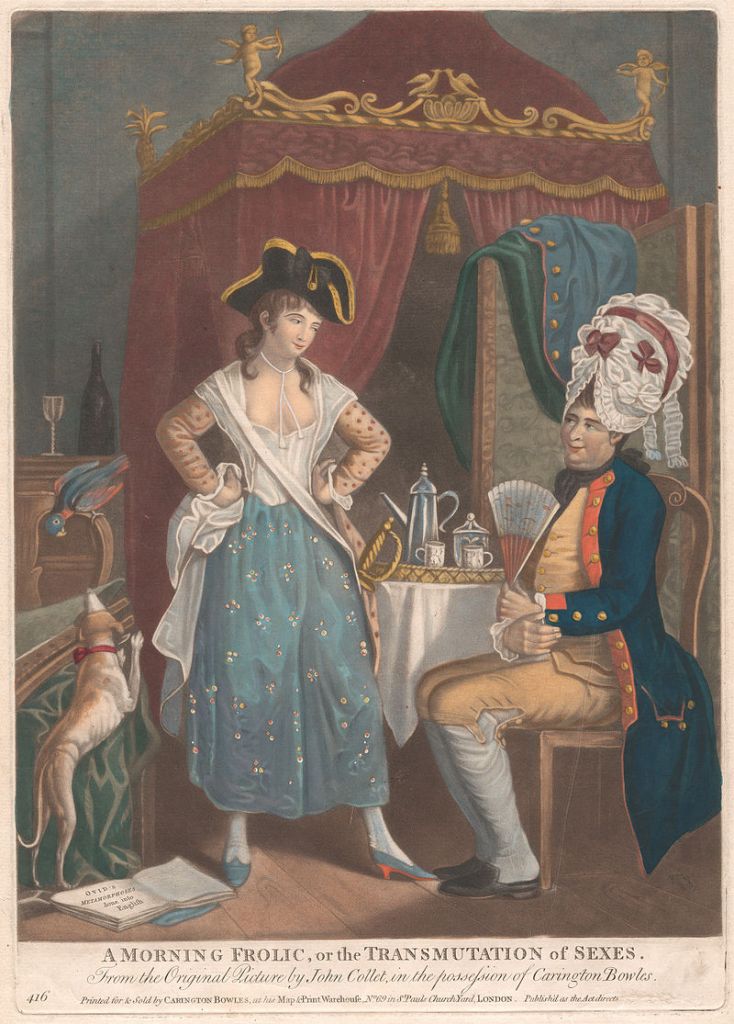
“A Morning Frolic, or the Transmutation of the Sexes,” satirical cartoon depicting crossdressing by John Collett (1780) – http://collections.britishart.yale.edu/vufind/Record/3633908, Public Domain, https://commons.wikimedia.org/w/index.php?curid=45273164

Before “homosexual,” queer people had been called or called themselves “Uranians,” “fairies,” “fribbles,” “jemmies,” “queans,” “mollies,” and “Ganymedes,” to name just a few. The term “lesbian” has been around since the 18th century, as has “tommy” (the original “butch”), “tribade,” “sapphic,” and the rather visual “friccatrice” (“One who rubs”). Queer people could speak to one another in codes and secret languages. They could tap a friend on the shoulder and ask, in a whisper, about a mutual acquaintance, “Is he earnest?” Or “Is she musical?”

“Are they family?”

The fact that all of these terms and codes were considered slang should not rob them of their legitimacy as words for both queer behaviour and queer people. In fact, they are all rare, precious things, rescued from the dust-bin of history through a combination of luck, and changing circumstances in English literacy.

In England, prior to the time of Henry VIII, literacy was largely inaccessible for all but a privileged few. But following the introduction of public schools (for men, at least), we begin to see a much higher incidence of slang terms entering the written record. Ordinary people who previously could not tell their own stories now had access to the most powerful technology on earth at that time – a pen and paper – and could write in the language of the street, the pub, the marketplace.

Such was the world wherein queer communities were able to thrive: criminalized as a class of “vagabonds and sturdy (i.e., false) beggars,” many queer people made their living as sex workers and performers, jobs that allowed them to build relationships with others like themselves. Their stories survive in legal records and prison lists, but also in plays and poetry, perhaps most famously in The Roaring Girl (c. 1610) by Thomas Dekker and Thomas Middleton, which dramatized the life of gender nonconforming local celebrity Moll “Cutpurse” Frith, and put numerous slang terms in writing for the very first time.

Moll Frith pictured on the quarto cover of The Roaring Girl (1611)
Public Domain, https://commons.wikimedia.org/w/index.php?curid=18269007

Because of their gradual inclusion in the written record, we now know some details about the lives of queer early moderners. In London, they gathered in particular neighbourhoods and houses, often located in “red-light” districts or near performance venues like Whitefriars or Paris Garden. From the 1700s, we have eye-witness accounts of clandestine competitive drag balls and gender-bending spectacles held in the so-called “Molly Houses” where queer men gathered.

Combining the medieval Lingua Franca with the underground dialect known as Thieves’ Cant, early modern queer people even developed their own complex language, Polari, as a way of communicating between each other without being understood by outsiders. Polari had such staying power that it is still spoken by some even today.

If that is not a community, a culture, a people – I don’t know what is.

Now, let’s jump ahead a bit – about three hundred years – to around the time that “homosexual” first pops up. Where did it come from, and why?

This story is full of twists and turns, so strap in…

Towards the end of the sexually repressive 19th century, after hundreds of years in which queer sex was heavily criminalized, things began to change – if not for queer people, then for Western society at large. The rise of the middle class, the end of slavery in the United States, and the Women’s Suffrage Movement (among other things), lead to growing anxieties within white academic circles about the “degeneration” of the human race – specifically, the white race.

While, in this view, non-white people certainly posed a threat to white racial purity, many believed an even greater threat came from within: white people who did not play by the “rules” of sex and gender.

But now that there was a white middle class to maintain, you couldn’t just… hang queer people anymore. A new age required new solutions to the problem of queerness, new words to describe it. Fortunately for the Victorian morality and racial purity police, a revolution in the study of the human psyche was underway on the European Continent: the rise of psychology.

The earliest psychologists called themselves “alienists.” Not because they studied aliens, har-de-har, but because their main interest was in studying those who were “alienated” from society. Naturally, the alienists found plenty of fertile ground (and deep pockets) amongst middle- and upper-class white queer people, many of whom were desperate to cure themselves of their “affliction.”

Rather than seeing queer people as simply monstrous criminals, early psychologists proposed that queerness – or rather, again, queer behaviour – should be reclassified as a mental disease.

They named this new illness “Homosexuality.”

First known use of the word “homosexual” in a letter written by Karl Maria Kertbeny (1868)
By Unknown author – http://www.geheimsache.at, Public Domain, https://commons.wikimedia.org/w/index.php?curid=539078

But early psychologists did not invent the word. Poetically, perhaps, it was stolen. Coined by Hungarian author and queer rights campaigner Károly Mária Kertbeny (who also coined “heterosexual”), “homosexual” was conceived to describe an “innate and unchanging” sexual identity. Fed-up with having to choose between “vulgar” slang terms and vicious slurs to describe himself, Kertbeny hoped that “homosexual” would be embraced by other queer men, but his goal was bigger still: to humanize queerness in the general population, opening the door for the abolition of sodomy laws.

From 2024, maybe we say Kertbeny won in the end. But it was a very, very long game.

Once the medical establishment got their hands on “homosexual,” Kertbeny’s project came to an inglorious end. Soon, it had been redefined to mean “a person suffering from the mental disease of homosexuality.” Homosexuals who repented their condition and aspired to heterosexuality were subjected to conversion “therapies” such as electro-shock, aversion therapy, even lobotomies. But for queer people who did not desire to change, or who failed to adopt a convincing pretence of heteronormativity, the prisons remained open.

As a result of “homosexual’s” connotations, many queer thinkers and writers of the first half of the 20th century utterly rejected the term. After all, why on earth would anyone want to self-define as a mental illness? Famously, queer author, politician and enfant terrible Gore Vidal, who preferred the term “fag” over “homosexual,” argued for a total separation of personal identity from what he termed “sexual acts” – or, to put it in other words, “sexual behaviour.”

Yes, it was a queer intellectual who first advocated for the separation of behaviour and identity. The call was coming from inside the house all along.

But white, cis, middle- to upper-class gay men like Vidal were only the loudest and most visible queers of their time, and historically, those most often subjected to pathologization by the medical establishment. Just across town from Mr. Vidal’s cushy Uptown digs, in Harlem, Brooklyn, and the Bronx, you would find very different attitudes about queer identity.

For nearly one hundred years, Black queer culture had been thriving right under the noses of white New York society.

At venues like The Cotton Club, Connie’s Inn, and Barron’s, Black queer people gathered to dance, drink, hook up, watch gender-bending spectacles and express themselves in a place of relative safety and acceptance. Even as early as 1869, the Hamilton Lodge hosted drag balls which drew crowds of thousands. To build off RuPaul, it was in the grand tradition of the Hamilton Lodge balls that Paris Is Burning was made.

A drag ball hosted at Webster Hall (c. 1920s) By Unknown author – http://gvh.aphdigital.org/items/show/947, Public Domain, https://commons.wikimedia.org/w/index.php?curid=34430528

The reasons why New York’s civil authorities often turned a blind eye towards Black queer culture are enormously complicated, and to no small extent bound up in the racial pseudo-science known as eugenics – essentially, a form of white supremacist racial engineering whose popularity from the late 19th through at least the middle of the 20th century simply cannot be overstated. According to eugenicists, Black people were sexually inferior to whites and naturally “perverse.” Queerness in whites threatened the grand project of eugenics – the building of the white master race – but queerness in Black people did not.

And so, police often let Black queer clubs go about their business. Under this permissive atmosphere, New York City’s drag balls flourished into the Prohibition era, drawing higher and higher numbers of attendees, Black and white, queer and straight. Soon, a fad for “Pansy Clubs” arose, leading to the popping up of drag spectacles all over the country. On a personal note: my grandfather was a drag performer in the 1930s, and plied his trade in the respectable halls of the University of Pittsburgh. He even had his picture taken with the mayor, if that’s any indication of just how normalized it was.

That would be grandpa in the middle (1933). Photo from the author’s collection.

It’s no accident that all this coincided with the Harlem Renaissance, which was not merely a Black movement but also a queer one. Poets, artists, and musicians such as Langston Hughes, Alain Locke, Bessie Smith, Ma Rainey, and Countee Cullen all maintained queer relationships with varying degrees of openness. Singer Gladys Bentley, who performed at the aptly-named Clam House, wore masculine clothing, proudly adopted the term “dyke,” and even married her then girlfriend in a highly publicized civil ceremony.

Gladys Bentley (c.1930), by Anonymous. Unattributed. – This file has been extracted from another file, Public Domain, https://commons.wikimedia.org/w/index.php?curid=108820760

The golden age was not to last, however. By the time Gore Vidal was making his incendiary remarks about queer identity, McCarthyism and the Lavender Scare had swept American queer culture back into the closet. While Black queer people continued to hold drag balls and found gathering spaces like the now iconic Stonewall Inn, they did so in secret, under constant threat of police raids and vigilante mob attacks.

Meanwhile, white, cis, middle- to upper-class gay men like Gore Vidal sought to distance themselves from the queer culture of nightclubs, sex workers, and drag bars, yearning for acceptance in cis-heteronormative society.

To put it another way: they wanted the freedom to engage in queer behaviour, without having to live a queer life.

Today, perhaps, we’d call them “pick mes.”

What I hope is clear from this longwinded but by no means exhaustive history is that people have been living queer lives since long before there was any textbook definition of “queer,” and that the trajectory of queer history has by no means been one long, uphill climb towards the relative freedoms we know today. And, as most queer people will tell you, queerness is absolutely not defined by sexuality and/or sexual “behaviour.” Nor was it ever. We have only found new ways of talking about what was already there, all along.

Queerness is a social code, a manner of existing, a culture and language all its own. It is intensely private and individual but also communal, signalling both inwards and outwards. It evolves, adapts, innovates. It exists everywhere, regardless of whether the wider culture accepts it.

Queerness is connected to all aspects of a person’s humanity. To reduce queerness to mere “behaviour” is an inherently dehumanizing act.

This brings us all the way back to the beginning: the study of queer history.

The problem for queer historians is that history is basically just a big fat record of human behaviour. Often, a researcher’s first task in writing queer history is to prove that something queer happened, usually by taking an individual or group and exposing whatever might be known of their sex lives, scrutinizing their manner of dress, the people they associated with, things they either said or wrote, in search of evidence. In doing so, we become the Victorian morality police, sniffing around someone’s dirty linens in attempt to “out” them. It feels distasteful, to say the least.

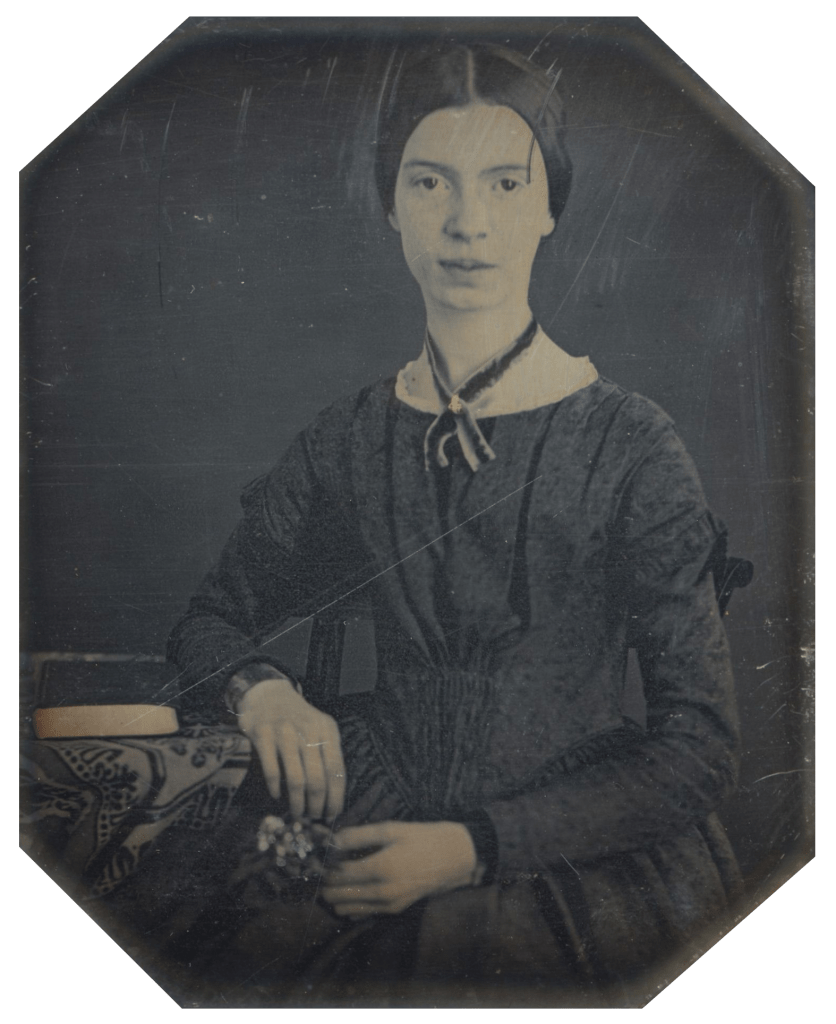
However, without doing so – without first building an unimpeachable case for queerness – queer historians cannot move onto their main premise, whatever it may be, lest it be rejected as mere conjecture, or worse, fantasy. Prove Emily Dickinson was queer, or you can forget about your dissertation entitled “The Lesbian Poems of Emily Dickinson.”

So here we are, trying to please the frowny-faced greybeards who stand guard at the door marked “Serious History.” Maybe, if we say the right words, they’ll let us in?

At some point during my academic career, feeling frustrated and sullied by the constant need to prove that queer people existed without being allowed to say so, I had a revelation:

The ones who need to be convinced by dirty linens are never going to accept my queer little stories anyway.

Why would they? They operate from the assumption that, first of all, the default setting of all human beings is heterosexuality, and therefore, history is straight – the only history that matters, anyway. They will argue that concerning oneself with the sexuality of people from the past is tawdry and trivial, because they believe queerness to be tawdry and trivial. They are the same people who say “I don’t care who you go to bed with” as a way of keeping you in the closet, because for them, queer identity is about who and how you fuck – nothing else.

It might have been because of this revelation that I ultimately became a novelist instead of a historian. But though flawed, queer history is necessary. Urgently necessary. This is evidenced by the volume of outcry against it – the now familiar claims that we, along with Black historians in particular, are “rewriting history,” as if queerness is simply some modern mass delusion that will disappear if we only stop talking about it long enough.

Queer historians are not “rewriting” history any more than human sexuality is being distorted by queer or trans people living openly as themselves. That which has been here all along, buried, suppressed, rejected, erased, is at last being discovered and brought into the story of humankind. We are not rewriting, we are enriching. We are not distorting, we are revealing.

Nowadays, with so many queer terms available to describe ourselves, sometimes it takes a good deal of soul-searching and trial and error before hitting upon one that feels right. But my favourite word is not really a new one. It can be traced back to the early 20th century, but might go back even further.

The word is “family.”

Queer people are a family, and like all families, we stand on the shoulders of thousands of years’ worth of ancestors. As a storyteller, I no longer hesitate to call my ancestors queer. I claim them as queer: for myself, for queer culture, and for my queer brothers, sisters, and siblings, both alive and dead.

One big, weird, queer family – with roots all the way to the centre of the Earth.

By Elvert Barnes (2019) – 15a.QueerMarch.CP.6Ave.NYC.30June2019, CC BY-SA 2.0, https://commons.wikimedia.org/w/index.php?curid=80815194

Sources:

  • Queer City: Gay London from the Romans to the Present Day by Peter Ackroyd
  • Homosexuality in Renaissance England by Alan Bray
  • A Queer Geography: Journeys Towards A Sexualized Self by Frank Browning
  • Gay New York: Gender, Urban Culture, and the Making of the Gay Male World, 1890-1940 by George Chauncey
  • Homophobia by Byrne Fone
  • Sodometries: Renaissance Texts, Modern Sexualities by Jonathan Goldberg
  • Racism and Sexual Oppression in Anglo-America: A Genealogy by Ladelle McWhorter
  • The Changing Room: Sex, Drag, and Theatre by Laurence Senelick
  • Black On Both Sides: A Racial History of Trans Identity by C. Riley Snorton

Featured image: Joseph Brown, drag and vaudeville performer, Gregory & Brown (pictured c. 1902). Wikimedia Commons.