

Last week, I traveled to London to see my book off into the world and to revisit a few of the locations from the novel, some of which I hadn’t managed to see in person since the early days of research. Call it a pilgrimage. While there was no particular requirement for me to visit London last week, it felt wrong not to be there when Lightborne finally hit the shelves in the city that had inspired me for the past 20 years.
Luckily for me, I have a wonderful publishing team at Atlantic Books, who seemed to know exactly how to celebrate the Big Day. After giving me the full star treatment at their offices in Bloomsbury, they swept me off to the legendary and venerable Gay’s the Word, the UK’s oldest queer bookshop, for a signing and some photos.

I can’t begin to express how exciting it was to step behind the desk at Gay’s the Word, a staple in London’s queer community for 40 years – nor, for that matter, can I tell you what went through my head when I first saw Jim and Uli putting Lightborne on the shelves. There was such a whirlwind of emotions that the only moment I remember with true clarity is when I sat down to do my signing and noticed a picture of queer artist, author, AIDS activist and personal hero David Wojnarowicz looking down on me from the wall above. There came a singularly strange, out-of-body sensation, as if I were watching myself from across the room.
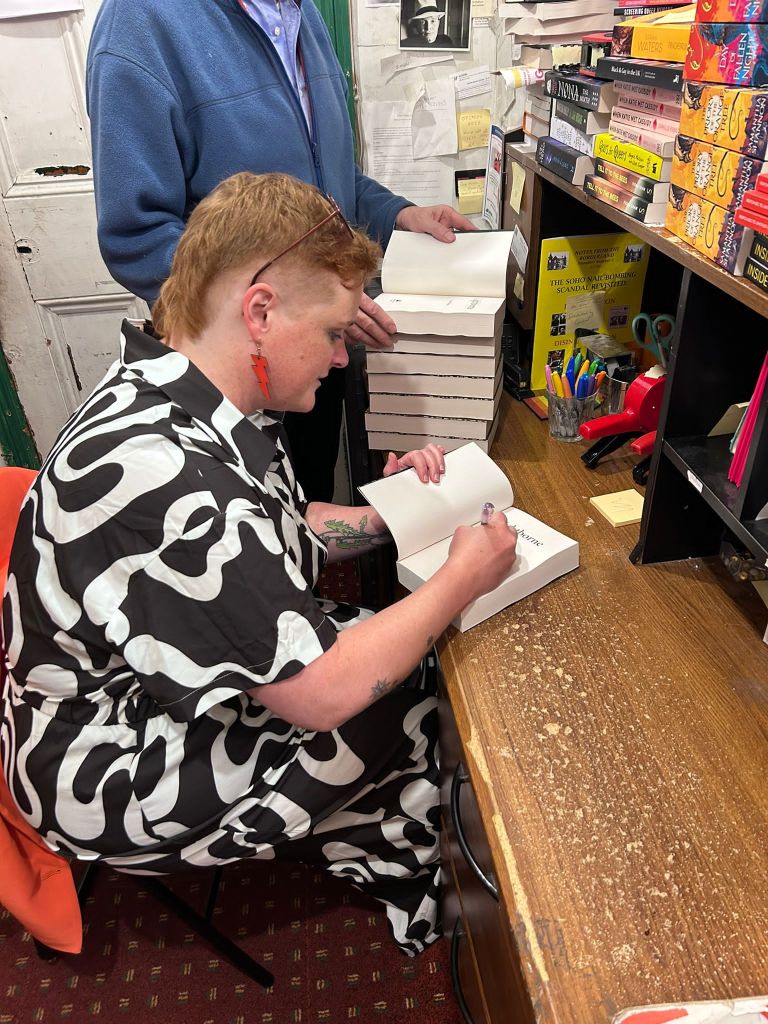
It’s one thing to write about history, quite another to touch it. To enter it, even, for the briefest of moments. Gay’s the Word is one of those places made all the more sacred by having survived so many attempts to destroy it, much like the queer community it serves. Opened on the brink of the AIDS crisis, raided under “obscenity” laws, threatened with closure, its tenacity in the face of hardship and ignorance is every bit as inspirational as the lives of people like Wojnarowicz and his contemporaries Keith Haring, Candy Darling, Angie Xtravaganza, Peter Hujar, Marsha P. Johnson and Sylvia Rivera – every bit as inspirational as a life like Kit Marlowe’s, queer before “queer” was even a thing. I don’t know whether it’s possible to top the feeling of knowing that I have my own little corner in such a space, for however long it lasts.

As part of promotional efforts, while in London I also had to take myself and my very patient wife on a tour of locations from the novel in order to record some short videos, which I will hopefully post in the future. Despite the destruction wreaked on London by the Great Fire of 1666 and the Blitz, you can still visit numerous places that existed during Marlowe’s lifetime, from the Church of St. Helen’s, Bishopsgate to Southwark Cathedral, not to mention Marlowe’s final resting place in the yard of St. Nicholas’s Church, Deptford – a living archive to mine for gold.
Not all have survived exactly as Marlowe might have remembered them, but sometimes the traces left behind feel still realer than brick and mortar, straddling the line between story and substance. Just down the street from Shakespeare’s Globe on Bankside lies an ordinary looking office block with an extraordinary secret in the cellar – the ruins of the Rose Playhouse, the setting of Lightborne’s opening scene:
The curtains part, cutting a gash of daylight through the backstage gloom. Beyond, the Rose Playhouse appears, a vortex of timber and plaster and densely packed humanity that reels upwards, three stories, to a dilated eye of cloud-streaked sky.
The Rose, brainchild of entrepreneurs Philip Henslowe and John Chomeley, was the earliest of London’s theatres to take on the now iconic, polygonal form later echoed by the Swan and the Globe. It opened in 1587 and existed just into the 17th century, hosting the first performances of most of Marlowe’s plays and many of Shakespeare’s. Its performance and financial records, scrupulously recorded in a small leatherbound book by manager Henslowe, comprise some of the most important documentary evidence of theatrical activity during the Elizabethan period. Perhaps most famously, the Rose was recreated for the Oscar winning film Shakespeare In Love.

After lying buried in the Bankside mud for four centuries, the Rose came to light again in 1988 when building works exposed its remarkably well-preserved foundations. But although the playhouse’s discovery was initially met with a flurry of excitement from theatre makers and devotees, writers, archeologists and historians, the Rose has long lain in hibernation while funds are raised to resume the excavations cut short in 1989. In the meantime, the remains of Shakespeare and Marlowe’s first theatre remain mostly dormant, lovingly cared for by a team of volunteers and archeologists, subsisting on charitable donations and high-profile benefactors such as Dame Judi Dench and Sir Ian McKellen. Last Saturday, for the first time in ten years, I was able to see it again.

It may not look like much. Due to their centuries spent buried in the Thames’ anerobic mud, the Rose’s foundations must now be kept underwater to forestall decay. Thus, what you see when you enter the former dig site is a pit of raw earth enclosing a dark, shallow pool. Beneath the water’s unnervingly still surface, strings of red light outline the footings of the stage and the yard, throwing an eerie glow onto the steel beams that crush down from overhead. It is cold inside, damp-smelling and dim, lending the space a grave-like atmosphere.
But far from diminishing the Rose’s power, the sepulchral surroundings have a strange way of imbuing it with all the hushed, unearthly hauntedness of an ancient site of pilgrimage. Contrast the chilly silence with the roar of the crowds that came centuries ago, and you can’t help but imagine yourself in the company of many thousands of restive ghosts – maybe Kit Marlowe’s among them.
My hope, of course, is for the Rose to come alive again, however affecting it may be in its current state. Previous excavations carried out on the site were performed hastily and under constant threat of foreclosure by developers, meaning that there’s still much left to uncover. In addition, plans are underway on The Rose Revealed Project, a proposed visitor’s centre, performance space and museum which will preserve the Rose for generations to come. Though there’s an enormous, money-shaped hurdle still to climb, I’m hopeful that those plans will come to fruition – and I sincerely hope all this might inspire someone out there to support the project.
Today, the Rose Playhouse sleeps again, awaiting its next day in the spotlight. A signed copy of Lightborne sits in the front window of Gay’s the Word, gleaming spectacularly gold in the afternoon sun. (May it find a loving home!) And all I can do is wait and see.


 HESSE PHILLIPS