Lightborne Updates: UK Paperback Sneak Peek

I can’t help but want to talk about perhaps too many things in this post, as I know many of us are still reeling after last week. Perhaps shocked and blindsided, perhaps proven right in the worst way possible, perhaps teetering just above despair. Anyone celebrating is invited to leave at this point. Anyone lashing out, lighting fires, throwing blame at those more vulnerable than themselves, screeching “I told you so” as they rub salt into others’ open wounds, is invited to seek therapy.

It feels very strange and not a little delusional to be talking about my book at a time like this. Not that it doesn’t feel strange to talk about the future at all, given how little we can say for certain about it, other than that things look bleak. They certainly look bleak if, like me, you are a queer author who writes queer books. As I discussed at length in my previous blog post, we could easily be entering a dark age in terms of art and literature, an age in which books like mine will become hotly contested objects. But it’s one thing to worry about whether or not your book might still be legal in your home country a year from now, quite another to worry whether you, as a human being, will also be legal: your marriage, your passport, your family, your friends, your livelihood, your joy, your resistance, your thoughts, your dreams.

However, as a number of other queer authors have also pointed out, there’s no sense whatsoever in backing down before the fight has even truly begun. We are already tired, especially those of us who have been targeted before, but I hope we are far from giving up. Now is a time for those of us who can afford to be loud to scream with all our might.

Knowing my history as a queer person is a double-edged sword, because I’ve seen my community in its darkest hour, but I’ve also seen us emerge from that darkness, again and again. Whatever is coming, we have every right to feel dread in the pits of our stomachs, but also every reason to believe we will find ways to survive it. As Marlowe says in Lightborne, “to live is a form of vengeance, when so many have sought to destroy you.”

As long as humanity lives, we live. I’m sure it drives those who hate us crazy.

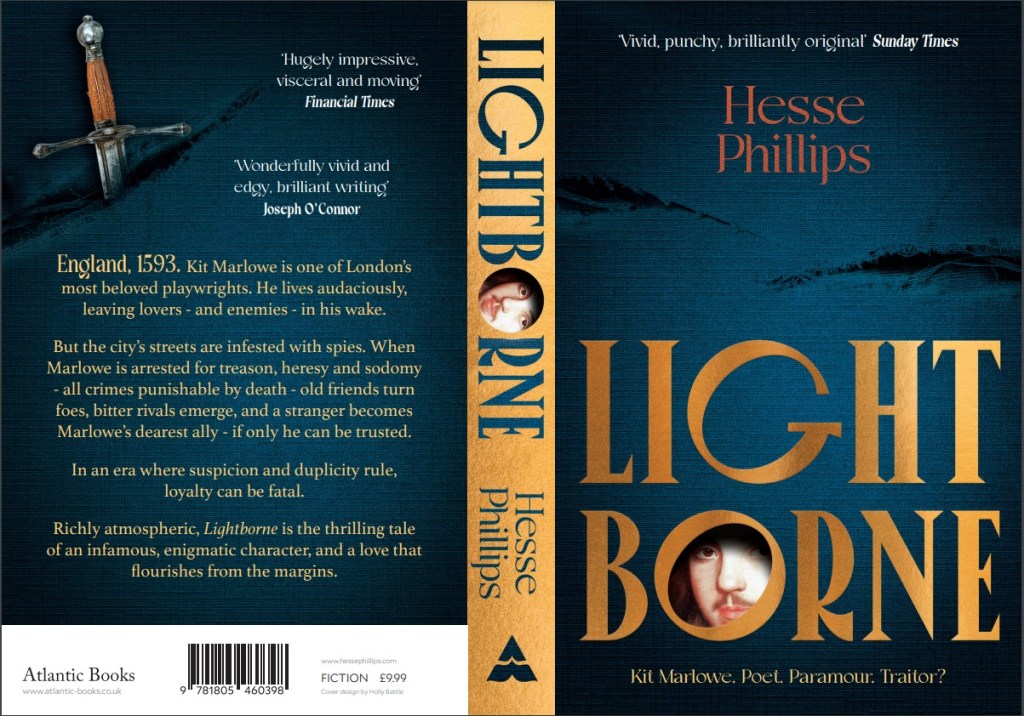
All that said, I’m extremely lucky to have exciting things to look forward to in 2025, among them the paperback launch of Lightborne in the UK. Come what may, in March there will be a whole new edition of the book out in the world, with a stunning new cover to rival the old one.

And now, without further ado:

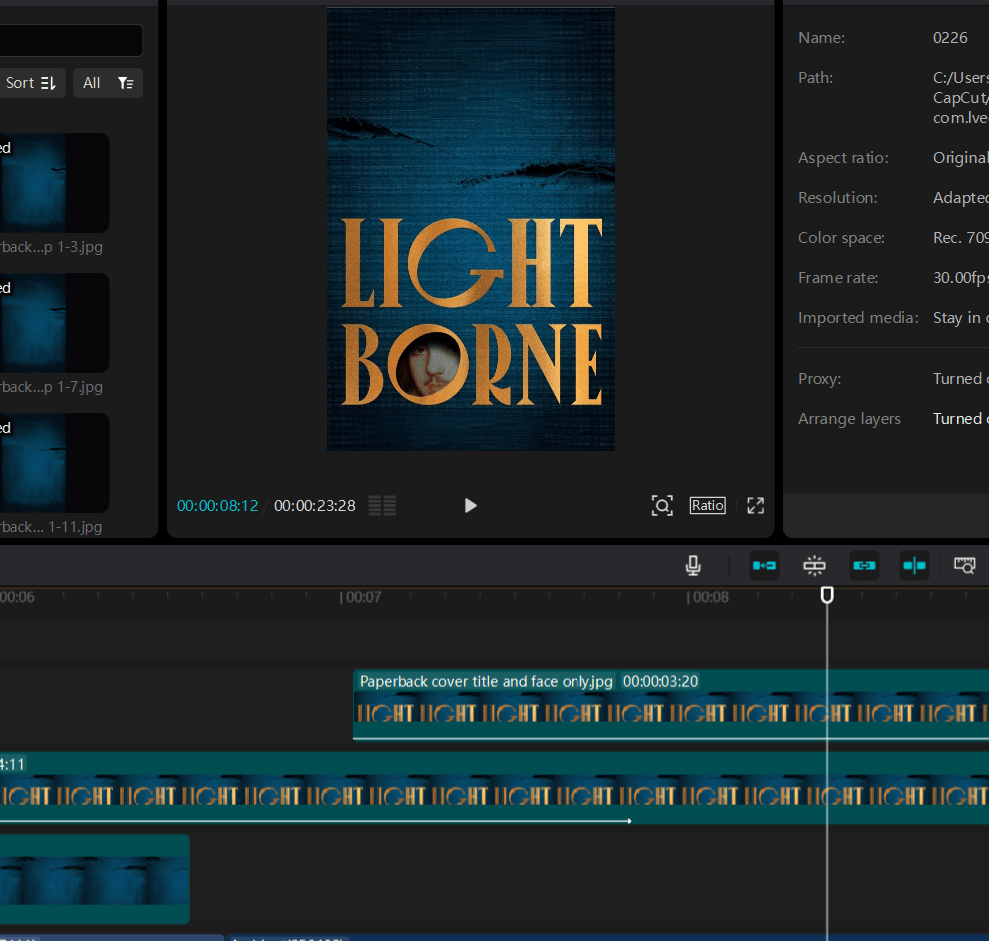
Courtesy of Atlantic Books

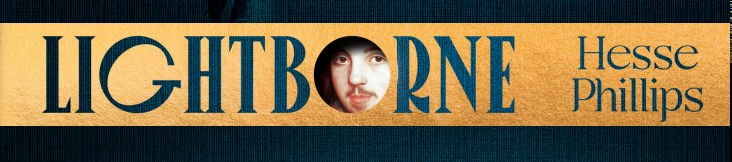
We still have the beautiful gold accents that gave the original cover such a bold presence on the shelf, but now with a much darker, moodier atmosphere, and even a subtle appearance from Kit Marlowe himself. I chose this design among several options – it wasn’t easy, as they were all impressive – but I loved this one for that rich blue tapestry background, and the vintage feel of the design.

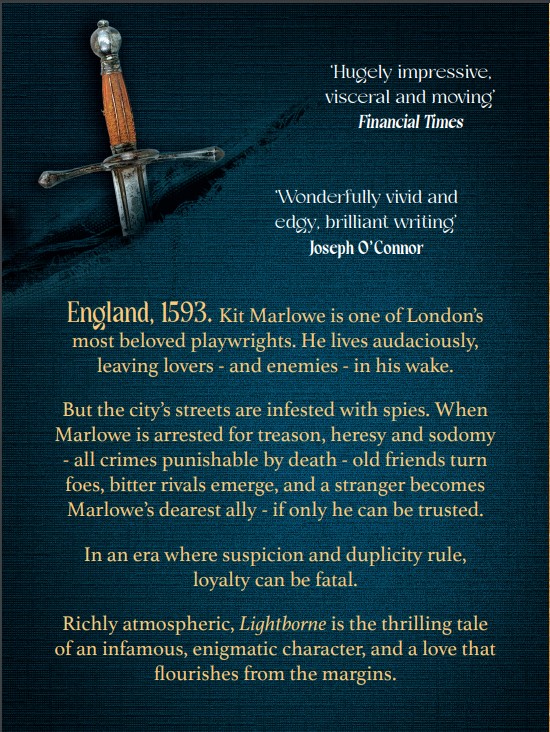
The back cover, I should add, is equally gorgeous:

Courtesy of Atlantic Books.

Those who have read the book already will surely recognize Frizer’s knife peeking out! I fought for that knife, I will say, and I’m so glad I did. Authors – this is me advising you to fight for things you want on the cover. You might not get them, but you’ll have no regrets.

I’m beyond excited to see the paperback in its full glory, as I hope readers will be as well. Whatever dangers are barreling down at us from the future, I hope we’re able to find reasons to stay excited and engaged. After all, the world desperately needs that from us. Our anger and outrage is necessary, but so is our hope, our creativity, our joy.

It might mean the difference between simply getting through whatever comes next, and doing the work that desperately needs to be done: of building a better world than the one we started with.

Research Diary #2: Becoming “Queer”

(CW: This post contains the f-slur, as well as historical terms for queer people that are offensive today.)

For those who don’t know, in a former life I was a theatre historian, but I began my academic career studying queer history.

Now, even having left academia behind, I’m still writing queer history. Only fictionalized. Historians are storytellers – it’s right there in the name – I’ve simply found myself more at home with a slightly different form of storytelling.

I just can’t quit queer history. (Sorry.) For me, it’s like genealogy – not merely an attempt to reconstruct lives from the past, but in a way, to actively construct my own identity. Every time I learn about a queer person from the past, no matter where or when they are from, I feel like I am meeting my own long-lost family.

There’s just one thing about the practice of queer history that never sat right with me.

I could be reading about a writer, a general, a pirate, a dedicated breeder of cows – it doesn’t matter. If the person I’m reading about was queer, or is believed to have been queer, and was alive at any time before, say, 1900, the author will have included a little disclaimer in their article that always goes a bit like this:

“In discussing the life of X, we have been careful only to talk about them in terms of queer behaviour, not as a queer person. We must not conflate sexuality with identity, which of course doesn’t happen until Freud and his whole deal. Besides, since the word ‘homosexual’ didn’t exist until the 1860s, and was barely known until decades later, we obviously can’t describe anyone alive before then as ‘homosexual,’ let alone ‘queer!’”

That’s it. Open up a brand new book about a queer historical figure and there it is, like a bad penny. I call it the “In the beginning, there was the Word” Fallacy. ITBTWTWF.

The first flaw in this logic is that actually, things are not created with the Word. Words are created to describe things that already exist.

To talk about the other reasons why this disclaimer is problematic at best, we have to go way, way back in time, to long before the word “homosexual” was even a twinkle in some Hungarian guy’s eye.

Because, “homosexual” was not the first word invented that described a queer person.

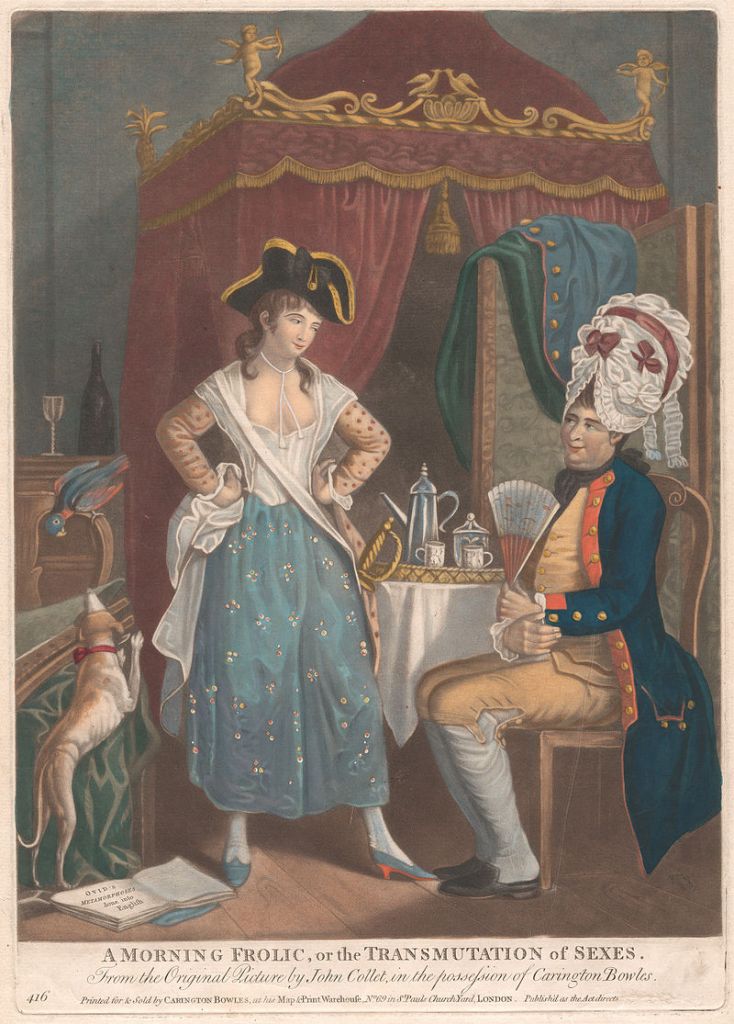
“A Morning Frolic, or the Transmutation of the Sexes,” satirical cartoon depicting crossdressing by John Collett (1780) – http://collections.britishart.yale.edu/vufind/Record/3633908, Public Domain, https://commons.wikimedia.org/w/index.php?curid=45273164

Before “homosexual,” queer people had been called or called themselves “Uranians,” “fairies,” “fribbles,” “jemmies,” “queans,” “mollies,” and “Ganymedes,” to name just a few. The term “lesbian” has been around since the 18th century, as has “tommy” (the original “butch”), “tribade,” “sapphic,” and the rather visual “friccatrice” (“One who rubs”). Queer people could speak to one another in codes and secret languages. They could tap a friend on the shoulder and ask, in a whisper, about a mutual acquaintance, “Is he earnest?” Or “Is she musical?”

“Are they family?”

The fact that all of these terms and codes were considered slang should not rob them of their legitimacy as words for both queer behaviour and queer people. In fact, they are all rare, precious things, rescued from the dust-bin of history through a combination of luck, and changing circumstances in English literacy.

In England, prior to the time of Henry VIII, literacy was largely inaccessible for all but a privileged few. But following the introduction of public schools (for men, at least), we begin to see a much higher incidence of slang terms entering the written record. Ordinary people who previously could not tell their own stories now had access to the most powerful technology on earth at that time – a pen and paper – and could write in the language of the street, the pub, the marketplace.

Such was the world wherein queer communities were able to thrive: criminalized as a class of “vagabonds and sturdy (i.e., false) beggars,” many queer people made their living as sex workers and performers, jobs that allowed them to build relationships with others like themselves. Their stories survive in legal records and prison lists, but also in plays and poetry, perhaps most famously in The Roaring Girl (c. 1610) by Thomas Dekker and Thomas Middleton, which dramatized the life of gender nonconforming local celebrity Moll “Cutpurse” Frith, and put numerous slang terms in writing for the very first time.

Moll Frith pictured on the quarto cover of The Roaring Girl (1611)
Public Domain, https://commons.wikimedia.org/w/index.php?curid=18269007

Because of their gradual inclusion in the written record, we now know some details about the lives of queer early moderners. In London, they gathered in particular neighbourhoods and houses, often located in “red-light” districts or near performance venues like Whitefriars or Paris Garden. From the 1700s, we have eye-witness accounts of clandestine competitive drag balls and gender-bending spectacles held in the so-called “Molly Houses” where queer men gathered.

Combining the medieval Lingua Franca with the underground dialect known as Thieves’ Cant, early modern queer people even developed their own complex language, Polari, as a way of communicating between each other without being understood by outsiders. Polari had such staying power that it is still spoken by some even today.

If that is not a community, a culture, a people – I don’t know what is.

Now, let’s jump ahead a bit – about three hundred years – to around the time that “homosexual” first pops up. Where did it come from, and why?

This story is full of twists and turns, so strap in…

Towards the end of the sexually repressive 19th century, after hundreds of years in which queer sex was heavily criminalized, things began to change – if not for queer people, then for Western society at large. The rise of the middle class, the end of slavery in the United States, and the Women’s Suffrage Movement (among other things), lead to growing anxieties within white academic circles about the “degeneration” of the human race – specifically, the white race.

While, in this view, non-white people certainly posed a threat to white racial purity, many believed an even greater threat came from within: white people who did not play by the “rules” of sex and gender.

But now that there was a white middle class to maintain, you couldn’t just… hang queer people anymore. A new age required new solutions to the problem of queerness, new words to describe it. Fortunately for the Victorian morality and racial purity police, a revolution in the study of the human psyche was underway on the European Continent: the rise of psychology.

The earliest psychologists called themselves “alienists.” Not because they studied aliens, har-de-har, but because their main interest was in studying those who were “alienated” from society. Naturally, the alienists found plenty of fertile ground (and deep pockets) amongst middle- and upper-class white queer people, many of whom were desperate to cure themselves of their “affliction.”

Rather than seeing queer people as simply monstrous criminals, early psychologists proposed that queerness – or rather, again, queer behaviour – should be reclassified as a mental disease.

They named this new illness “Homosexuality.”

First known use of the word “homosexual” in a letter written by Karl Maria Kertbeny (1868)
By Unknown author – http://www.geheimsache.at, Public Domain, https://commons.wikimedia.org/w/index.php?curid=539078

But early psychologists did not invent the word. Poetically, perhaps, it was stolen. Coined by Hungarian author and queer rights campaigner Károly Mária Kertbeny (who also coined “heterosexual”), “homosexual” was conceived to describe an “innate and unchanging” sexual identity. Fed-up with having to choose between “vulgar” slang terms and vicious slurs to describe himself, Kertbeny hoped that “homosexual” would be embraced by other queer men, but his goal was bigger still: to humanize queerness in the general population, opening the door for the abolition of sodomy laws.

From 2024, maybe we say Kertbeny won in the end. But it was a very, very long game.

Once the medical establishment got their hands on “homosexual,” Kertbeny’s project came to an inglorious end. Soon, it had been redefined to mean “a person suffering from the mental disease of homosexuality.” Homosexuals who repented their condition and aspired to heterosexuality were subjected to conversion “therapies” such as electro-shock, aversion therapy, even lobotomies. But for queer people who did not desire to change, or who failed to adopt a convincing pretence of heteronormativity, the prisons remained open.

As a result of “homosexual’s” connotations, many queer thinkers and writers of the first half of the 20th century utterly rejected the term. After all, why on earth would anyone want to self-define as a mental illness? Famously, queer author, politician and enfant terrible Gore Vidal, who preferred the term “fag” over “homosexual,” argued for a total separation of personal identity from what he termed “sexual acts” – or, to put it in other words, “sexual behaviour.”

Yes, it was a queer intellectual who first advocated for the separation of behaviour and identity. The call was coming from inside the house all along.

But white, cis, middle- to upper-class gay men like Vidal were only the loudest and most visible queers of their time, and historically, those most often subjected to pathologization by the medical establishment. Just across town from Mr. Vidal’s cushy Uptown digs, in Harlem, Brooklyn, and the Bronx, you would find very different attitudes about queer identity.

For nearly one hundred years, Black queer culture had been thriving right under the noses of white New York society.

At venues like The Cotton Club, Connie’s Inn, and Barron’s, Black queer people gathered to dance, drink, hook up, watch gender-bending spectacles and express themselves in a place of relative safety and acceptance. Even as early as 1869, the Hamilton Lodge hosted drag balls which drew crowds of thousands. To build off RuPaul, it was in the grand tradition of the Hamilton Lodge balls that Paris Is Burning was made.

A drag ball hosted at Webster Hall (c. 1920s) By Unknown author – http://gvh.aphdigital.org/items/show/947, Public Domain, https://commons.wikimedia.org/w/index.php?curid=34430528

The reasons why New York’s civil authorities often turned a blind eye towards Black queer culture are enormously complicated, and to no small extent bound up in the racial pseudo-science known as eugenics – essentially, a form of white supremacist racial engineering whose popularity from the late 19th through at least the middle of the 20th century simply cannot be overstated. According to eugenicists, Black people were sexually inferior to whites and naturally “perverse.” Queerness in whites threatened the grand project of eugenics – the building of the white master race – but queerness in Black people did not.

And so, police often let Black queer clubs go about their business. Under this permissive atmosphere, New York City’s drag balls flourished into the Prohibition era, drawing higher and higher numbers of attendees, Black and white, queer and straight. Soon, a fad for “Pansy Clubs” arose, leading to the popping up of drag spectacles all over the country. On a personal note: my grandfather was a drag performer in the 1930s, and plied his trade in the respectable halls of the University of Pittsburgh. He even had his picture taken with the mayor, if that’s any indication of just how normalized it was.

That would be grandpa in the middle (1933). Photo from the author’s collection.

It’s no accident that all this coincided with the Harlem Renaissance, which was not merely a Black movement but also a queer one. Poets, artists, and musicians such as Langston Hughes, Alain Locke, Bessie Smith, Ma Rainey, and Countee Cullen all maintained queer relationships with varying degrees of openness. Singer Gladys Bentley, who performed at the aptly-named Clam House, wore masculine clothing, proudly adopted the term “dyke,” and even married her then girlfriend in a highly publicized civil ceremony.

Gladys Bentley (c.1930), by Anonymous. Unattributed. – This file has been extracted from another file, Public Domain, https://commons.wikimedia.org/w/index.php?curid=108820760

The golden age was not to last, however. By the time Gore Vidal was making his incendiary remarks about queer identity, McCarthyism and the Lavender Scare had swept American queer culture back into the closet. While Black queer people continued to hold drag balls and found gathering spaces like the now iconic Stonewall Inn, they did so in secret, under constant threat of police raids and vigilante mob attacks.

Meanwhile, white, cis, middle- to upper-class gay men like Gore Vidal sought to distance themselves from the queer culture of nightclubs, sex workers, and drag bars, yearning for acceptance in cis-heteronormative society.

To put it another way: they wanted the freedom to engage in queer behaviour, without having to live a queer life.

Today, perhaps, we’d call them “pick mes.”

What I hope is clear from this longwinded but by no means exhaustive history is that people have been living queer lives since long before there was any textbook definition of “queer,” and that the trajectory of queer history has by no means been one long, uphill climb towards the relative freedoms we know today. And, as most queer people will tell you, queerness is absolutely not defined by sexuality and/or sexual “behaviour.” Nor was it ever. We have only found new ways of talking about what was already there, all along.

Queerness is a social code, a manner of existing, a culture and language all its own. It is intensely private and individual but also communal, signalling both inwards and outwards. It evolves, adapts, innovates. It exists everywhere, regardless of whether the wider culture accepts it.

Queerness is connected to all aspects of a person’s humanity. To reduce queerness to mere “behaviour” is an inherently dehumanizing act.

This brings us all the way back to the beginning: the study of queer history.

The problem for queer historians is that history is basically just a big fat record of human behaviour. Often, a researcher’s first task in writing queer history is to prove that something queer happened, usually by taking an individual or group and exposing whatever might be known of their sex lives, scrutinizing their manner of dress, the people they associated with, things they either said or wrote, in search of evidence. In doing so, we become the Victorian morality police, sniffing around someone’s dirty linens in attempt to “out” them. It feels distasteful, to say the least.

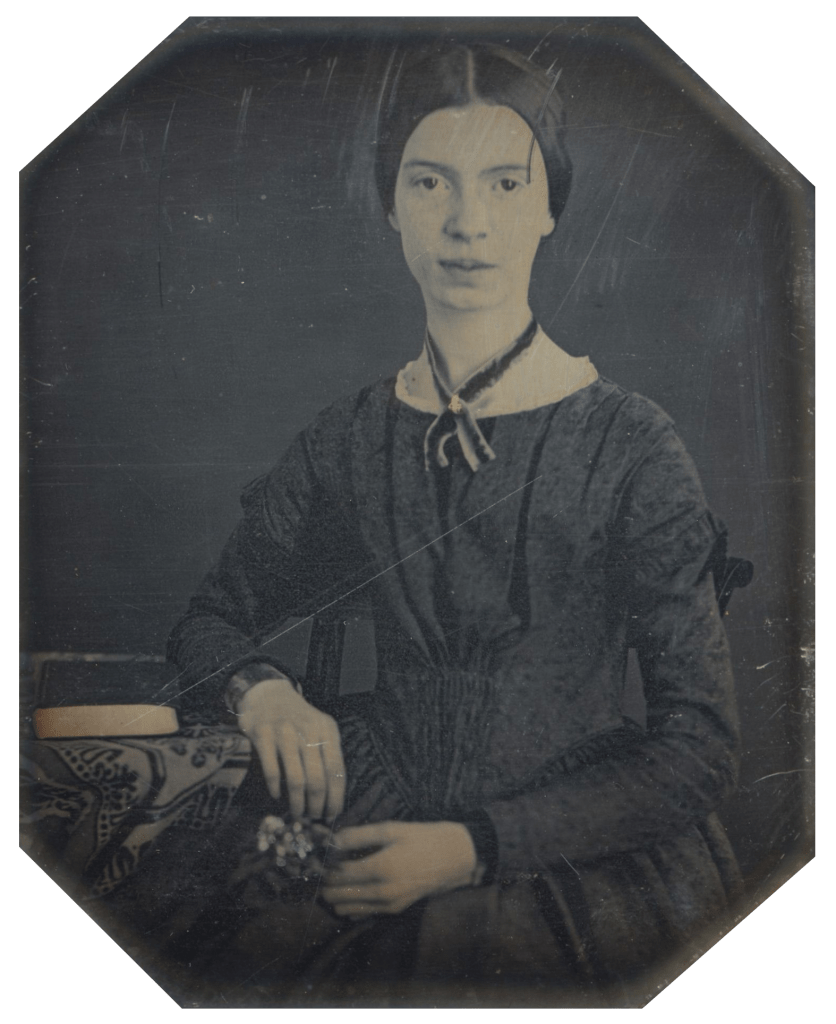
However, without doing so – without first building an unimpeachable case for queerness – queer historians cannot move onto their main premise, whatever it may be, lest it be rejected as mere conjecture, or worse, fantasy. Prove Emily Dickinson was queer, or you can forget about your dissertation entitled “The Lesbian Poems of Emily Dickinson.”

So here we are, trying to please the frowny-faced greybeards who stand guard at the door marked “Serious History.” Maybe, if we say the right words, they’ll let us in?

At some point during my academic career, feeling frustrated and sullied by the constant need to prove that queer people existed without being allowed to say so, I had a revelation:

The ones who need to be convinced by dirty linens are never going to accept my queer little stories anyway.

Why would they? They operate from the assumption that, first of all, the default setting of all human beings is heterosexuality, and therefore, history is straight – the only history that matters, anyway. They will argue that concerning oneself with the sexuality of people from the past is tawdry and trivial, because they believe queerness to be tawdry and trivial. They are the same people who say “I don’t care who you go to bed with” as a way of keeping you in the closet, because for them, queer identity is about who and how you fuck – nothing else.

It might have been because of this revelation that I ultimately became a novelist instead of a historian. But though flawed, queer history is necessary. Urgently necessary. This is evidenced by the volume of outcry against it – the now familiar claims that we, along with Black historians in particular, are “rewriting history,” as if queerness is simply some modern mass delusion that will disappear if we only stop talking about it long enough.

Queer historians are not “rewriting” history any more than human sexuality is being distorted by queer or trans people living openly as themselves. That which has been here all along, buried, suppressed, rejected, erased, is at last being discovered and brought into the story of humankind. We are not rewriting, we are enriching. We are not distorting, we are revealing.

Nowadays, with so many queer terms available to describe ourselves, sometimes it takes a good deal of soul-searching and trial and error before hitting upon one that feels right. But my favourite word is not really a new one. It can be traced back to the early 20th century, but might go back even further.

The word is “family.”

Queer people are a family, and like all families, we stand on the shoulders of thousands of years’ worth of ancestors. As a storyteller, I no longer hesitate to call my ancestors queer. I claim them as queer: for myself, for queer culture, and for my queer brothers, sisters, and siblings, both alive and dead.

One big, weird, queer family – with roots all the way to the centre of the Earth.

By Elvert Barnes (2019) – 15a.QueerMarch.CP.6Ave.NYC.30June2019, CC BY-SA 2.0, https://commons.wikimedia.org/w/index.php?curid=80815194

Sources:

  • Queer City: Gay London from the Romans to the Present Day by Peter Ackroyd
  • Homosexuality in Renaissance England by Alan Bray
  • A Queer Geography: Journeys Towards A Sexualized Self by Frank Browning
  • Gay New York: Gender, Urban Culture, and the Making of the Gay Male World, 1890-1940 by George Chauncey
  • Homophobia by Byrne Fone
  • Sodometries: Renaissance Texts, Modern Sexualities by Jonathan Goldberg
  • Racism and Sexual Oppression in Anglo-America: A Genealogy by Ladelle McWhorter
  • The Changing Room: Sex, Drag, and Theatre by Laurence Senelick
  • Black On Both Sides: A Racial History of Trans Identity by C. Riley Snorton

Featured image: Joseph Brown, drag and vaudeville performer, Gregory & Brown (pictured c. 1902). Wikimedia Commons.