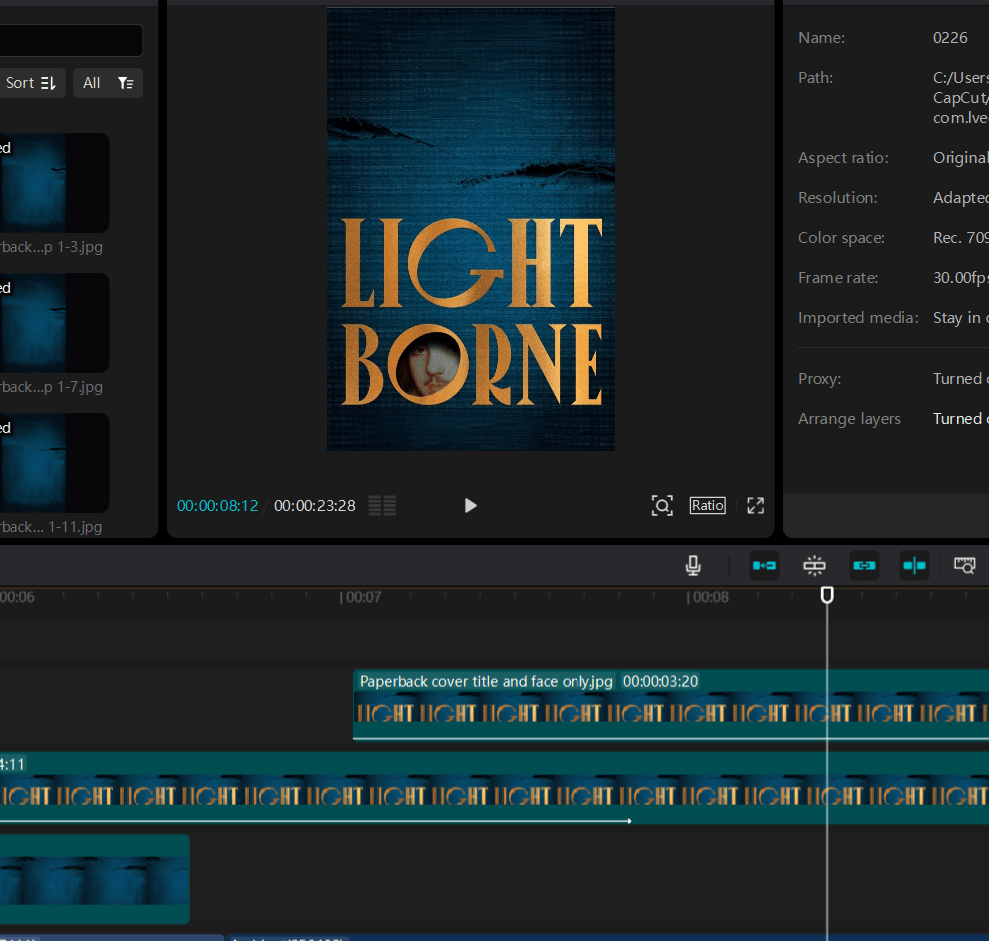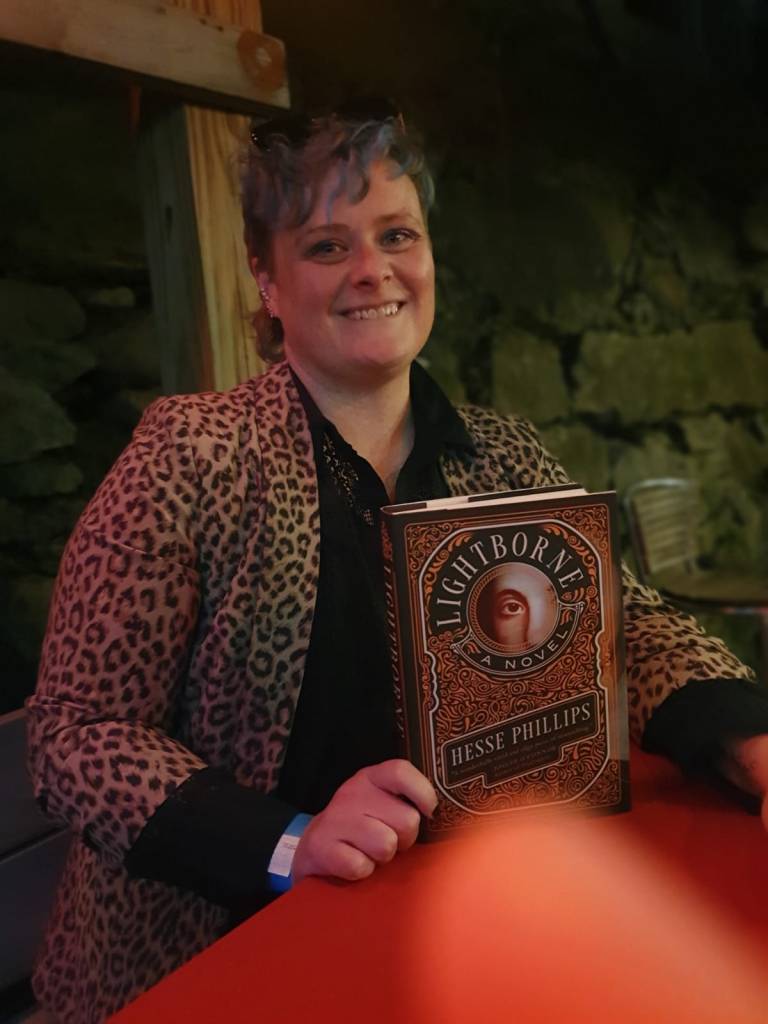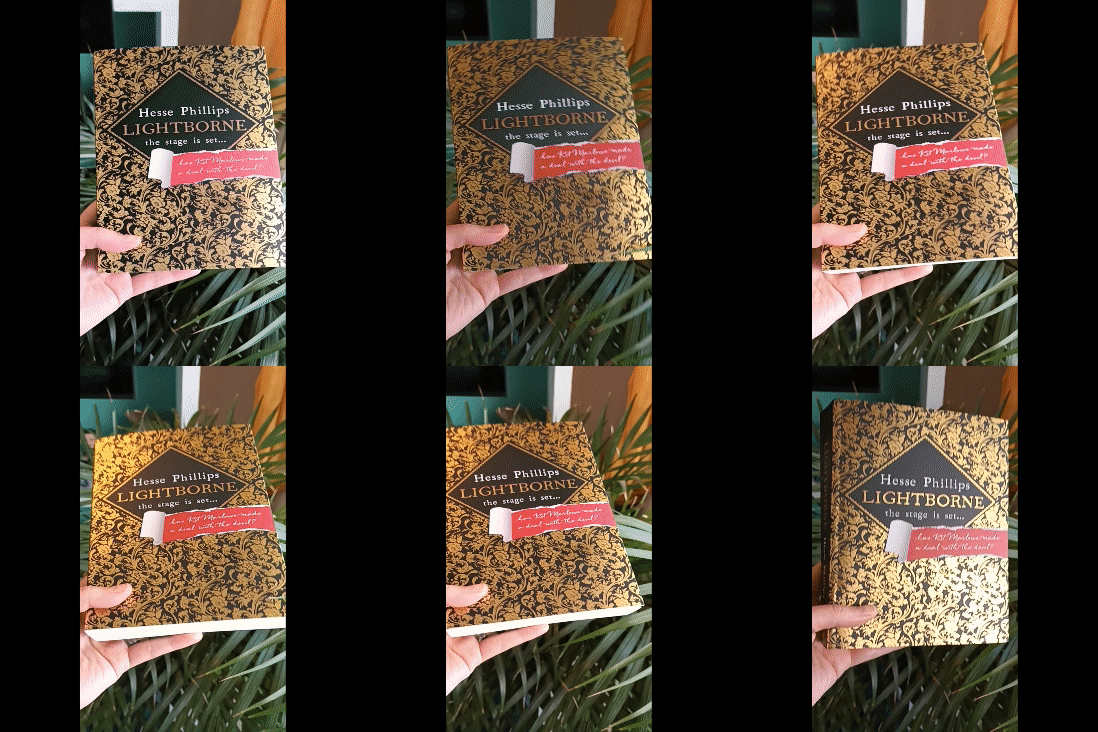
Today is filled with all the usual excitement, expectation, and nail-biting dread of every milestone I’ve faced thus far in this weird business of being a published author. However, today also marks a bittersweet end of the road in my publishing journey. Unless I pull a Pachinko within the next year or two, this will be the last UK pub day Lightborne ever gets.
I loved this book. I worked on it through my 20s and 30s, and into my 40s. It was a way of life for so long that tearing myself away from it took nearly as much discipline as writing the damn thing. Now I’ve moved on, and it already feels distant at times, but the lessons I learned in writing it will hopefully stick with me forever.
I’ve been living a weird double-life over the past two years, embarking on my next book while my first was making its international debut by slow stages. In the beginning, transitioning away from a book I knew so well I could set the characters free in the maze of my head and simply sit back and “observe” them was painful at times. After two years, I still don’t know my new cast of characters that well, although I am getting closer. It’s a strange feeling to be back in a part of the writing process which I last experienced so long ago it’s only a distant memory for me, leading me to second-guess myself – to think I’m doing it wrong. Connecting with other writers is keeping me grounded, but I already can’t wait to be in the 15th or 20th revision again, at the point where “mess becomes book.”
Those are some of my most treasured memories of Lightborne, even now. While publication is exciting and vindicating, it’s also a lengthy process of letting go. And while I still love “my boys” – even the wicked ones (looking at you, Poley) – I will never again experience that sense of mutual habitation that came with writing their story. This is what people mean, I suppose, when they talk about being visited by the Muse: a collaboration between me and the imaginary beings I’ve created, acting not independently of me (obviously) but in ways I can’t entirely explain. People also call writing a lonely profession, but when the writing is going well, it’s anything but.
So I’m a bit sad, but very excited to keep working, keep writing, and celebrate not the last, but the first of many last, glorious voyages of my debut into the world, with hope that it will find readers who will love it and need it as much as I did.
I must admit I love a good paperback. Smaller, lighter, easy to carry, a paperback book feels like a close friend. I love the subtly textured surface and faint newsprint smell of the paper, and the way the spine of a truly beloved paperback becomes grooved and whitened with age. Hardbacks are great and all, don’t get me wrong – but a paperback is a living thing.
So naturally I was giddy with excitement when my complimentary author’s copies of the forthcoming Lightborne paperback edition showed up at my door the other day. I’ve seen PDFs of the new cover and therefore thought I knew what I was getting into when I opened the box, but no PDF could possibly do it justice.
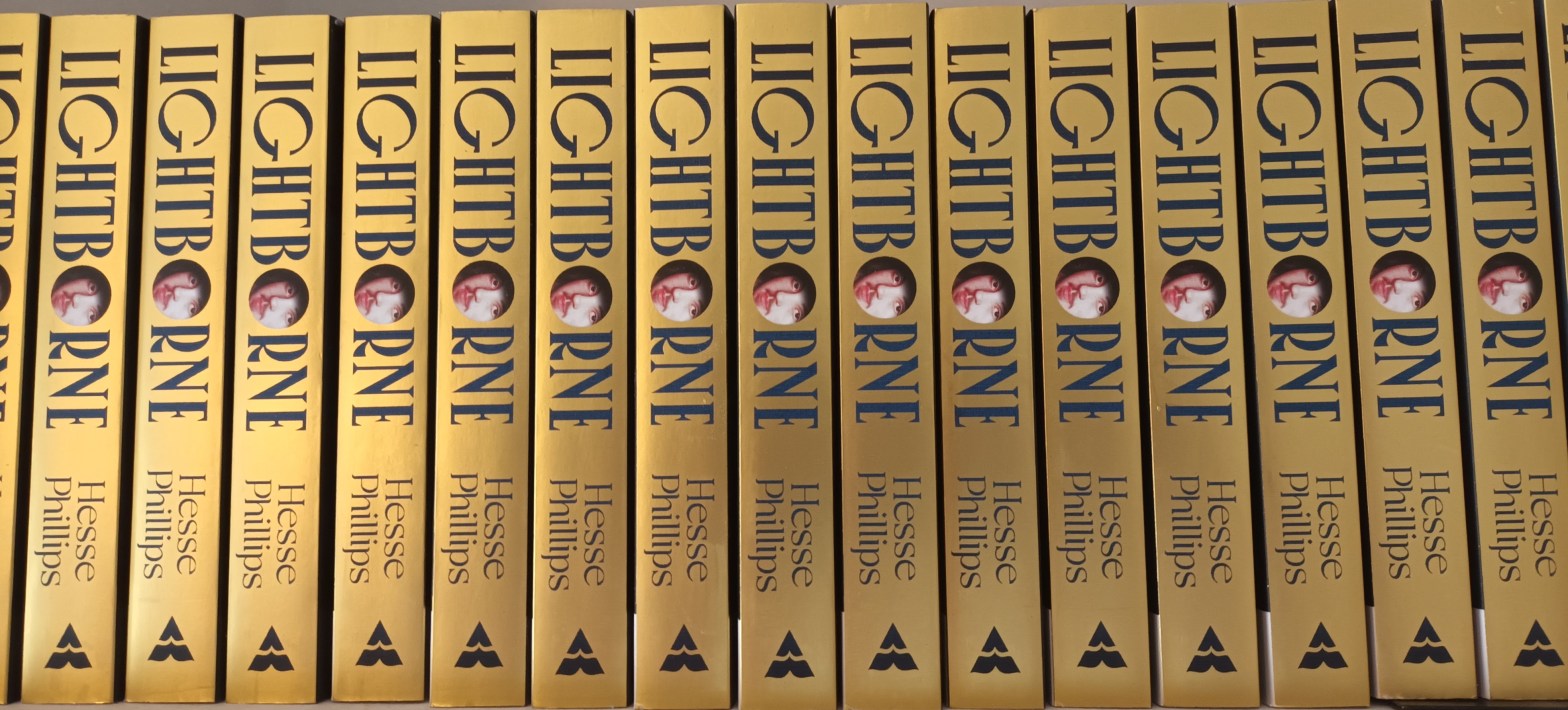
I think someone in the design department at Atlantic Books must have heard me going on and on about how much I loved the gold on the “deluxe” edition cover from last year, because they went all-out with it. Believe me when I tell you, this baby glows.
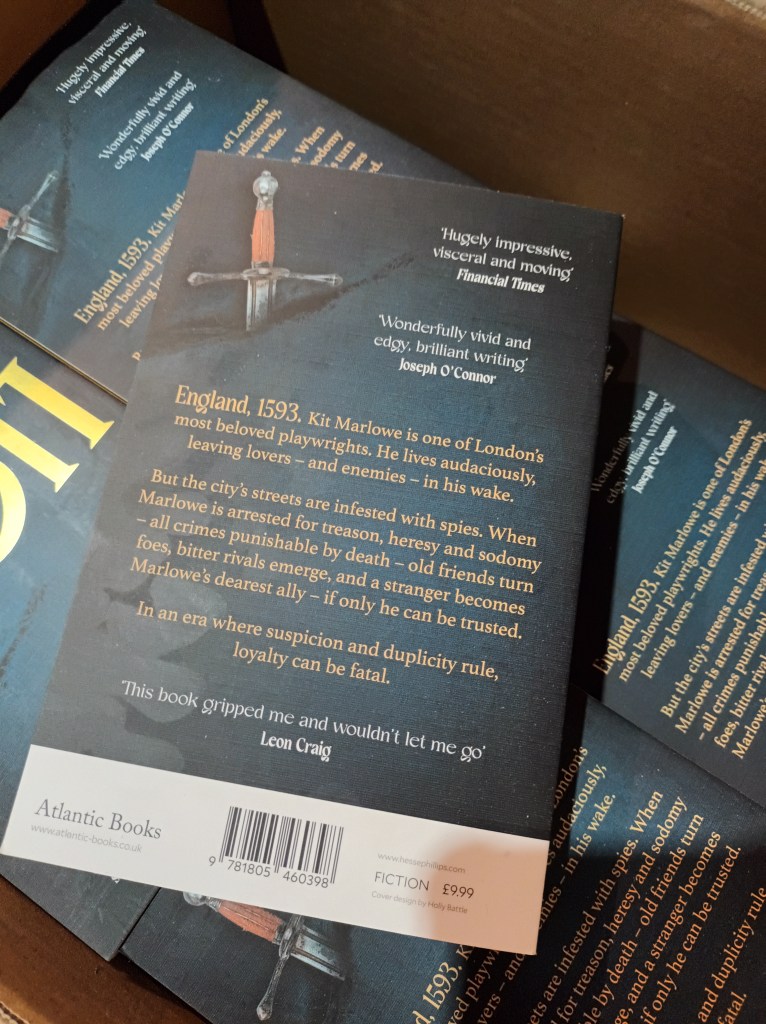
And it looks pretty great from the back too.
With the official paperback launch date set for 6 March, preorders are of course available (and encouraged!) But for those who prefer ebooks, the ‘Zon is also running a Kindle Deal on Lightborne for the month of February, where you can score a copy for just £2.19.
It should probably go without saying that all of this is coming at an exceedingly weird time, particularly yet not exclusively if you’re American like myself, and particularly yet not exclusively if you happen to also be queer, and writing queer books, and plan to continue being and doing all of those things for as long as you have breath in your body. I am glad, at the very least, that I made some difficult but necessary decisions to start out the year, and intend to carry that energy with me into whatever comes next.
The intersection of my self and my obsession with history means I cannot avoid writing about queer survival under truly intolerable conditions – history is sadly saturated with them. It also means, of course, that not everybody makes it out alive, and those that do emerge scarred, battered, and at least a little bit broken. But we will always have a future, even in the bleakest of times. History may often show us in our darkest hour, but it also offers hope: we’ve always been here, and will always be here.
For me, the most important words I wrote in Lightborne were these:
You must live because I love you – because you must be avenged – because to live is a form of vengeance, when so many have sought to destroy you.
Sometimes it comes down to that: staying alive. Because us staying alive really pisses off the ‘phobes.
And if I’ve learned anything about myself this year, it’s that I get a kick out of pissing off ‘phobes.
I can’t help but want to talk about perhaps too many things in this post, as I know many of us are still reeling after last week. Perhaps shocked and blindsided, perhaps proven right in the worst way possible, perhaps teetering just above despair. Anyone celebrating is invited to leave at this point. Anyone lashing out, lighting fires, throwing blame at those more vulnerable than themselves, screeching “I told you so” as they rub salt into others’ open wounds, is invited to seek therapy.
It feels very strange and not a little delusional to be talking about my book at a time like this. Not that it doesn’t feel strange to talk about the future at all, given how little we can say for certain about it, other than that things look bleak. They certainly look bleak if, like me, you are a queer author who writes queer books. As I discussed at length in my previous blog post, we could easily be entering a dark age in terms of art and literature, an age in which books like mine will become hotly contested objects. But it’s one thing to worry about whether or not your book might still be legal in your home country a year from now, quite another to worry whether you, as a human being, will also be legal: your marriage, your passport, your family, your friends, your livelihood, your joy, your resistance, your thoughts, your dreams.
However, as a number of other queer authors have also pointed out, there’s no sense whatsoever in backing down before the fight has even truly begun. We are already tired, especially those of us who have been targeted before, but I hope we are far from giving up. Now is a time for those of us who can afford to be loud to scream with all our might.
Knowing my history as a queer person is a double-edged sword, because I’ve seen my community in its darkest hour, but I’ve also seen us emerge from that darkness, again and again. Whatever is coming, we have every right to feel dread in the pits of our stomachs, but also every reason to believe we will find ways to survive it. As Marlowe says in Lightborne, “to live is a form of vengeance, when so many have sought to destroy you.”
As long as humanity lives, we live. I’m sure it drives those who hate us crazy.
All that said, I’m extremely lucky to have exciting things to look forward to in 2025, among them the paperback launch of Lightborne in the UK. Come what may, in March there will be a whole new edition of the book out in the world, with a stunning new cover to rival the old one.
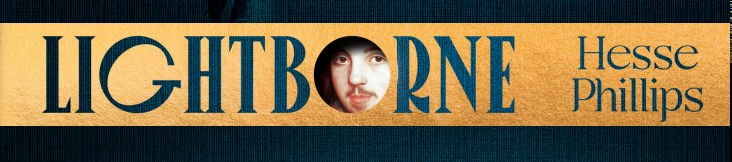
And now, without further ado:
Courtesy of Atlantic Books
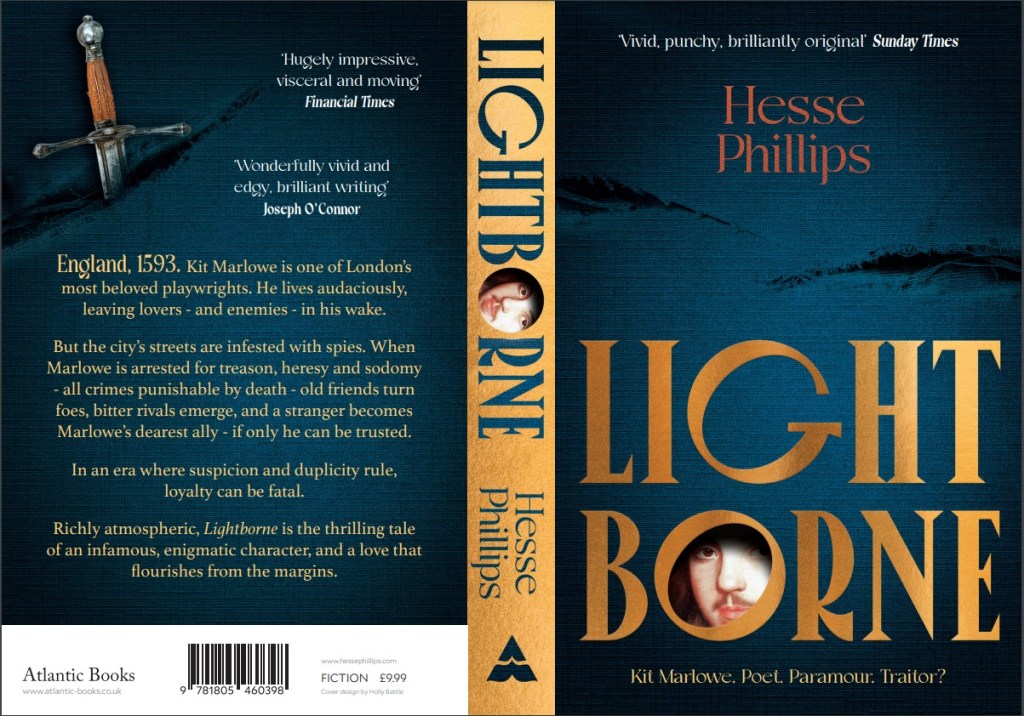
We still have the beautiful gold accents that gave the original cover such a bold presence on the shelf, but now with a much darker, moodier atmosphere, and even a subtle appearance from Kit Marlowe himself. I chose this design among several options – it wasn’t easy, as they were all impressive – but I loved this one for that rich blue tapestry background, and the vintage feel of the design.
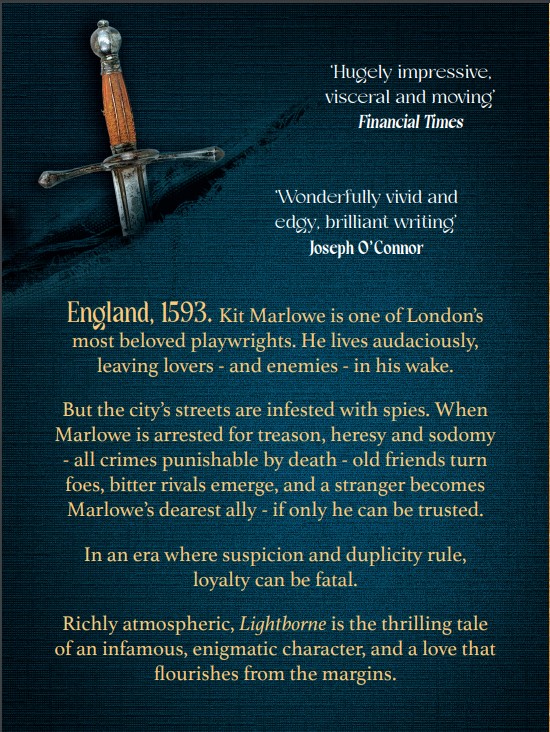
The back cover, I should add, is equally gorgeous:
Courtesy of Atlantic Books.
Those who have read the book already will surely recognize Frizer’s knife peeking out! I fought for that knife, I will say, and I’m so glad I did. Authors – this is me advising you to fight for things you want on the cover. You might not get them, but you’ll have no regrets.
I’m beyond excited to see the paperback in its full glory, as I hope readers will be as well. Whatever dangers are barreling down at us from the future, I hope we’re able to find reasons to stay excited and engaged. After all, the world desperately needs that from us. Our anger and outrage is necessary, but so is our hope, our creativity, our joy.
It might mean the difference between simply getting through whatever comes next, and doing the work that desperately needs to be done: of building a better world than the one we started with.
On the eve of the US presidential election, this historical fiction writer has some thoughts.
CW: Racism, medical abuse, SA
I keep thinking about the several weeks this past summer, just before Joe Biden announced his intention to drop out of the US presidential race, when social media became absolutely flooded with appeals for a return to “precedented” times. Even now, type the word “precedented” into any search bar, and you’ll get thousands of hits, all expressing the same mixture of exhaustion and dread: Free us from nonstop whiplash. Give us boring and predictable.
I understand the sentiment. Our particular historical moment feels uniquely dire. But every time one of these posts pops up in my feed, I can’t help but think that all times have been both precedented and unprecedented, that we exist just as our ancestors did and our descendants will, putting one foot in front of the other as we trudge the treadmill of history. The shape of our times, and of our little lives within them, will inevitably be decided by those who outlive us – a hazard of being situated on the inside rather than the outside of a story.
Were we capable of peeking into future history books, what we’d read about the early 21st century would likely surprise and bewilder us. Possibly, we’d barely recognize ourselves – as would our ancestors, were they privy to our contemporary take(s) on them. Just as myths and folklore evolve over eons – as old tales are rewritten, lost, and rediscovered – history changes wildly based on who is telling the story, and when, and for what purpose. Whether times are precedented or unprecedented is not a matter of fact, but point-of-view.
Still, we, the players on that stage, are not helpless. Our work is in the making of those future historians – in the shaping of that point-of-view. Here and now, we decide what truths will be self-evident in the decades and (hopefully) centuries to come.
Take J. Marion Sims, for example: medical doctor, known as “the Father of Gynecology,” immortalized in statues, medical schools, and public buildings all over the United States. For most of the 130+ years since his death, Sims was lauded as a champion of women, having revolutionized a profoundly neglected field and led the vanguard in techniques ranging from fistula repair to anesthesia. It’s only within the last few decades that Sims’ use of enslaved Black women and girls as test subjects for his agonizing experimental procedures – performed without anesthesia, due to his belief (which many in the medical field still absurdly hold today) that Black people cannot feel pain – began to overshadow his previously spotless legacy.
J. Marion Sims statue located in Columbia, South Carolina. Wikimedia Commons.
The reason why it took so long is that prior to the 1990s, Sims was mainly written about by white men, occasionally white women, for whom Sims’ well documented anti-abolitionist stance, Confederate sympathies, and medical (and possibly sexual) abuse of enslaved women and girls simply made him “a man of his times.”
It took Black women scholars like Durrenda Ojanuga and Harriet Washington to shine a light on the harrowing stories of girls like Anarcha, a thirteen-year-old fistula patient on whom Sims operated without sedation more than thirty times, often before an audience comprised of both medical students and morbidly curious looky-loos. But even prior to these scholars’ work, Anarcha was not some deeply buried secret in Sim’s story. In his memoirs and diaries, Sims himself had painstakingly – and proudly – documented his own mistreatment of Anarcha and other young Black women.
A self-evident truth in the worldview of Sims, and many – too many – who came after him, was that Black lives mattered less. All Black researchers did was simply ask that Anarcha be given full consideration in the story – that she be treated as a human being, not merely a tool for the “hero” to make use of on his journey to immortality. Nowadays, the women and girls who suffered under Sims’ knife are more frequently depicted as the main characters of their own story, appearing in documentaries, plays, paintings, and even, at last, a monument installed in Montgomery, Alabama in 2021, dedicated to “The Mothers of Gynecology.”
Here’s the point: the history we learn about Sims now, in 2024, is immensely different from what was taught just 30 years ago. The past, obviously, did not change. The way we see and understand the past changed, in large part thanks to a wider diversity of voices involved in the researching and shaping of history, and culture in general. Such has led to a slow shift in the way humanity views itself: a long overdue upheaval of who fully “counts” as human in the Western world.
The infuriating truth of the matter is, we are still only at the very beginning of that revolution in thought. The powerful and privileged still look much the same as they did 30 years ago, 130 years ago, 230 years ago, only a tiny minority of whom have plucked up the raw ore of the idea that humanity is a trait equally and innately shared by all human beings, none more or less deserving than any other, and are puzzling over what to do with it. How does this idea fit into their worldview? What’s in it for them?
[Historical fiction] brings you up against events and mentalities that, should you choose to describe them, would bring you to the borders of what your readers could bear. The danger you have to negotiate is not the dimpled coyness of the past – it is its obscenity.
Hilary Mantel, The Guardian, 2009
I can’t be the only historical fiction writer who is also a disillusioned former academic. In a sense, all history is historical fiction, in that all historians make decisions about what to highlight and what to suppress. But there’s a spectrum between “truth” and “straight-up bullshit.” Whether you’re writing literature or academic history depends on where in the spectrum you land, or at least aim to land, which itself depends (rather a lot more than some would like to think) on who you are and what you believe.
Even the most impartial and considerate historian can rarely ever hope to get much further than halfway from bullshit. Read too deeply into almost any subject and you’ll soon discover that “experts” are frustratingly fallible people, prone to contradicting themselves, repeating falsehoods, confusing conjecture for empirical fact, encoding bias into praxis, cherry-picking their sources, etc., etc. It certainly doesn’t help that the field of History has been so long dominated by men first, white men second, and wealthy white men third – demographics generally adverse to challenging one another in any way likely to disturb the overall homogeneity of their precious worldview.
Title page of Thomas Bowdler’s infamous The Family Shakespeare (1818), a heavily expurgated version of Shakespeare’s plays which omitted “words and expressions… which cannot with propriety be read aloud in a family.” Wikimedia Commons.
The Victorians did immeasurable damage in their time, committing just about every academic fallacy under the sun, shoehorning all the terrible and beautiful chaos of human history into prissy parables about the virtues of piety and obedience. It’s frankly criminal that much of the Elizabethan history I studied in school came secondhand from those Bowdlerizing little creeps, forcing me to waste many hours in simply peeling back layer after layer of bias and bullshit in order to reach a kernel of truth, if any had managed to survive. And yet, the Victorians were only “men of their times,” working in the grand tradition of a field developed in service to the moral and martial instruction of aristocratic young boys. “Close your book, Master Algernon, and tell me: what was Xerxes greatest mistake at Salamis?”
Don’t get me wrong – I loved studying history (theatre history, specifically), but decided to write historical fiction instead because I saw a potential in literature to do what scholarship could not: to somehow transcend the narrative imposed by generations of Ivory Tower greybeards and recover the fugitive now-ness of the past, at the point when it was still present. The raw, churning, messy humanity of it all.
Maybe the potential is there, but achieving it is a pipe-dream. Firstly, because books are meant to be enjoyed. For the sake of the modern reader’s comfort (and sanity), the only way to bridge the gap between, say, 1593, when my novel Lightborneis set, and 2024 is to bring 2024 to 1593, and not the other way around. Characters might speak in an approximation of period dialect; certain events might have to be simplified or ignored; the broad concerns of a person alive in that specific time and place will have to be selected based on their relevance to the story and their relatability to the modern reader. In historical fiction, the “now-ness” of the past is an illusion, refracted through the now-ness of, well, now.
Secondly, as I tried to illustrate above with the case of Sims and Anarcha, historical truth is political. Unfortunately, we novelists are as human as anyone else, each of us with our own little agenda, which is often secret even from ourselves. Nowadays we say that “the personal is political,” meaning we are obliged to examine our biases, and correct them to the best of our ability; meaning also that, for some of us, our personhood, our mere existence, is politicized whether we like it or not. Quite naturally, this effects how we write, and what we write about.
Some writers might aim for a neutral view of humanity – a so-called “universality” – but I’m afraid there’s no such thing. Just as true political centrism is a myth, a “neutral” view of humanity presupposes that there is a single, standard, immutable shape, size, color, and kind of human being. Nearly always, this true “neutral” human is presented to us as white, heterosexual, cisgendered, male, Christian, and “middle-class” (another myth).1 When authors and literary critics employ terms like “universal” to describe stories or characters, they are often (perhaps unknowingly) doing the work of white supremacy.
Those awful Victorians owe much of their awfulness to the fact that they lived in a time and place where the definition of humanity was about as narrow as it gets. Worse, as historians, their profession obliged them to be ruthless guardians of those borders. Prior to the egregious intellectual and cultural wrongs inflicted by early anthropology and psychology – not to mention eugenics, whose poisonous influence on the western world cannot be understated – history was the scholarly field most responsible for shaping the way humans viewed themselves. Therefore, it bears enormous responsibility for our still-blinkered view of the past as a string of white men’s accomplishments, in a world utterly devoid of queer, Black, non-European, non-Christian, disabled, and/or women’s ingenuity, innovation, or simple relevance.
Essentially, every human story is political – because politics determine, firstly, who gets to be human.
So much of human history is selecting what to remember, deifying or reifying some aspects and forgetting others. I’m not suggesting the past haunts us, but until one comes to terms with it, the past will be a haunting – something you can’t shake.
Two months ago, many of us were shocked and horrified by images of hundreds of books piled high in dumpsters at the New College of Florida, the former contents of its recently dissolved Gender and Diversity Center. But few of us who had been following the US book bans closely, or who know our history, were surprised to see the inevitable fruits of the right-wing war on free speech and free thought. As Matthew Gabriele and David M. Perry point out in their excellent article, incidents of mass book removal, disposal, and/or destruction go back far enough to demonstrate a chilling pattern:
Would-be tyrants have been destroying books for centuries, and once you start destroying books, it’s usually not long until you treat groups of people the same way.
As the infamous Nazi burning of the library at Magnus Hirschfeld’s Institute of Sexology made terrifyingly clear, it is a remarkably short step between burning books and burning people.2 And yet, for all that the extreme right’s rhetoric has grown increasingly violent and dehumanizing over the past few weeks, major media outlets such as The New York Timesare seemingly twisting themselves into ever more Gordian linguistic knots in effort to normalize the, excuse the phrase, utter batshittery of what is being said and done. Meanwhile, even historically “apolitical” types are looking over their shoulders, wondering, Are we at the point of no return yet? Has it gone that far?
Reader, I guarantee you: in 1933, people were asking themselves the same question.
The presumptive architects of an American autocracy have made their plans freely available to read online. Those of us who like to know what our enemies are plotting can now recite highlights from the Project 2025 playbook point-by-point. The apparent goal is to “take back” the United States to some illusory, simpler time, when humanity was uncomplicated and unalloyed, when white was white and black was black and never the twain should meet – a vision not far from that of those accursed Victorian moralists. But the “perfect,” homogenous nation of obedient, pious and patriotic white, Christian, patriarchal households for which the right desperately longs can only be imposed through violence. Humanity was never thus, and never will be. America was never thus, and never will be.3
By banning LGBTQ+ books and the teaching of Critical Race Theory (which is simply uncensored US History), the right is testing our endurance for violence. For the destruction of books, and the denial of the right to an education, are indeed acts of violence. In the right’s perfect world, we will be told what to accept as “truth,” and forbidden to question it. There will be no historical fiction, only fictional history.
… he who has been treated as the devil, recognizes the devil when they meet.
James Baldwin, The Devil Finds Work
It’s no accident that history and literature are often among the first targets of tyrants. Throughout the tumultuous Tudor era, in which my novel Lightborne is set, theatres, schools and universities became political and sometimes literal battlegrounds as each new religious binge or purge rocked England’s foundations. With the country swinging from Protestant to Catholic to Protestant again, artists and educators frequently found themselves caught in the crosshairs for failing to obey the current dogma, whatever it happened to be. Some conformed, but others suffered horrendous fates. Lightborne is, of course, about one of the most famous dissenters of that age: queer poet, possible spy, and accused heretic, Christopher Marlowe.
Marlowe is now often known for the goriness of his plays, but what truly defines him as a writer was his obsession with power: how it was obtained, defended, employed as a hammer against ordinary people; how power, in its fierce need for ceaseless expansion, could crush whole civilizations in its path. Contrary to the ruling doctrine of his day that power was a gift endowed by God upon those most deserving, Marlowe’s plays suggested, rather, that power was a deadly weapon, won not through one’s innate virtue but through greed, megalomania, venality, and bloodshed.
Under the rule of Elizabeth I, who, as both Head of State and Head of the Church, demanded cultish devotion from her subjects, this was an extremely dangerous position to take, and one that may very well have cost Marlowe his life. Perhaps it was his experiences in espionage that “radicalized” him, as we might put it today; or perhaps it was simply his life as a queer man working in the rough-and-tumble world of the Elizabethan theatre – not the glamorous lifestyle we might think of now, but a precarious, marginal existence, likened in its day to sex work. Either way, Marlowe, like so many who came both before and after him, would have often found himself forced to choose between living freely, or simply living another day.
I dearly hope that one day, we’ll no longer have to concern ourselves with the same fears our ancestors faced 400 years ago. I hope for a future with fewer impossible choices in the name of basic survival.
But that hope feels more tenuous by the day. The Tudor monarchs and Donald Trump may bear little resemblance to one another at the surface, but both arise out of the same vicious impulses: to crush dissent without mercy, to villainize the vulnerable, to pander to grotesque wealth, to self-style as demigods, to reward violence and cruelty, to criminalize critical thought, to censor art and education, to undermine fact, to enforce religious conformity, and to make brutal examples of any who oppose them. Different yet equally terrifying tyrants, with different yet equally ridiculous hair.
Now, in our minute and perishing present, we risk becoming the intellectual property of bigots and autocrats, who will ensure the future remembers us as best suits their narrative. For many, this means losing access to our own humanity, a distinction which far too many human beings are still denied. To be Black or brown, queer or trans, an immigrant, non-Christian, disabled, working-class, unhoused, or certainly, Palestinian – to be in any way distant from historical power and privilege – is to be rendered into historical fiction while you are still alive, written out of your own story and into the shadows of some grand, artificial narrative, at best as villains and bogeymen, at worst as silence, as the blank spaces between words.
What greater threat is there to humanity than the desire to erase our history, our curiosity, our creativity, our defiance, our resilience, our joy? What greater evil is there than dehumanization?
And what are we going to do about it, while we still can?
If you’ll forgive me nerding-out here for a sec, the notion of class universality in literature goes way back as well. Take Everyman, a play printed in 1530 but possibly much older. As the title suggests, audiences are meant to interpret the main character as a universal representation of “man,” although in the play he is clearly depicted as a person of wealth and resources – much unlike the vast majority of people alive in in the 16th century, who existed in a state of indentured servitude. ↩︎
I’m echoing Heinrich Heine here, whose book Almansor was among those burned, and contained the words, “Where they burn books, they’ll burn people too.” ↩︎
“No,” you’ll say, “‘America’ is in fact a nation built upon the blood and bones of colonized and enslaved peoples” – but of course, those people were here, and still are, and are more than their suffering. We can care about justice for the dead without being apathetic to the living. ↩︎
I look back on the past version of myself who brought their laptop to their US book launch with the intention of keeping their blog updated and think, “Oh, you sweet summer child – so innocent, so full of big dreams!” In the end, I didn’t have time to unpack the laptop, let alone to sit up through my jetlag reaping the whirlwind of emotions for content. Even now, much of my trip to Boston, Massachusetts remains a blur of happy reunions with old friends, rooms filled with watchful, attentive faces, visits to old stomping grounds, old favorite beers in old favorite bars, new favorite books bought in new favorite bookshops.
At least one thing is clear: I’m extremely lucky. Not everyone gets their dream launch in their dream location with their dream conversation partner; not everyone gets to sit on a panel of rockstar authors and read their work to a packed audience. But I’ve been lucky for quite some time. I was lucky twelve years ago, when I discovered GrubStreet Boston’s Novel Incubator program and joined a community full of lifelong friends who all share a passion for the craft of writing. I was lucky to have some of the best writing instructors out there, Michelle Hoover and Lisa Borders, who gave me all the support I could possibly need.
There’s a bittersweetness to it all. Returning to the last place I called home just as the whole country is turning its gaze towards the abyss infuses even joyful moments with a sharp tang of dread. I fear for many of the friends I left behind, nearly all of whom said the same thing as we bade each other goodbye: “If the shit hits the fan, I’m coming to stay with you!” They were only half-joking, I could tell, just as I was only half-joking when I answered of course they could stay with me, I’d take every single one of them in if I could. Many told me how lucky I was to have gotten out when I did, how lucky I am to be so far away, which is a hard thing to hear, given how much I’ve missed them, and how much I’ve missed the place where, they say, I’m so lucky to no longer live.
I’ll have more to say on all of that later. For now, I’d like to just hang onto the excitement and gratitude of these days. I’d like to thank Nicole Vecchiotti and Timothy Deer, the organizers of Craft on Draft, as well as our hosts at Trident Booksellers, our Master of Ceremonies Cameron Dryden, and my fellow panelists Thérèse Soukar Chehade, Henriette Lazaridis and Janet Rich-Edwards. Thanks to Porter Square Books and to Marketing Director Josh for throwing Lightborne a launch party to remember, and to my conversation partner Michelle Hoover for knowing exactly the right questions to ask. A huge thanks to my publicist Meghan Jucszak at Pegasus Books, who helped put everything together.
A final shout-out also to the many dear friends who rallied together to give Lightborne the send-off I’ve always dreamed of. I told many of you that we have to come back and do it all again soon, and I mean it. This is a world that needs more art, more joy, more luck to go around. I sincerely hope we get to share in that.
At long last I can finally announce my US “mini-tour” plans – “mini” because it is indeed very wee, but “tour” because it requires way more travel than the average book tour to pull it off. Though returning to my old stomping grounds in Boston, Massachusetts from my new home here in Spain gets more complicated (and expensive) every year, it has always been my dream to launch Lightborne in the same city where it first leaped onto the page – albeit in a very different form than now.
It’s been over ten years since that first version came about, but finally, this October, I’ll be making a few stops around the Boston area to celebrate Lightborne’s US birthday:
October 22, 2024: “Craft on Draft” at Trident Booksellers, Newbury St. Boston, MA at 7pm – 9pm.
From the organizers: “Craft on Draft is a reading series created and managed by alumni of GrubStreet Boston’s Novel Incubator program devoted to great fiction and the mechanics behind it. This session’s topic: ‘Whose History?’ asks, can historical fiction radicalize and revolutionize? Come hear four authors discuss how they’re working to change mainstream perceptions of historical fiction by broadening the genre to include queer folx, non-white/non-Occidental people, even the ‘ordinary,’ non-aristocratic, outsiders, boundary pushers, changemakers… Spend an evening discussing stories that go beyond dead kings and queens to hash out what’s at stake in our reimagining of the past.
With Hesse Phillips (Lightborne), Henriette Lazaridis (Last Days in Plaka), Therese Soukar Chehade (We Walked On), and Janet Rich Edwards (Canticle). Moderated by Carla Miriam Levy.”
October 23, 2024: Lightborne Official US Launch at Porter Square Books: Hesse Phillips in Conversation with Michelle Hoover, Massachusetts Ave. Cambridge, MA at 7pm – 8pm.
From the time Lightborne was still a sprawling mess of loosely connected, overly ambitious ideas, I’d always dreamed of one day having a launch at Porter Square Books’ Cambridge location, just down Spring Hill from my old apartment in Somerville. They’ll be in brand new quarters by the time I finally get to do it, but no matter – we’re still in for a great evening in one of the most vibrant independent bookstores in the Boston area. With lively discussion led by Michelle Hoover, host of The 7AM Novelist Podcast, founder and instructor of the Novel Incubator Program at GrubStreet Boston (where Lightborne was born) and author of Bottomland and The Quickening; along with a reading (or two) performed by yours truly.
Free for all to attend, but please register here to help out our hosts!
Before I jet back across the Atlantic, I’ll also be stopping in at all my old favorite book shops to load up on probably more books than luggage weight restrictions will allow, and to leave a trail of signed copies in my wake. You’ll soon be able to pick one up at Porter Square Books’ locations in Cambridge or Boston, The Harvard/MIT COOP, Trident Booksellers, All She Wrote Books, or the Harvard Book Store.
This post will be updated with further information as it becomes available, so do check back. I hope some of you out there can join me on what will be an incredibly special trip – a return to the city I still often think of as home, even from the other side of the world, and a chance to see friends new and old, some for the first time in years.
Sometimes, book promo can actually be fun! Case in point: during my recent trip to London, I spent two days visiting some of the sites featured in Lightborne, from St. Helen’s Bishopsgate to Seething Lane, location of the Privy Court (Elizabethan MI5); from the Rose Playhouse to Deptford Strand, and Kit Marlowe’s final resting place.
I put it all together into two short videos which I’m posting below for the non-Instagrammers and -TikTokkers among us (seriously, all my respect).
There’s a slight misconception that all of medieval and early modern London has been lost, what with the fire of 1666, the Blitz, etc. In fact, a number of buildings survive, along with traces of the old neighbourhoods preserved in names, the layout of streets, even sometimes quite literally in basements. Please join me as I take you on a tour of some of these places, and offer a few brief insights into their connection to Christopher Marlowe’s story…
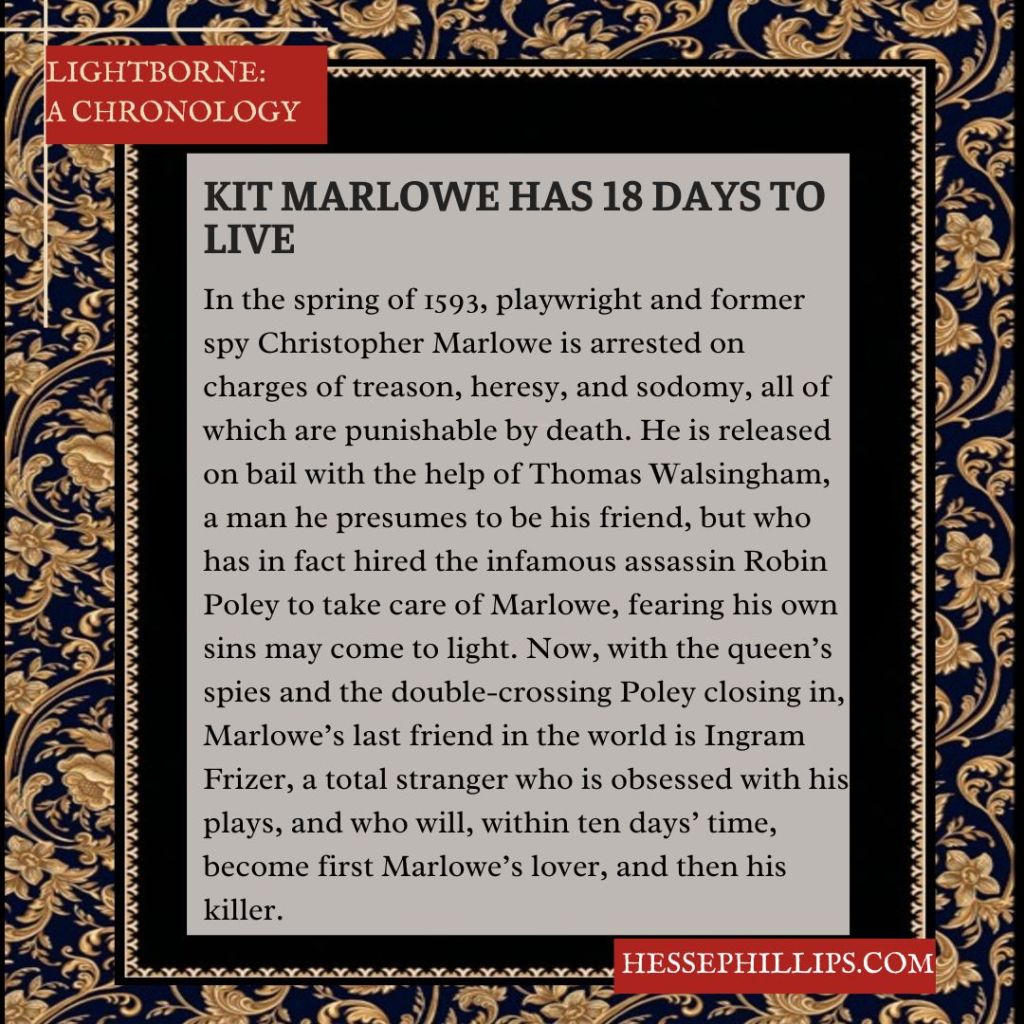
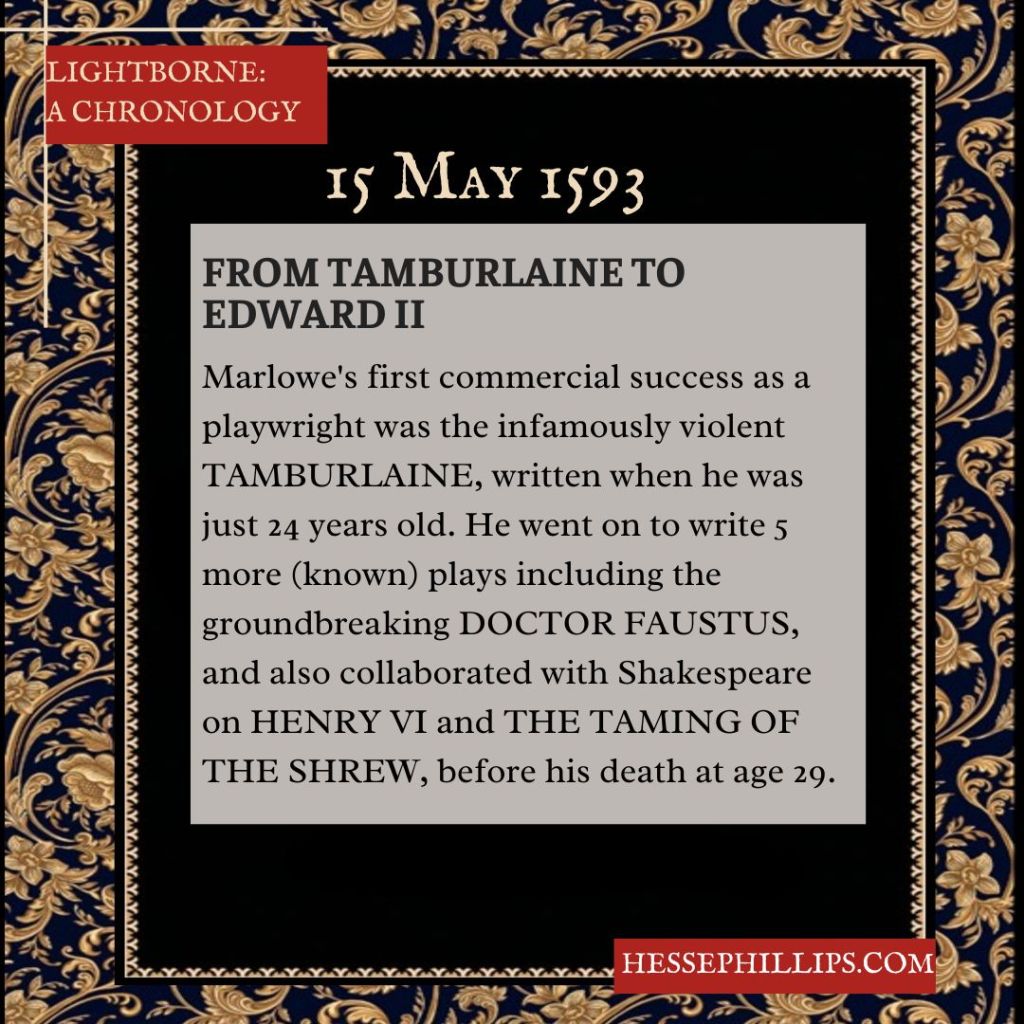
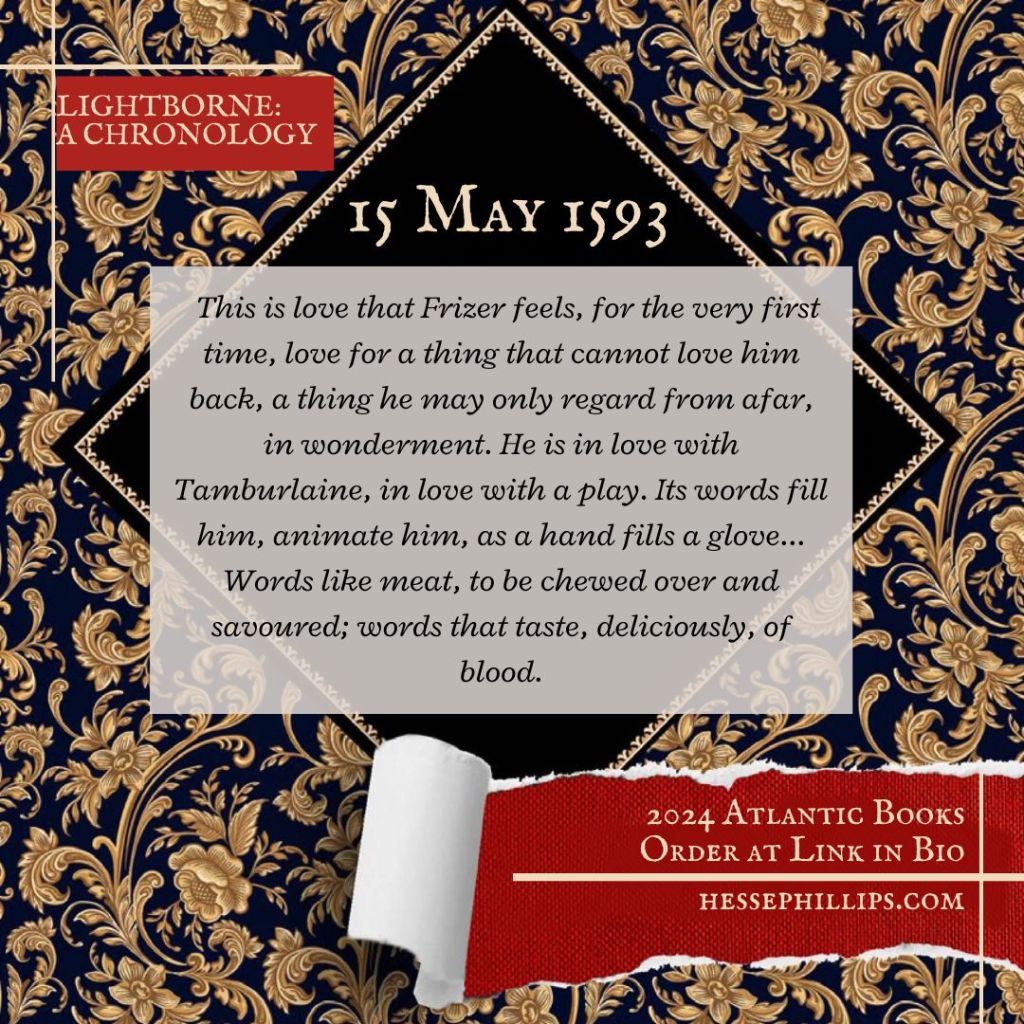
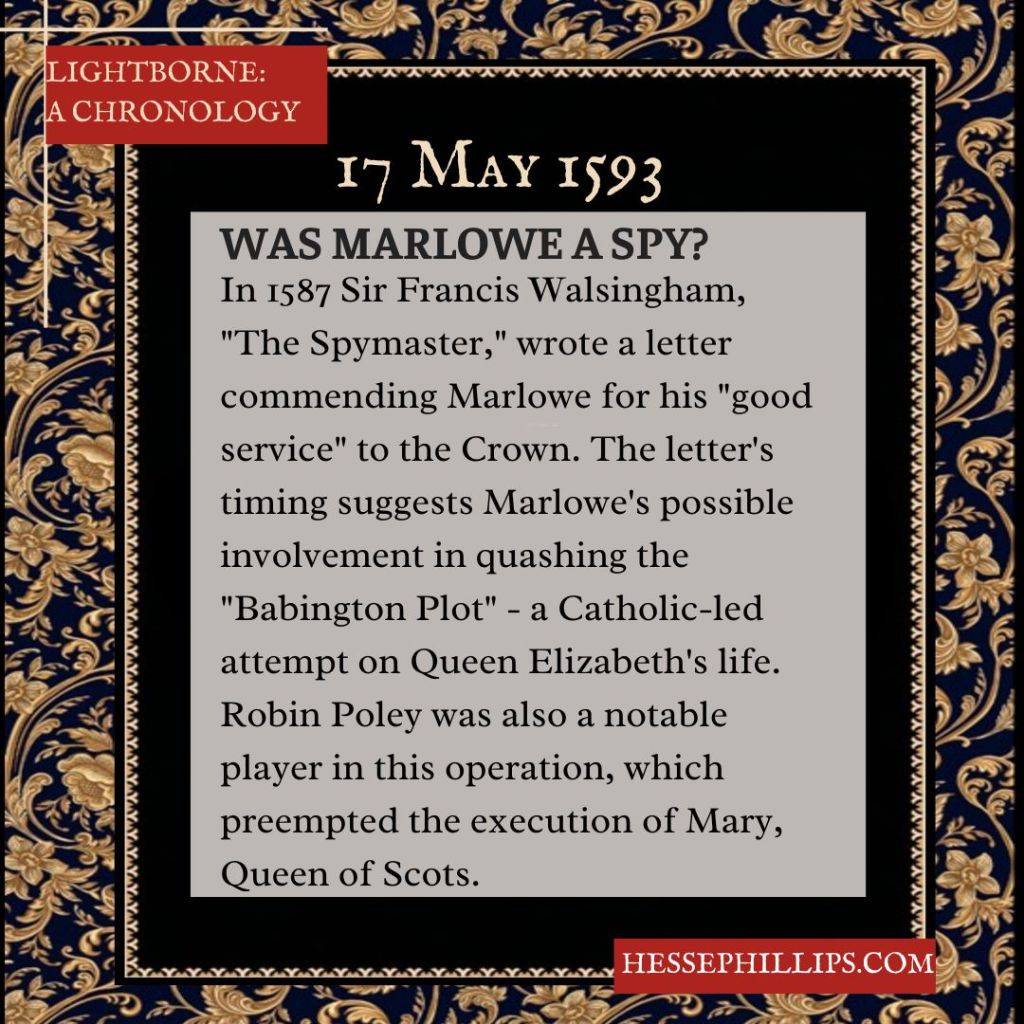
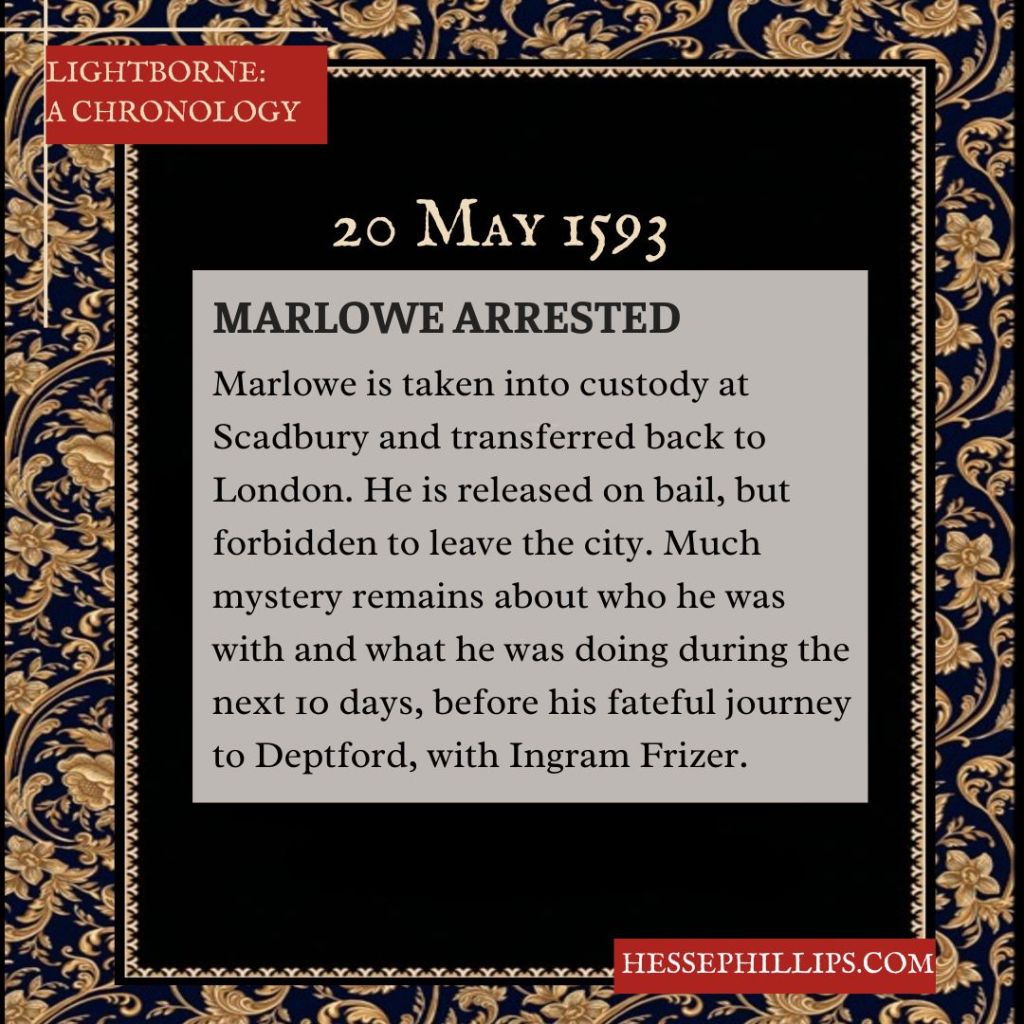
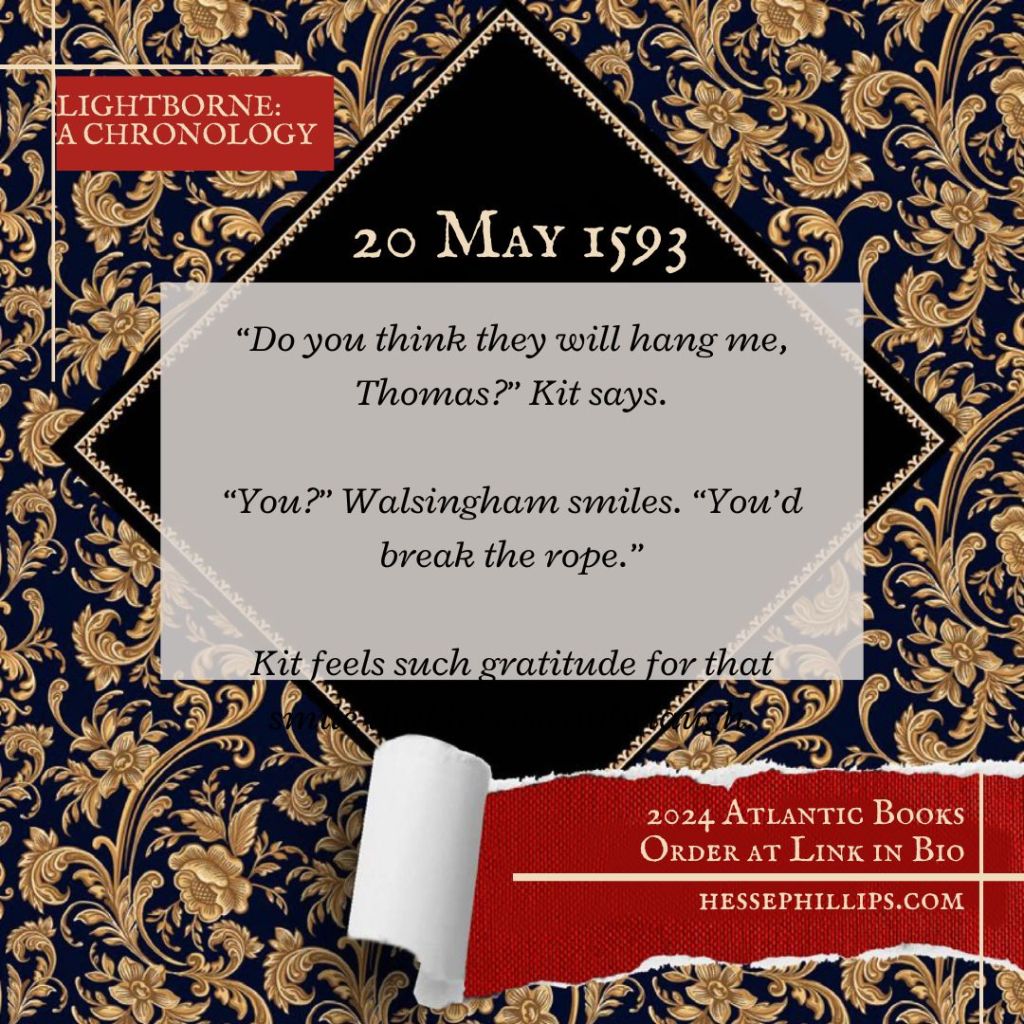
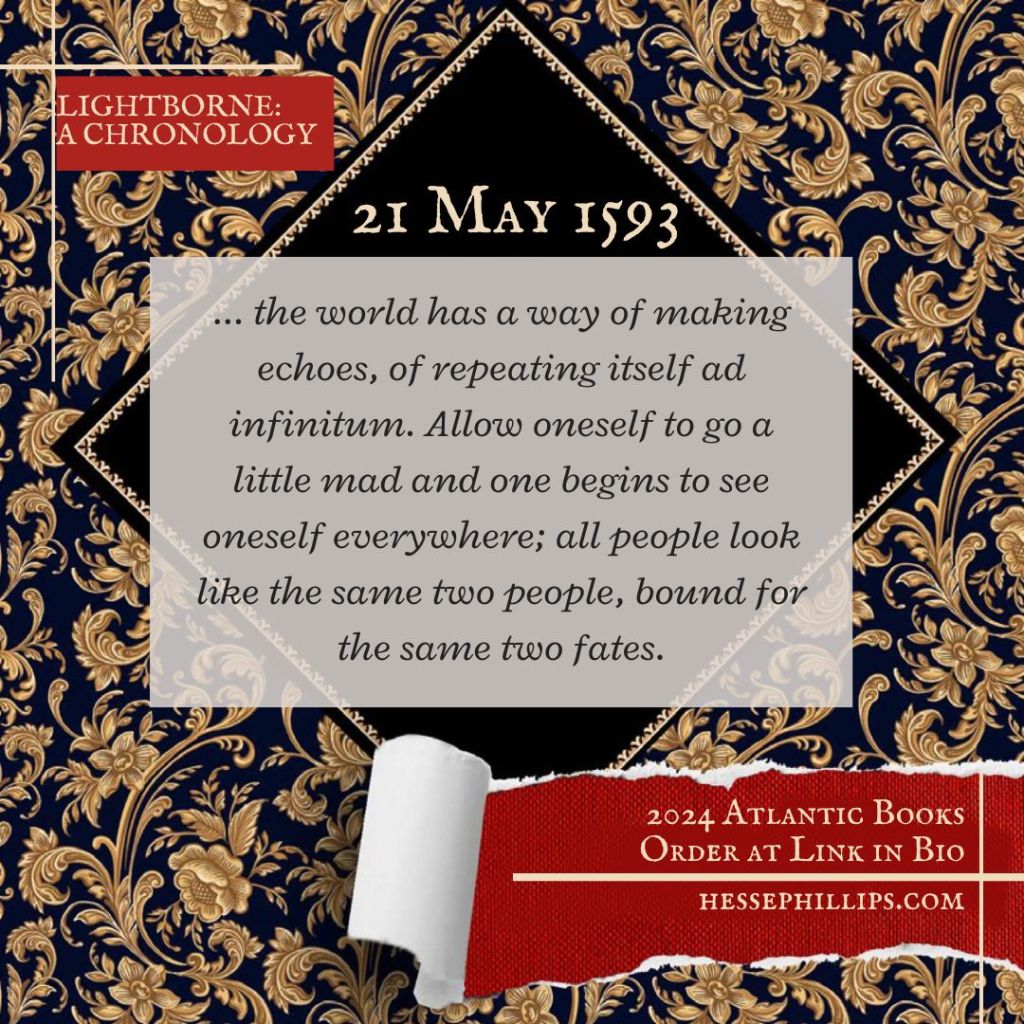
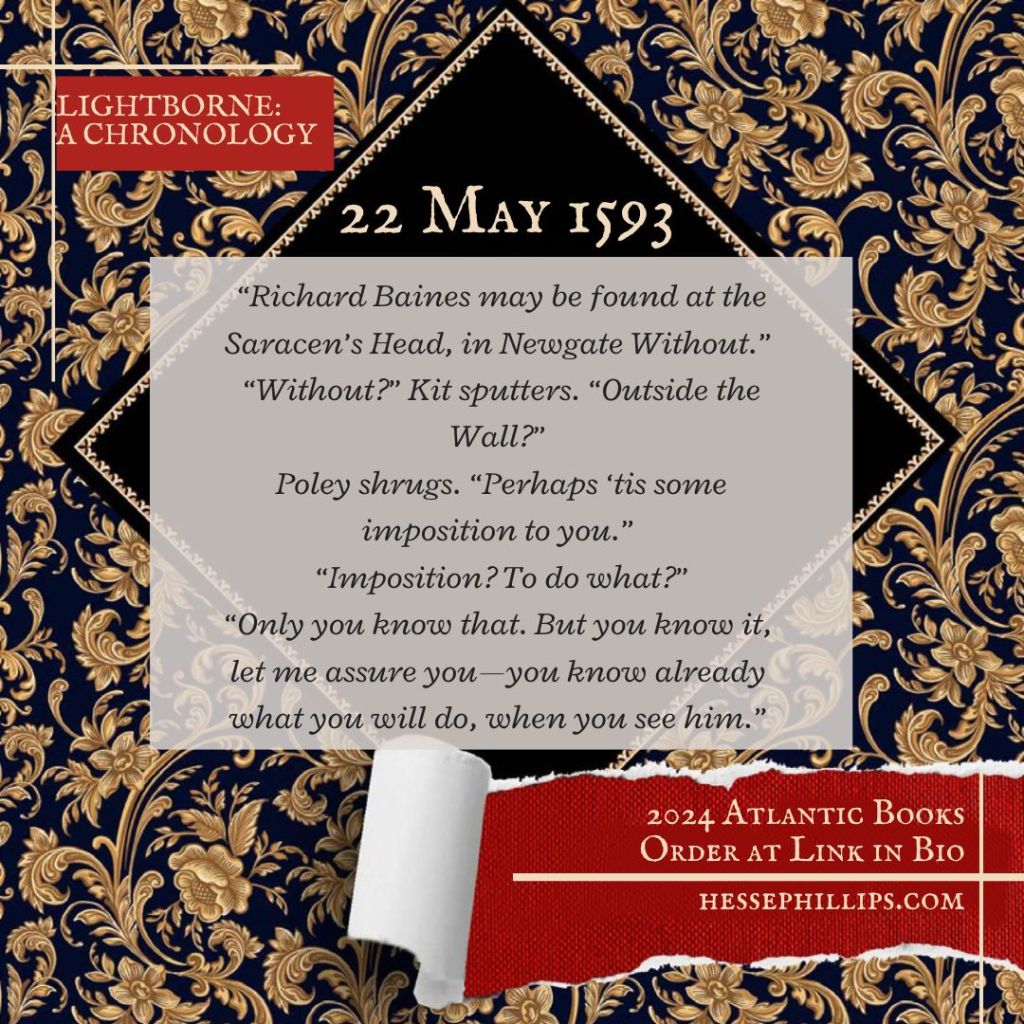
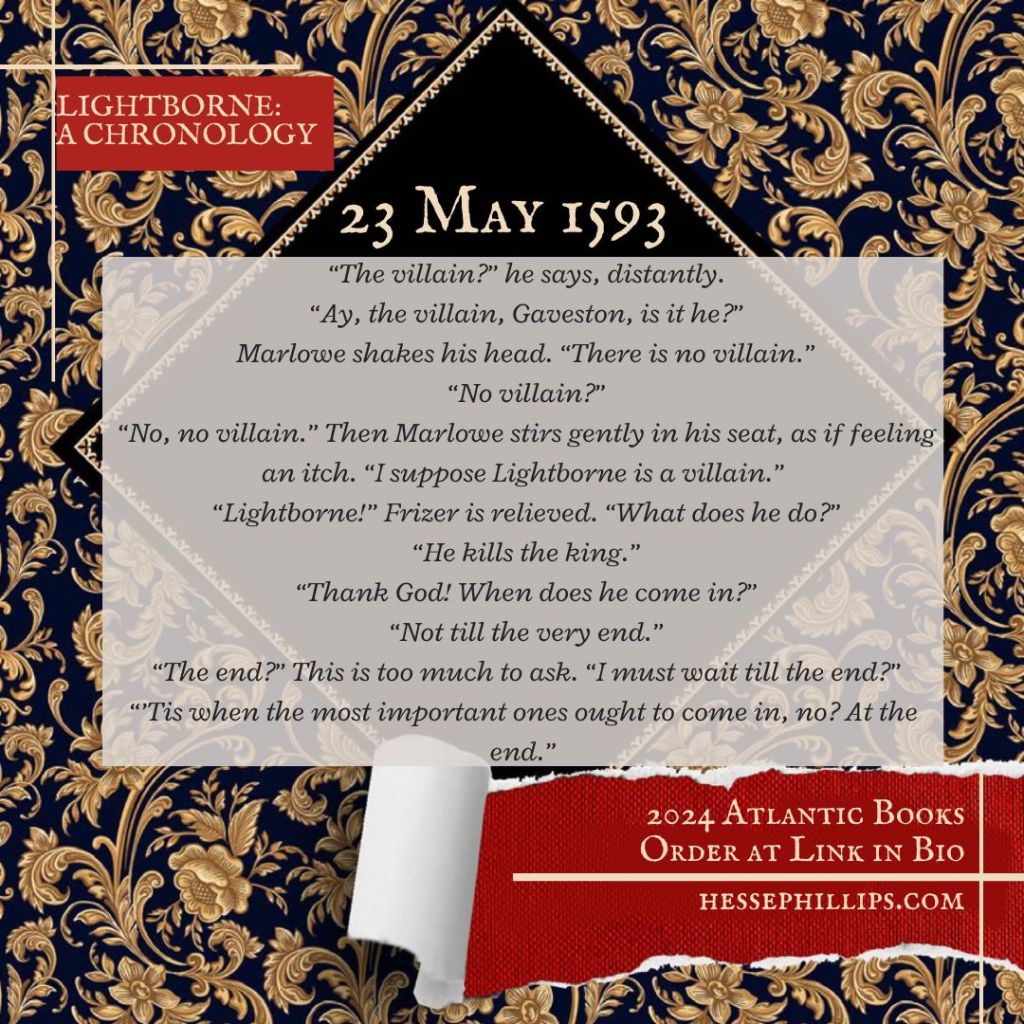
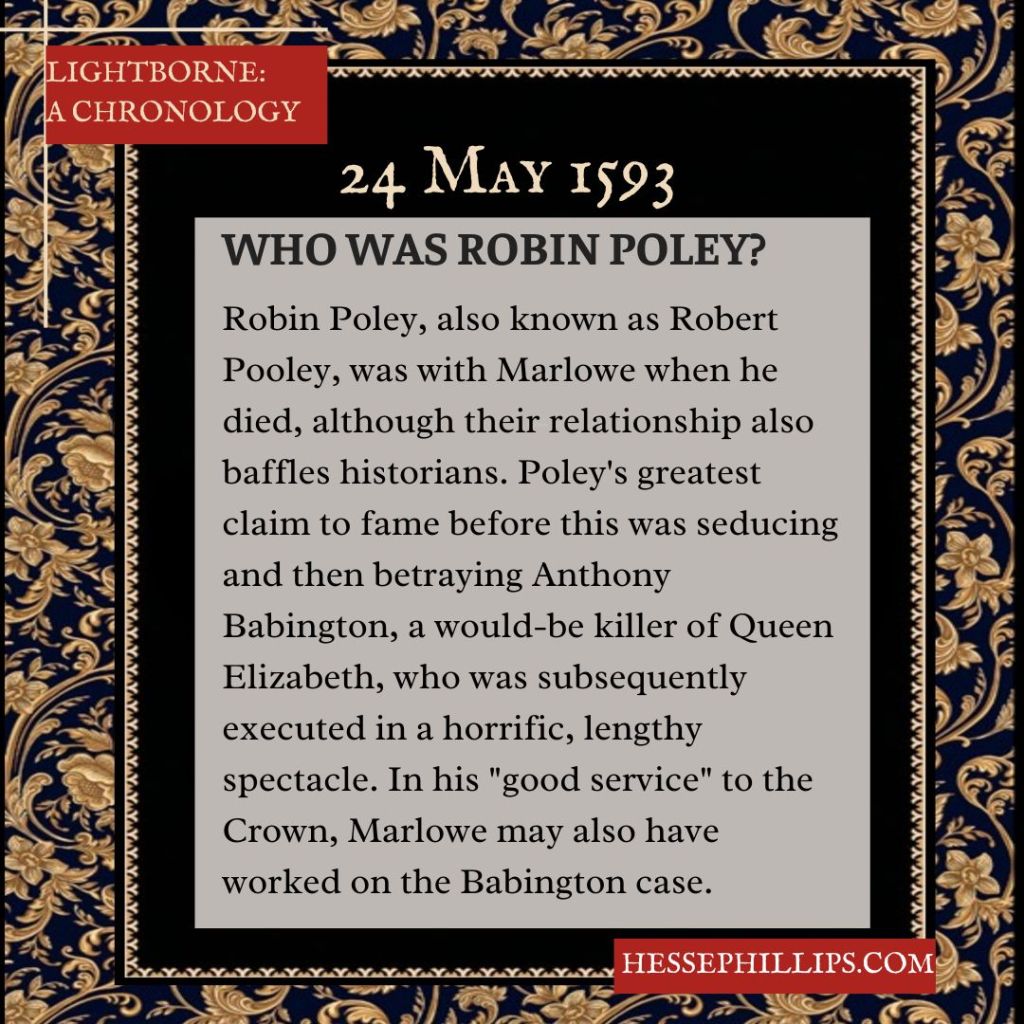
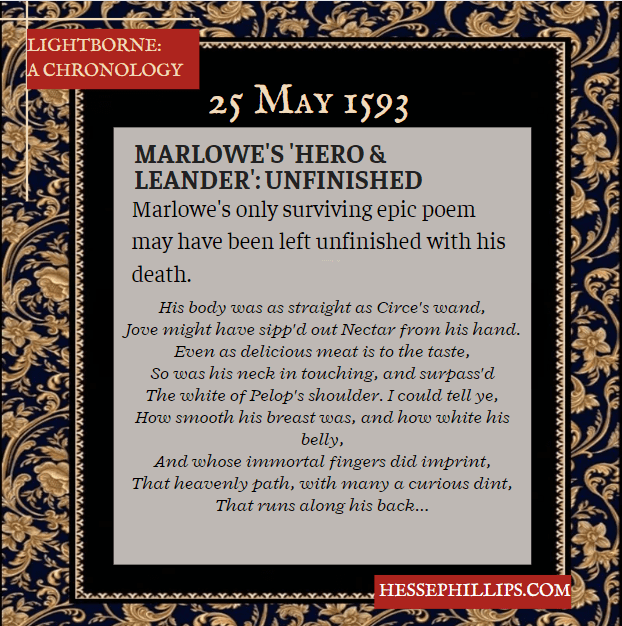
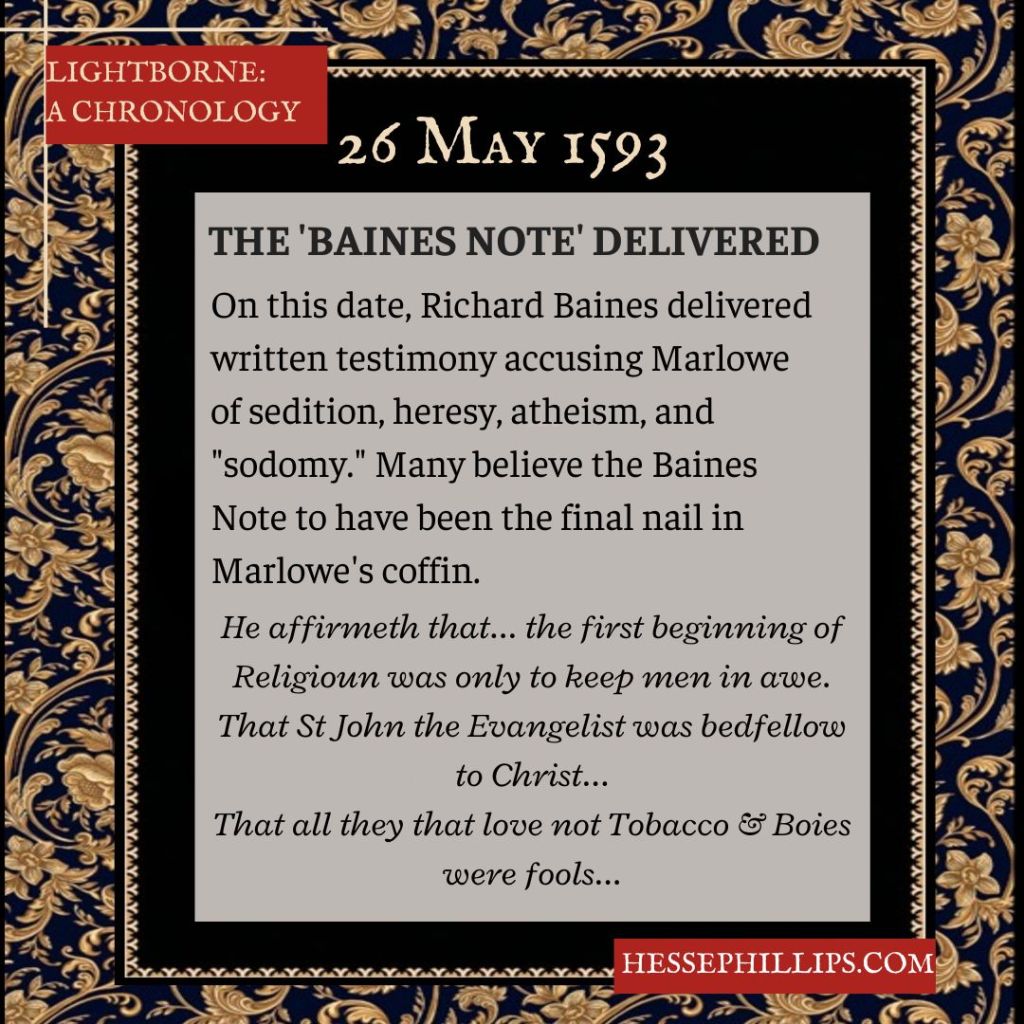
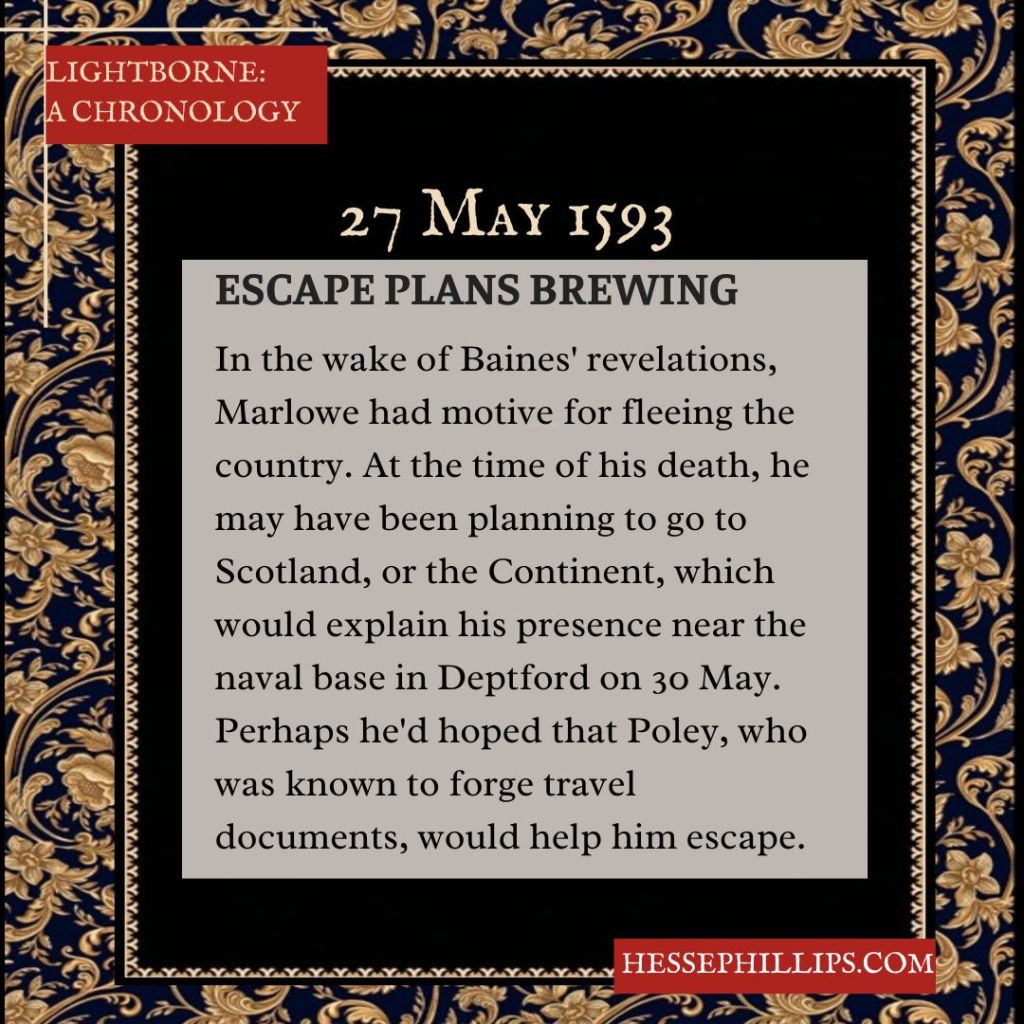
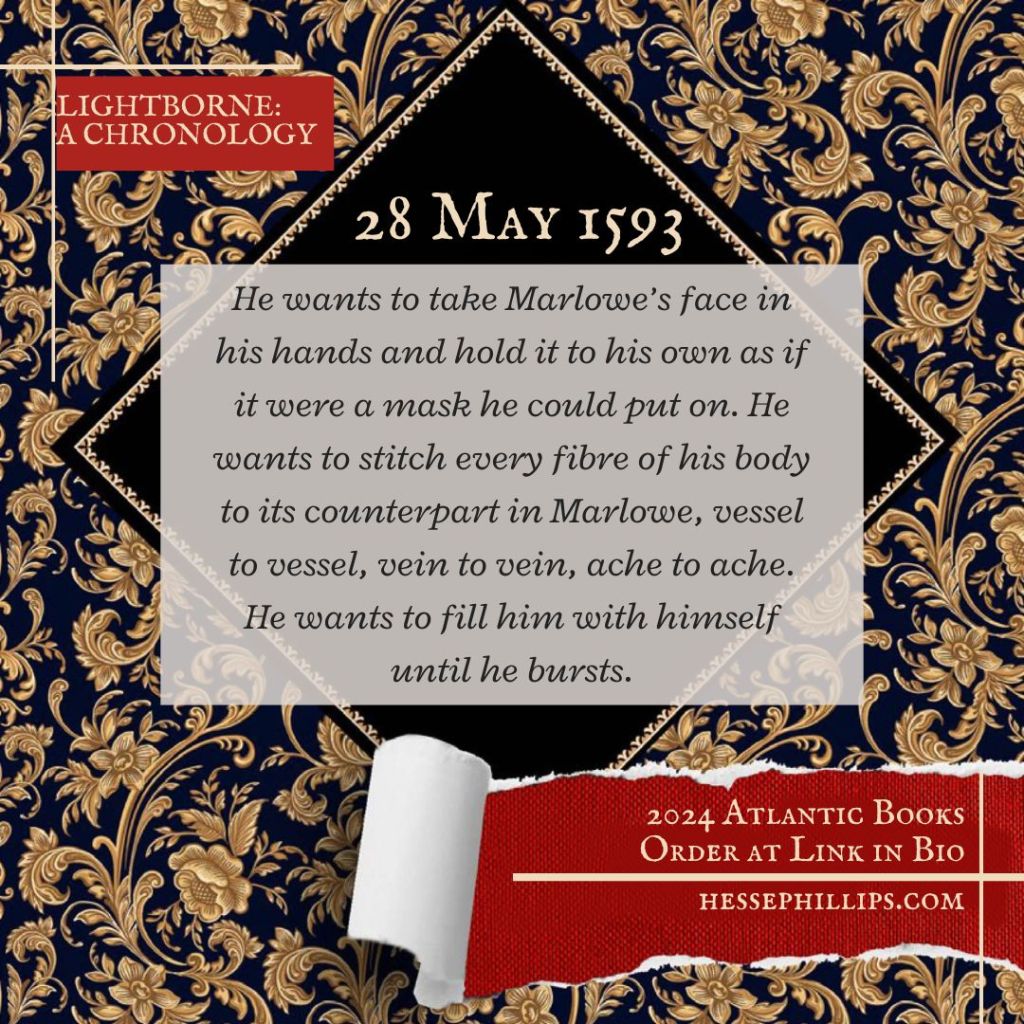
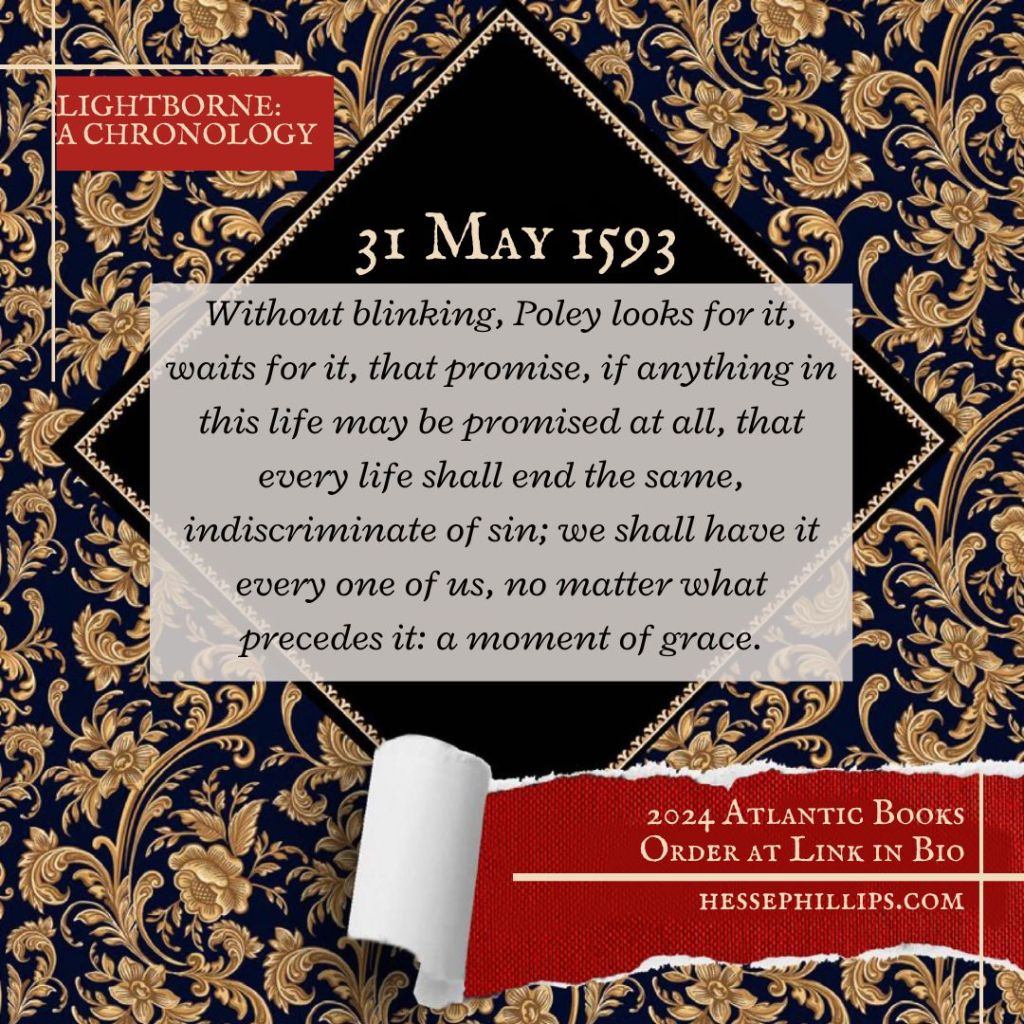
People who follow me on social media are sure to have noticed my daily Lightborne Chronology posts over the past few weeks, where I’ve been sharing historical tidbits alongside excerpts from the novel. We started on the 12th of May 2024, when, 431 years ago in 1593, Christopher Marlowe’s roommate and fellow playwright Thomas Kyd was arrested on suspicion of heresy, jump-starting the events of the book. We end, naturally, on the anniversary of Marlowe’s untimely death in Deptford, on 30th May – with a number of questions left unanswered.
For anyone cool enough to stay off social media (I tip my hat to you), or those who want to revisit the whole series in one convenient place, scroll down and click the arrows on the sides of each image to flip between the slides. Enjoy learning a little bit about Ingram Frizer, Robin Poley, Thomas Walsingham, early modern London, and of course, our protagonist Kit Marlowe, and the enduring mysteries surrounding his life and death that inspired Lightborne.
I have only a few words, and most of them are gibberish. Lightborne has been given this brief but amazing review from Nick Rennison, author of 1922: Scenes From A Turbulent Year and Sherlock Holmes: The Unauthorized Biography.
Obtaining reviews in mainstream papers requires a monumental effort mixed with pure dumb luck, and is a resource many authors are shut out from, whether for lack of connections or industry bias against indie published writers. I feel incredibly fortunate to have managed to worm my way in, thanks entirely to the hard work of my publicist at Atlantic Books.
Good press can certainly help sell books, but this is a fickle business, so we’re still in “wait and see” mode. Reviews from readers are naturally one of the best, if not the best determinant of a book’s success, so to anyone out there who has bought and read the book, please do leave your review on sites like Goodreads, Amazon, and Bookshop.org. (Even if it wasn’t for you – reviews are to help other readers decide whether the book is right for them. So help your fellow readers out!)
As for me, I’m going to take a short break from biting my nails, and throw myself into the best cure for debut author anxiety – working on the Next Book….!
Last week, I traveled to London to see my book off into the world and to revisit a few of the locations from the novel, some of which I hadn’t managed to see in person since the early days of research. Call it a pilgrimage. While there was no particular requirement for me to visit London last week, it felt wrong not to be there when Lightborne finally hit the shelves in the city that had inspired me for the past 20 years.
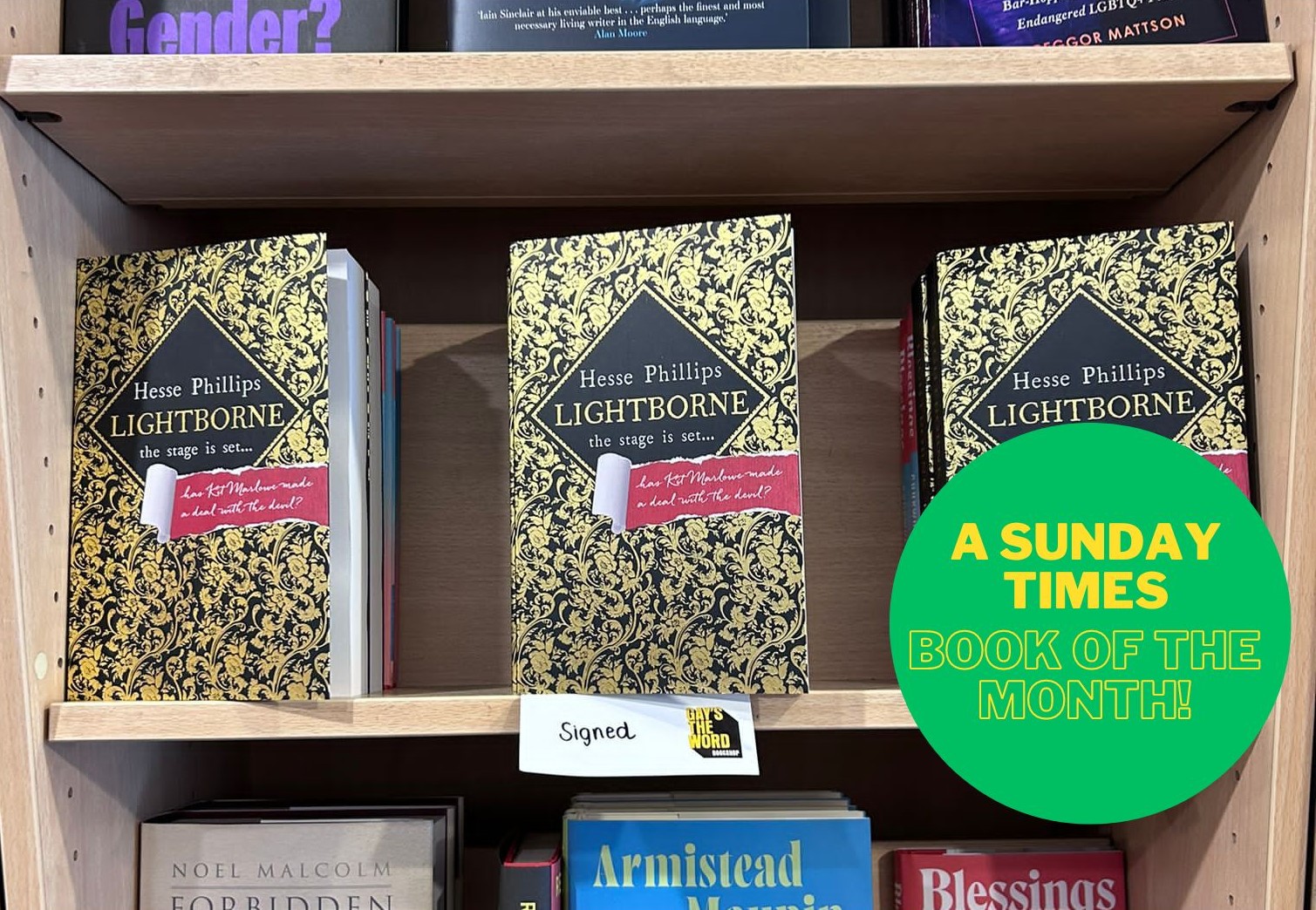
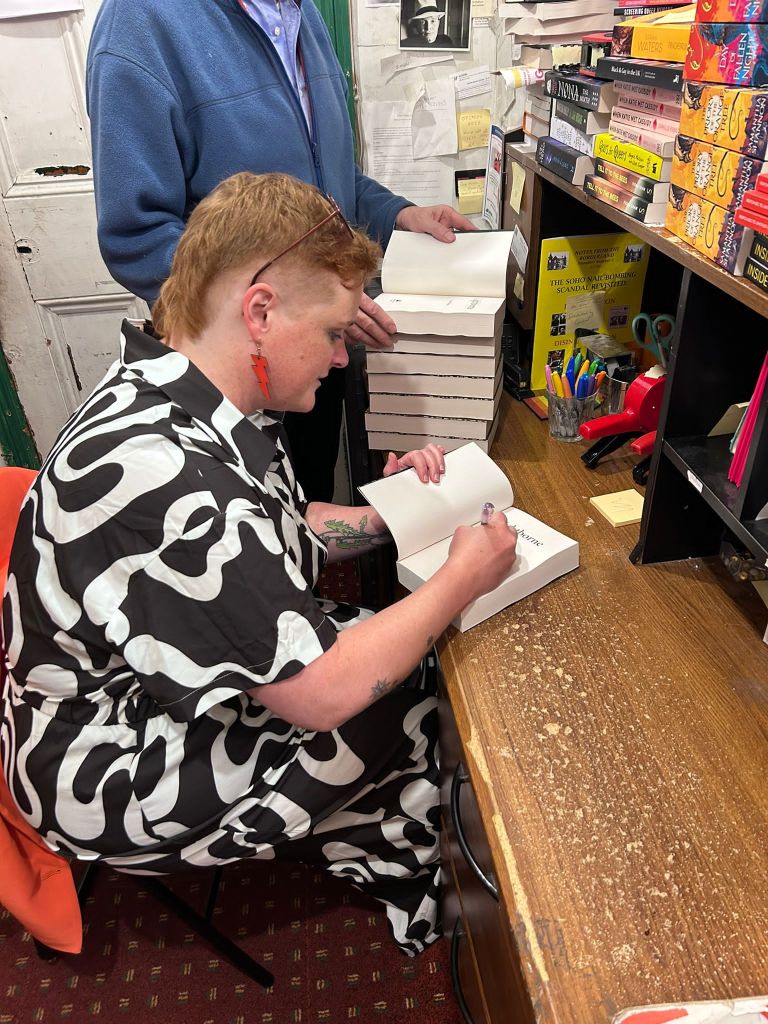
Luckily for me, I have a wonderful publishing team at Atlantic Books, who seemed to know exactly how to celebrate the Big Day. After giving me the full star treatment at their offices in Bloomsbury, they swept me off to the legendary and venerable Gay’s the Word, the UK’s oldest queer bookshop, for a signing and some photos.
Me with Jim MacSweeney, Manager of Gay’s the Word since 1989, looking as if he’s about to ask me what I’m doing standing in front of his shop. You can just see Lightborne by my right elbow! Photo by Laura O’Donnell.
I can’t begin to express how exciting it was to step behind the desk at Gay’s the Word, a staple in London’s queer community for 40 years – nor, for that matter, can I tell you what went through my head when I first saw Jim and Uli putting Lightborne on the shelves. There was such a whirlwind of emotions that the only moment I remember with true clarity is when I sat down to do my signing and noticed a picture of queer artist, author, AIDS activist and personal hero David Wojnarowicz looking down on me from the wall above. There came a singularly strange, out-of-body sensation, as if I were watching myself from across the room.
Photo by Laura O’Donnell.
It’s one thing to write about history, quite another to touch it. To enter it, even, for the briefest of moments. Gay’s the Word is one of those places made all the more sacred by having survived so many attempts to destroy it, much like the queer community it serves. Opened on the brink of the AIDS crisis, raided under “obscenity” laws, threatened with closure, its tenacity in the face of hardship and ignorance is every bit as inspirational as the lives of people like Wojnarowicz and his contemporaries Keith Haring, Candy Darling, Angie Xtravaganza, Peter Hujar, Marsha P. Johnson and Sylvia Rivera – every bit as inspirational as a life like Kit Marlowe’s, queer before “queer” was even a thing. I don’t know whether it’s possible to top the feeling of knowing that I have my own little corner in such a space, for however long it lasts.
They took RuPaul’s House of Hidden Meanings off the shelves for this photo-op, but I’m not bragging. Photo by Laura O’Donnell.
As part of promotional efforts, while in London I also had to take myself and my very patient wife on a tour of locations from the novel in order to record some short videos, which I will hopefully post in the future. Despite the destruction wreaked on London by the Great Fire of 1666 and the Blitz, you can still visit numerous places that existed during Marlowe’s lifetime, from the Church of St. Helen’s, Bishopsgate to Southwark Cathedral, not to mention Marlowe’s final resting place in the yard of St. Nicholas’s Church, Deptford – a living archive to mine for gold.
Not all have survived exactly as Marlowe might have remembered them, but sometimes the traces left behind feel still realer than brick and mortar, straddling the line between story and substance. Just down the street from Shakespeare’s Globe on Bankside lies an ordinary looking office block with an extraordinary secret in the cellar – the ruins of the Rose Playhouse, the setting of Lightborne’s opening scene:
The curtains part, cutting a gash of daylight through the backstage gloom. Beyond, the Rose Playhouse appears, a vortex of timber and plaster and densely packed humanity that reels upwards, three stories, to a dilated eye of cloud-streaked sky.
The Rose, brainchild of entrepreneurs Philip Henslowe and John Chomeley, was the earliest of London’s theatres to take on the now iconic, polygonal form later echoed by the Swan and the Globe. It opened in 1587 and existed just into the 17th century, hosting the first performances of most of Marlowe’s plays and many of Shakespeare’s. Its performance and financial records, scrupulously recorded in a small leatherbound book by manager Henslowe, comprise some of the most important documentary evidence of theatrical activity during the Elizabethan period. Perhaps most famously, the Rose was recreated for the Oscar winning film Shakespeare In Love.
An artist’s reconstruction of the Rose with a cross-section exposed. By William Dudley.
After lying buried in the Bankside mud for four centuries, the Rose came to light again in 1988 when building works exposed its remarkably well-preserved foundations. But although the playhouse’s discovery was initially met with a flurry of excitement from theatre makers and devotees, writers, archeologists and historians, the Rose has long lain in hibernation while funds are raised to resume the excavations cut short in 1989. In the meantime, the remains of Shakespeare and Marlowe’s first theatre remain mostly dormant, lovingly cared for by a team of volunteers and archeologists, subsisting on charitable donations and high-profile benefactors such as Dame Judi Dench and Sir Ian McKellen. Last Saturday, for the first time in ten years, I was able to see it again.
The Rose as it appears today. Photographer unknown.
It may not look like much. Due to their centuries spent buried in the Thames’ anerobic mud, the Rose’s foundations must now be kept underwater to forestall decay. Thus, what you see when you enter the former dig site is a pit of raw earth enclosing a dark, shallow pool. Beneath the water’s unnervingly still surface, strings of red light outline the footings of the stage and the yard, throwing an eerie glow onto the steel beams that crush down from overhead. It is cold inside, damp-smelling and dim, lending the space a grave-like atmosphere.
But far from diminishing the Rose’s power, the sepulchral surroundings have a strange way of imbuing it with all the hushed, unearthly hauntedness of an ancient site of pilgrimage. Contrast the chilly silence with the roar of the crowds that came centuries ago, and you can’t help but imagine yourself in the company of many thousands of restive ghosts – maybe Kit Marlowe’s among them.
My hope, of course, is for the Rose to come alive again, however affecting it may be in its current state. Previous excavations carried out on the site were performed hastily and under constant threat of foreclosure by developers, meaning that there’s still much left to uncover. In addition, plans are underway on The Rose Revealed Project, a proposed visitor’s centre, performance space and museum which will preserve the Rose for generations to come. Though there’s an enormous, money-shaped hurdle still to climb, I’m hopeful that those plans will come to fruition – and I sincerely hope all this might inspire someone out there to support the project.
Today, the Rose Playhouse sleeps again, awaiting its next day in the spotlight. A signed copy of Lightborne sits in the front window of Gay’s the Word, gleaming spectacularly gold in the afternoon sun. (May it find a loving home!) And all I can do is wait and see.
Last Friday I received the most exciting bookmail any author could ask for: a box full of shiny (very shiny) new copies of my debut novel, hot off the press! They even have that “new book smell,” which, IYKYK.
Look at that GOLD!
With my planned trip to London for pub-day fast approaching, just about every friend I talk to asks me whether things are starting to feel “real” yet. What I’ve discovered throughout this whole publishing process is that the goalposts for “real” keep moving the closer you come to the big day. Seeing the manuscript become a digital ARC felt “real,” then holding the physical ARC in my hands felt even “realer”; after that came the final cover design, then the corrected digital proof, and now I sit here with a copy of Lightborne next to me – the same as will soon appear on bookshelves across the UK, Ireland, even as far away as Australia.
It can’t possibly get any “realer” than that, can it? Have we not, at last, reached “maximum realness,” as a drag queen somewhere is probably also wondering right now?
I count on nothing, as far as that is concerned. A year ago, in my naivete, I might have believed that walking into my book launch would be the peak of this whole experience, but now I’m no longer certain there will be such a thing as a peak. (Or a launch, for that matter!) We writers like to impose the rules by which our little worlds are governed onto the “real” world, in the hope that we might feel just a little more in control of our lives, but the shape of a publishing journey is not a single curve building towards climax, probably more like a series of waves of varying lengths. There’s an addictive element to it – the highs are very high, the lows abysmally low. And you never really know when one is going to hit.
For now, amidst so much uncertainty, I’m doing my best to focus on the milestones I can count on happening: the next time I hand a friend or a family member their very own copy of the book and blushingly insist, “You don’t have to read it”; the first time I get to listen to the entire audiobook, and hear award-winning narrator Will M Watt bring Kit Marlowe, Ingram Frizer and Robin Poley to life. The first time I walk into a bookshop and see Lightborne for sale – an experience I’ll be lucky enough to share with my wife, and my parents, who are traveling all the way from Pittsburgh.
For now, please enjoy this extremely amateur unboxing video, in which I finally get to hold Lightborne for the first time – another beginning in a long series of beginnings.
It’s finally happening: after many months of tireless work from my agent and rights manager, Lightborne has officially found a home in my home country with Pegasus Books! While it’s available to pre-order in the US now, you can look for it in bookstores from October 22, 2024.
As soon as my agent gave me the good news, I realized there was something very familiar about the name Pegasus. Like many of my anecdotes, it all starts with my dad and his ever-expanding collection of books.
Cast your eyes across the innumerable spines packed higgledy-piggledy into Dad’s groaning, sagging bookcases, and two things will surely stand out to you: one, that nearly every book has something to do with history, and two, that the Pegasus logo appears over and over again. Turns out, my dad is one of their most dedicated customers. He likes to describe himself as a history buff – though “fanatic” might be a more accurate word – and for just about every notable person, important event, place or people you can think of, there’s a book or two in Pegasus’ catalogue. On any given weekend morning, you may find old Dad planted in the history section of one of his local bookstores, flipping through some massive tome about a medieval Venetian cartographer or the life of Hannibal or the beef between Andrew Mellon and Winston Churchill. Only rarely does he walk out with his wallet unscathed. I’m fairly sure that some of the booksellers in southwestern Pennsylvania are only keeping the lights on thanks to his patronage.
It’s humbling and exciting to see my own name listed alongside luminaries like these. But naturally, nothing brings me more pleasure than to imagine Dad walking into one of his favorite bookstores on a Saturday morning and seeing a copy of Lightborne there on the shelf, in its gorgeous new American jacket.
A stunner, isn’t she? I’ve really lucked out with my cover designs!
(Dad, if you’re reading this, when the time comes: DON’T BUY IT. You’ll be getting a free copy!)
And now – for now – it’s back to gearing up for the UK launch on 2nd May. There will be an event scheduled in London to celebrate Lightborne’s birthday. More details to come!