“Interesting places”

According to my bio, I’ve written one book.

But if you actually bother to go through all the myriad files within files squirreled away in the recesses of my laptop, it amounts to something more like four or five books. Four or five books, some weighing-in at over 400 pages, just to whittle it all down to ONE.

This is not as unusual as you might imagine. Depending on what kind of writer you are, what kind of book you’re writing, and what kind of support is available to you, the sum total of words you generate towards completing a novel might be thousands or hundreds of thousands more than the finished product. Sometimes you fall down rabbit-holes, and sometimes…

Sometimes you have to go a long distance out of the way in order to come back a short distance correctly.

Edward Albee
Werner Holmberg, Landscape from Leppälahti in Kuru, Unfinished, Wikimedia Commons

Throughout the process of writing Lightborne, I wrote a hefty historical fiction novel centered on William Shakespeare; tossed it out, then wrote something quite ambitious, a novel which alternated between the 16th, 17th, and 21st centuries; trashed that, then wrote another novel, alternating between just two time-periods this time – and oh yes let’s not forget the TWO MORE hist-fic novels I wrote after that, by which time Shakespeare had long since disappeared from the book (except in a blink-and-you’ll-miss-it cameo), and Christopher Marlowe was the main character. This isn’t even counting the numerous revisions that each of those earlier novels went through before being unceremoniously scrapped and scavenged for parts.

So what was it that finally got me to “done?”

Depends on how you define “done.” The thing about writing a book is that the goalposts are always moving. Even as I write this, I know my book will likely go through still more changes before it (fingers crossed) ends up on a shelf at Waterstones or Barnes & Noble, as even a publication deal is rarely the end of revising. Another quote springs to mind:

A painting is never finished. It simply stops in interesting places.

Paul Gardner
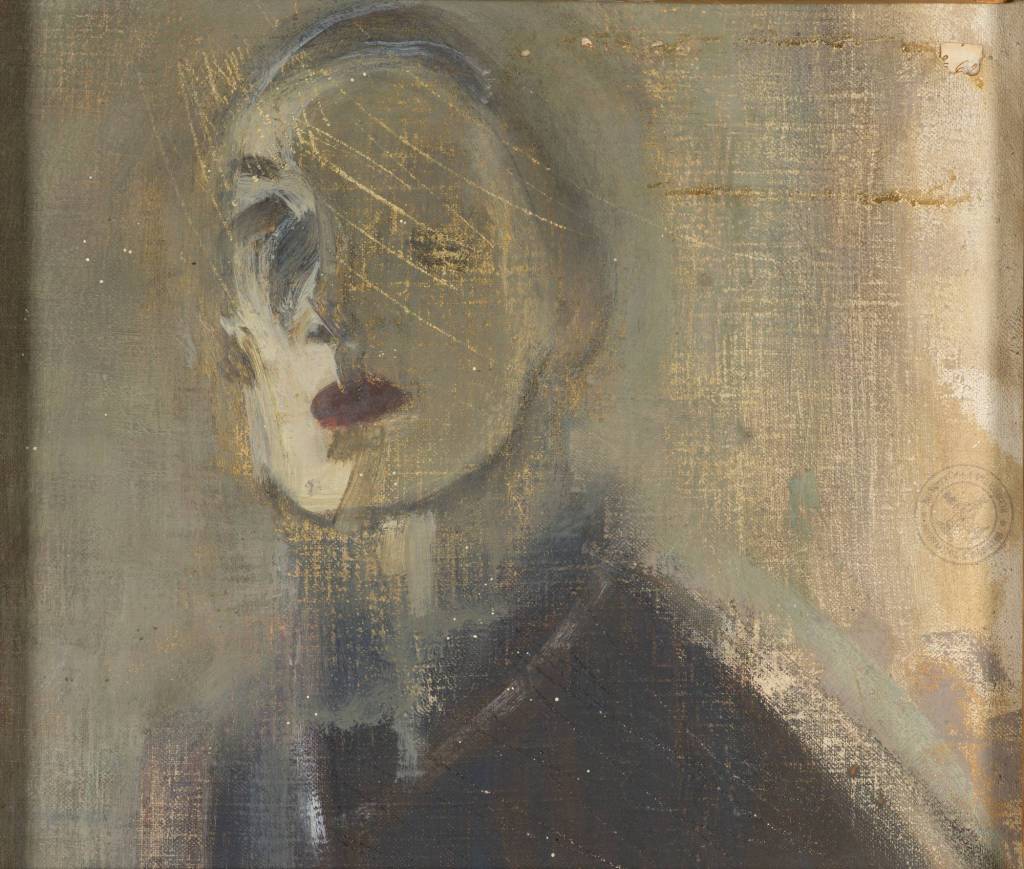
Helene Schjerfbeck, Unfinished and Defaced Self-Portrait, Wikimedia Commons

Painting and literature may seem like very different mediums, but all art shares some DNA in the process of its creation. Anyone trying to make art goes through a trial of false starts, erasures, making, and remaking. In all art there is is a discovery process, where at times you think you know where you are going only to find yourself going in circles, or occasionally, ending up in interesting places you’d no idea were there.

I often use maps as a metaphor for the writing process, because in my experience there are many roads through a novel, with many possible endings. As in real life, the most interesting places are almost never found at the end of a single, straight path, with no diversions, bushwhacking, or backtracking involved. The way through the landscape sometimes requires going all the way back to zero, and then setting out again.

I never would have gotten this far if it hadn’t been for good beta-readers, workshop partners, and instructors showing me that there was more beyond the horizon I had previously set for myself. Draft after draft, I kept arriving at interesting places only to discover even more interesting places a little further down the road. The “finished” novel, as it stands, doesn’t cover even half the territory I mapped out over all those related but different books, all those out-of-the-way journeys I had to take in order to come back to the right place by the right route. But, like a painting, my book eventually found a view to put in its frame – not the whole view, but an interesting one.

My favorite novels always feel like this: landscape paintings with more going on over the horizon, or in the distant city, or the harbor, or even in the sky. The reader will never see it all, never know it all, but the fact of it being there, just outside the frame, makes all the difference.

Pieter Bruegel the Elder, Landscape with the Fall of Icarus, Wikipedia

More Posts…

Good Advice/Bad Advice

Today I had a conversation with a friend about her past experience with a manuscript consultant. “He gave some good advice,” she said. “But also a lot of bad suggestions.” At the time, she was still relatively new to novel writing, and didn’t know what to make of the reader’s comments. The wisdom in the good advice eluded her for years because it was buried under the bad.

The question is, how do you tell the difference?

Experience certainly counts for a lot. The more people you ask to read and critique your work, the better you will become at telling gold from brass. But if you’re just starting out, it’s helpful to know how to recognize red flags.

Red Flag #1: Runaway Ego. If you receive comments along the lines of, “Instead of having them get married at the end, she should murder him and hide his body in the freezer,” or “She would be sexier if she were a redhead” or “Turn the cat into an eight-year-old child,” that’s the reader’s ego talking. They’re trying to write your book for you, not helping you write the story you want to write.

Feedback of this kind must always be relevant to the story (so, no trying to rewrite the ending), free from the reader’s own biases (the redhead comment is just gross), and justified in context (how would a child serve the story better than a cat?) Generally speaking, if a reader encourages you to experiment with an idea, that idea should have originated in you, not them.

Red Flag #2: The Prophet of Doom. One particularly unhelpful piece of advice my friend received from her consultation was, “Cut the prologue – agents hate prologues.” Trusting that this advice came from a place of expert, insider knowledge, she followed it. A few years and many frustrating revisions down the road, she realized that what her book needed was a prologue – the same prologue that the consultant made her cut!

Literary types are often full of “insider knowledge” based on hearsay, or even from their own unique experiences in the I N D U S T R Y. But literary agents and editors are human. Some may indeed “hate” prologues, but others will like them. Most will have no opinion one way or another. If a reader tells you to change any major building-block of the story, make sure they can back this up with something other than, “the gods demand it so,” or “I heard it on Twitter.”

Red Flag #3: The Morality Police. “I don’t like the protagonist – make her ‘likeable.'” “I can’t stand this character.” “This character makes bad choices and I therefore can’t relate to them.” You have never made a bad choice in your life, have you? Sure, Jan.

Aside from the reductive insistence that protagonists must be “likeable” (barf), comments of this sort focus on the wrong problem and inevitably lead to confusion and frustration on the part of the writer. It’s never a reader’s place to declare whether they “like” a character or not, or agree with the character’s choices. Characters, like real people, will not get along with everybody. In fact, characters need to stand in opposition to something, make questionable choices, and occasionally stick their foot in it if they’re going to hold up a riveting plot. If a character is not coming across, the issue is never likeability or moral purity, but often a question of whether the character’s motivations are clear enough. A good reader will know where to put their focus.

Which brings me to Red Flag #4: No Further Questions. A reader with your best interests in mind should mostly ask questions, rather than make statements or offer suggestions. This has to do with the reader’s understanding of their role in the writing process: not to help the writer “finish the book,” but to inspire them to see it anew.

Often, we turn our writing over to a reader only once we’ve convinced ourselves it’s “perfect.” But really, the best time to seek feedback is when we’re at an impasse: we think we might be on to something, but we’re not sure; we tried something new but don’t know if it’s working; we like what we did, but will anyone else? Those who hand over monuments will receive piles of rubble. The trick is to treat your book like fertile ground.

Some of the most fruitful creative periods I’ve ever experienced directly followed feedback that made me ugly-cry. But this is the true test of good advice. Good advice should make you want to experiment, branch out, investigate. It should make your book feel alive, and full of possibility.

In my next post, I plan on talking more about how good advice actually works, using my own novel, Lightborne, as an example.

More Posts…

The Long and Winding Road

It took me nearly twenty years and at least twice as many drafts to write my first novel Lightborne, which, at the time of writing this, is finally out on submission. Point-of-fact, it isn’t really my first novel, but my twelfth or thirteenth, if you count all of the now-embarrassingly adolescent “novels” I churned out from years 14 to 23 while my peers were out doing fun things, such as, I dunno, hanging-out in malls. What I mean to say is, my journey to this point in my writing career, such as it is, brought me down a long and winding road, possibly longer and windier than average. But there’s an end in sight for me at last. Or possibly a beginning.

In those early years, I shuddered at the thought of anyone else reading my work, as much as I yearned to be a “real writer.” But the road didn’t lead me much of anywhere until I finally got myself some travelling companions. Whatever I’ve learned about novel-writing comes not from solitary hours bent over a desk, but from other people: reading other writers, and sharing my work with other writers. In many cases, these writers were people like me, who had started out writing for themselves long before it ever occurred to them to write for anyone else. Workshops, writing classes, even just having a “writer-buddy” who will support you through the tough times, and keep you on track – all of these things can make the difference between having a book in a drawer and a book that’s ready to submit.

What made the biggest difference, for me anyway, were beta-readers. Beta-readers are fellow writers who will read and critique your full manuscript in exchange for you returning the favor, and they are among my favorite people on Earth. Without the sharp feedback of other writers, I’d still be wandering around the vast wastes of aimless rewriting (Draft 46, Draft 46.2, Draft 46.3, Draft 46.3.1… You get the idea.) Before I submitted my novel to the Irish Writers Centre Novel Fair, through which I met my agent, it was a handful of beta-readers who whipped my book into shape: people who were readers of my genre (literary-historical fiction), who knew something about writing themselves, and whose opinions I trusted.

I have been a beta-reader as many times as I’ve worked with one. That too has been an education: in writing craft, of course, but also in humility, which we writers need to have in scads. When offering criticism or feedback on someone else’s novel (their BABY, for God’s sake!) it was essential for me to learn to silence that little voice that says “I could do this better.” No, I can’t. That story belongs to the author, not to me. Feedback should never be proscriptive, because it’s always based in a subjective interpretation of what the author is trying to get across. Every reader’s interpretation will be a little different. The author’s goal is to create a world that feels open to the inhabitation of outsiders – a time, place, or person that anyone can exist in comfortably for a while.

It took me ages to figure out that the problem with my novel was that it was not welcoming to outsiders. The characters I knew and loved seemed like complete strangers when other people described them to me; the plot-points that I thought ran smoothly were, to others, complicated or obscure. This was devastating to hear at first, but gradually, a new and marvelous excitement kicked in. Now, I could go back into my little world armed with the knowledge necessary to bring readers along with me. This was my opportunity to get to know my characters and my story deeper, to experiment and explore. In time, a new roadmap took shape – rough at first, as are all maps into uncharted territory. But I could see multiple paths ahead.

My experiences with beta-readers absolutely made me a better writer. And it made my book not just a better book, but my book, my vision: a world with open doors, one which nearly anybody can step into, and live.

More Posts…