Research Diaries #2: Hell is empty & all the devils are here.

Content Warning: this post discusses historical cases of violence against women, including r*pe.

Hi. This is me poking my head out of my writing cave, wanting to talk about a work-in-progress for a minute – perhaps an incredibly foolhardy thing to do, because after all, there are no guarantees that any work-in-progress will ever come to aught. It’s Schrodinger’s book, as it stands. But with any luck – and a lot more work – perhaps it will one day step out of the box, alive.

For now, at least, I’m calling it The Devils of Denham Manor.

Like my first book, Lightborne, it is based on a true story of a crime which has gone unresolved for centuries. The case was well-documented in its time, though nearly forgotten today. At the heart of “The Devils” lies a sex scandal, which unfolded at the remote country estate of Denham Manor over the winter of 1585-6. For some eight months, an underground group of Catholic priests forced three teenaged girls to feign demonic possession before paying audiences of Catholic sympathizers and the morbidly curious. The priests’ stated purpose, in a nutshell, was to “prove the truth of” their faith through demonstrations of the supernatural powers it bestowed on them. Powers such as the ability to exorcise of “all the devils of hell.” They also undoubtedly made a lot of money.

By the early 17th century, the Denham “demoniacs”, and the names of their supposed resident demons, were so infamous that Shakespeare quite cheekily dropped them a reference in a famous scene of King Lear:

Bless thee, good man’s son, from
the foul fiend! Five fiends have been in poor Tom at once: of
lust, as Obidicut; Hobbididence, prince of dumbness; Mahu, of
stealing; Modo, of murder; Flibbertigibbet, of mopping and
mowing, who since possesses chambermaids and waiting women.
1

Just two years earlier, a book recording the women’s ordeal at Denham Manor had been published to enormous success: an instant bestseller, you could say. Such was due in part to the book’s sensationalist and often comic tone, lingering on the salacious details of three girls held captive, “used and abused,” by a group of older men. If the women did not become household names, their “demons” certainly did: Modo, Maho, Flibbertigibbet, Hobbidicut, Hobberdidance.

As so often happens in the aftermath of a scandal, many contemporaries – evidently, Shakespeare among them – sought to turn the whole episode into a joke, and the women into collaborators in their own abuse. Some of the events that went on at Denham were indeed ridiculous, and the exorcisms themselves sometimes had the audience in stitches rather than cold sweats. There were dirty jokes, grotesque dances, songs, and ribald jabs at the Protestant Queen Elizabeth and her ministers. But reading the testimonies of the victims paints a very different and far darker picture.

The youngest victim in the Denham case, a chambermaid called Sarah Williams, was only fourteen or fifteen when her exorcisms began. As an adult reflecting on her experiences, Sarah claimed that her captors frequently enhanced her performances through the use of intoxicants, plus physical and psychological torture. While Sarah herself never explicitly alleged sexual abuse – for, of course, the legal language to make such an accusation did not exist at the time – her recollections of the “exorcisms” to which she was, remember, publicly subjected, quite clearly describe acts of sadism, sexual aggression, and even rape.

I want to spare you the details. Broadly speaking, Sarah’s exorcisms involved a range of bodily violations, from the forced ingestion of “potions” and inhalation of “fumes,” to the “Laying-on of Hands,” in which a priest fondles, pinches, or even wounds the possessed, supposedly in order to “chase” the devil through her body. Most horrifically, Sarah alleged that the priests of Denham would often squirt caustic liquids or insert objects – including human bones, or relics – into “her priviest part.”2

The first page of Sarah Williams’ testimony, published in A Declaration of Egregious Popish Impostures by Samuel Harsnett, 1602. (Internet Archive)

Sarah’s story may be 400 years old, but it feels like a wound that might easily have been opened only yesterday. With the Epstein Files still dominating the news cycle, not to mention online discourse; the mass-rape Pelicot Case still unresolved; the egregious institutional failures at the heart of the UK “grooming gangs” scandal leaving survivors feeling abandoned; the fact that a convicted sexual abuser now holds one of the highest positions of power on the planet… The list goes on. If 2017 was the Year of MeToo, then you might rightly call 2025 the Year of the Rapist.

One wonders whether much really has changed since Sarah was abused before a crowd of willing (and paying) spectators in 1586, or since she described her abuse to a panel of lawyers and churchmen in 1603. Then as now, rape largely went unreported and unpunished. Although Elizabethan legal experts often classified rape as second only to murder, earlier laws determined rape to be more a matter of property loss for a woman’s male relatives than a serious offence against the body of a woman.3 (I don’t say “bodily autonomy,” because the concept did not exist, less so when pertaining to women and children.) The few rape cases that did make it to court rarely resulted in convictions against the rapist, and even occasionally resulted in the accuser being penalized for slander, adultery, or indeed “fornication.”

Moreover, according to medieval statutes dating back to the 13th century, a woman who had been raped was obligated to make a spectacle of her own anguish if she had any intention of seeking justice:

She ought to go straight away and with Hue and Cry complaine to the good men of the next towne, shewing her wrong, her garments torne, and any effusion of blood[.]4

In other words, she had to present herself as “the perfect victim” – an all too familiar scenario in today’s discourse. She had to object loudly and early, be visibly distraught, disheveled, and damaged; she had to show contrition for “her part” in the crime and “seek for Everlasting Night,” as one poet put it.5 She could, by no means, become pregnant, as pregnancy was then believed to only result from consensual sex. Her life and her world came to a screeching halt.

Perhaps this is why accusations of rape were so rare, amounting to just 274 in the 142-year period from 1558 to 1700. Out of those 274 cases, a mere 45 resulted in convictions.6 For comparison, it is estimated that some 900,000 people over 16 were sexually assaulted in England and Wales in 2024. From June 2023 to June 2024, 69,184 rapes were reported to UK police, of which a mere 49% resulted in a conviction. That’s nearly 70,000 prosecutions in one year, versus just 274 over a period of more than a century.

But Sarah Williams and her fellow “devil-girls” of Denham Manor were not among those 274 litigants. For the Elizabethan authorities, rape ranked low amongst the crimes of their abusers, several of whom were tried and executed for attempted regicide. In fact, after the exorcists’ ring was broken up, Sarah, as well as her sister Frideswood “Fid” Williams and another girl, Anne Smith, all endured months in prison for their presumed complicity in treason. Upon release, all three spent the next seventeen years of their lives either laying low or in and out of trouble with the law, begging for audiences with religious and political figures or avoiding them like the plague, torn between a desire for safety and a need for justice, a need to be heard. To be believed.

I’m sure this is why, when I stumbled upon Sarah’s story while researching something unrelated, I felt immediately compelled to tell it.

Unusually for her day, Sarah’s record of abuse survives, mainly because the powers-that-be found it politically expedient to sensationalize it. By 1602, when Sarah, Fid, and Anne received their summons, Queen Elizabeth’s health was failing, and the heir apparent to the throne, James VI of Scotland, had shown leniency towards Catholics in the past. For those who hoped England would remain Protestant after the queen’s death, a wild story about three innocent girls tortured and raped by a gang of Catholic priests was everything they could have hoped for: a way to push sanguine English Catholics back into the shadows, and make certain the incoming James would know his place.

For that reason, some scholars have discredited the women’s testimonies over the centuries, proclaiming them to be only another clever piece of anti-Catholic Elizabethan propaganda.7 But details of the exorcisms had been reported in earlier depositions given by both Sarah and her sister. Who are we to believe? Men for whom such testimonies, if proven true, would be disastrous, or women for whom the giving of that testimony was itself a disaster – a sacrifice of their privacy, security, and peace?

For over 400 years, Sarah’s story has existed only as her inquisitors saw fit to record it, not in her voice, but in the third-person. The tragedy in this is that Sarah’s abusers at Denham had also denied her a voice, claiming that any sound she uttered or move she made came not from her, but from the devil inside her. In one instance, as Sarah implored one of the priests to stop the exorcisms, he

cast his head aside, and looking fully upon her face under her hat, said, ‘What, is this Sarah or the devil that speaks these words? No, no, it is not Sarah, but the devil.’ And then [Sarah], perceiving that she could have no relief at his hands, fell a-weeping, which weeping also he said was the weeping of the evil spirit.8

This is another form of rape, I think, of the kind that leaves no marks. But then, every rape of the body is also a rape of the mind, the soul. It is a form of possession: the demon that takes up residence, and robs the host of all credibility, empathy, and humanity. Telling the story is a flawed form of exorcism, as anyone who’s ever had to tell such a story knows: incomplete and arguably performative in its own way, so desperate to be witnessed, to be believed. But it’s something.

I hope I can do Sarah, Fid, and Anne some justice, for whatever that’s worth.

  1. William Shakespeare, King Lear, IV:1, 2312-9. ↩︎
  2. Descriptions of Sarah’s torture can be found in Samuel Harsnett, A Declaration of Egregious Popish Impostures, 1603, pp. 78, 110, 120, 175, 181-3, 185. ↩︎
  3. Julia Rudolph, “Rape and Resistance: Women and Consent in Seventeenth-Century English Legal and Political Thought.” Journal of British Studies, vol. 39, no. 2, 2000, pp. 157–84. ↩︎
  4. Nicholas Brady, The Lawes Resolution of Women’s Rights, 1632, p. 392, quoted in Bashar, p. 35. ↩︎
  5. Nicholas Brady, The Rape, Or The Innocent Imposters, 1692. ↩︎
  6. Bashar, p. 35. ↩︎
  7. See F.W. Brownlow, Shakespeare, Harsnett and the Devils of Denham Manor, University of Delaware Press, 1993. ↩︎
  8. Modern English transcription by Kathleen R. Sands, in Demonic Possession in Elizabethan England, Praeger Press, 2004, p. 104. ↩︎

Lightborne Updates: UK Trade Paperback OUT NOW!

Today is filled with all the usual excitement, expectation, and nail-biting dread of every milestone I’ve faced thus far in this weird business of being a published author. However, today also marks a bittersweet end of the road in my publishing journey. Unless I pull a Pachinko within the next year or two, this will be the last UK pub day Lightborne ever gets.

I loved this book. I worked on it through my 20s and 30s, and into my 40s. It was a way of life for so long that tearing myself away from it took nearly as much discipline as writing the damn thing. Now I’ve moved on, and it already feels distant at times, but the lessons I learned in writing it will hopefully stick with me forever.

I’ve been living a weird double-life over the past two years, embarking on my next book while my first was making its international debut by slow stages. In the beginning, transitioning away from a book I knew so well I could set the characters free in the maze of my head and simply sit back and “observe” them was painful at times. After two years, I still don’t know my new cast of characters that well, although I am getting closer. It’s a strange feeling to be back in a part of the writing process which I last experienced so long ago it’s only a distant memory for me, leading me to second-guess myself – to think I’m doing it wrong. Connecting with other writers is keeping me grounded, but I already can’t wait to be in the 15th or 20th revision again, at the point where “mess becomes book.”

Those are some of my most treasured memories of Lightborne, even now. While publication is exciting and vindicating, it’s also a lengthy process of letting go. And while I still love “my boys” – even the wicked ones (looking at you, Poley) – I will never again experience that sense of mutual habitation that came with writing their story. This is what people mean, I suppose, when they talk about being visited by the Muse: a collaboration between me and the imaginary beings I’ve created, acting not independently of me (obviously) but in ways I can’t entirely explain. People also call writing a lonely profession, but when the writing is going well, it’s anything but.

So I’m a bit sad, but very excited to keep working, keep writing, and celebrate not the last, but the first of many last, glorious voyages of my debut into the world, with hope that it will find readers who will love it and need it as much as I did.

Safe travels, boys. 💙

Lightborne Updates: Paperbacks & Staying Alive

I must admit I love a good paperback. Smaller, lighter, easy to carry, a paperback book feels like a close friend. I love the subtly textured surface and faint newsprint smell of the paper, and the way the spine of a truly beloved paperback becomes grooved and whitened with age. Hardbacks are great and all, don’t get me wrong – but a paperback is a living thing.

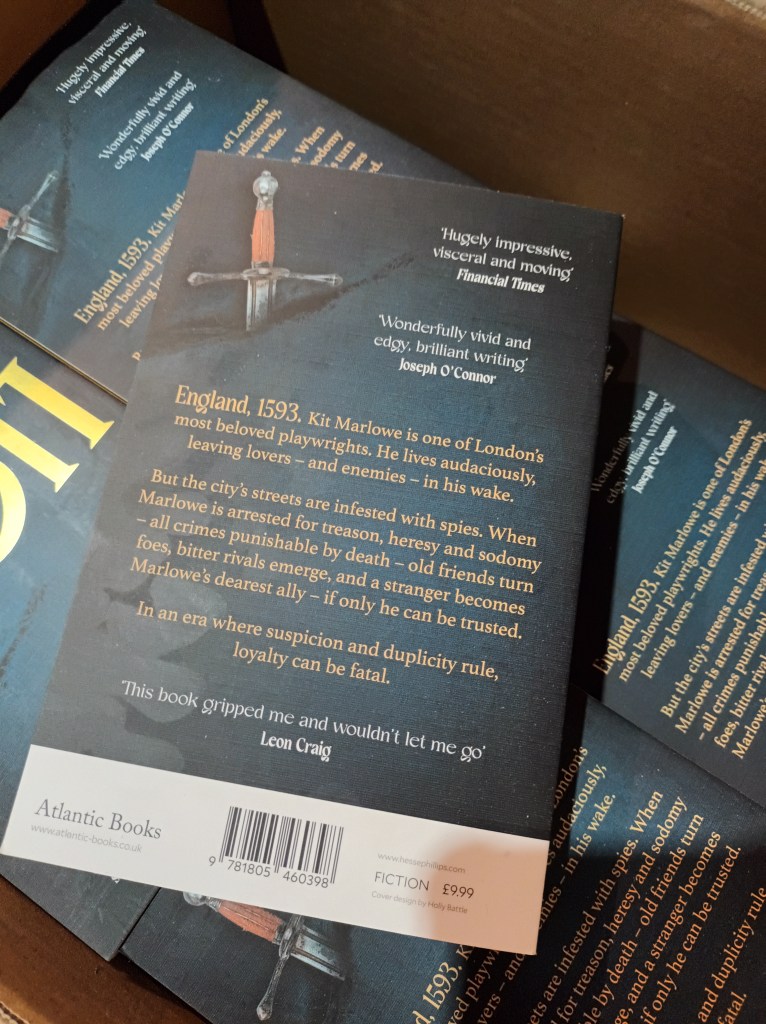
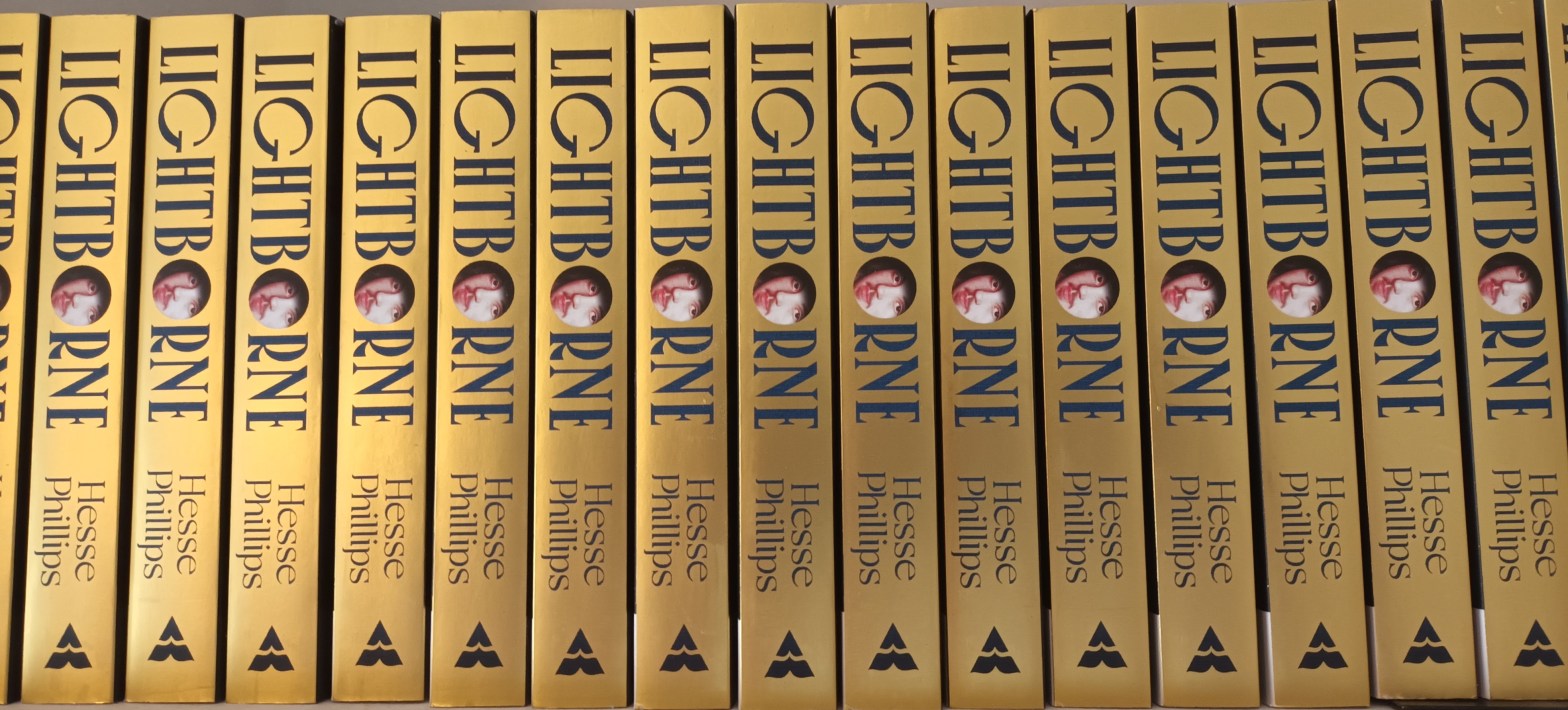
So naturally I was giddy with excitement when my complimentary author’s copies of the forthcoming Lightborne paperback edition showed up at my door the other day. I’ve seen PDFs of the new cover and therefore thought I knew what I was getting into when I opened the box, but no PDF could possibly do it justice.

I think someone in the design department at Atlantic Books must have heard me going on and on about how much I loved the gold on the “deluxe” edition cover from last year, because they went all-out with it. Believe me when I tell you, this baby glows.

And it looks pretty great from the back too.

With the official paperback launch date set for 6 March, preorders are of course available (and encouraged!) But for those who prefer ebooks, the ‘Zon is also running a Kindle Deal on Lightborne for the month of February, where you can score a copy for just £2.19.

It should probably go without saying that all of this is coming at an exceedingly weird time, particularly yet not exclusively if you’re American like myself, and particularly yet not exclusively if you happen to also be queer, and writing queer books, and plan to continue being and doing all of those things for as long as you have breath in your body. I am glad, at the very least, that I made some difficult but necessary decisions to start out the year, and intend to carry that energy with me into whatever comes next.

The intersection of my self and my obsession with history means I cannot avoid writing about queer survival under truly intolerable conditions – history is sadly saturated with them. It also means, of course, that not everybody makes it out alive, and those that do emerge scarred, battered, and at least a little bit broken. But we will always have a future, even in the bleakest of times. History may often show us in our darkest hour, but it also offers hope: we’ve always been here, and will always be here.

For me, the most important words I wrote in Lightborne were these:

You must live because I love you – because you must be avenged
– because to live is a form of vengeance, when so many have
sought to destroy you
.

Sometimes it comes down to that: staying alive. Because us staying alive really pisses off the ‘phobes.

And if I’ve learned anything about myself this year, it’s that I get a kick out of pissing off ‘phobes.

Lightborne Updates: Cover Sneak Peek!

Before we get into the thing you’re actually here for, let me start this one off by saying, if you’re not listening to the 7AM Novelist Podcast with Michelle Hoover, then start now – not just because yours truly makes the occasional appearance on the show, but because I do so in excellent company. This latest season features an all-star cast, including Anjali Duva, Ron Maclean, Nancy Crochiere, Sara Johnson Allen, Marjan Kamali, Joanna Rakoff, Emily Ross, Andrea Meyer, Virginia Pye, Henriette Lazaridis, Colwill Brown, Crystal King, Chris Boucher, Dawn Tripp, Hank Phillippi Ryan, Mark Cecil, Jenna Blum, Jane Roper, Ethan Gilsdorf, Whitney Scharer, Shalene Gupta, Louise Miller, and many more, all ready to help struggling writers work through whatever’s holding them back from getting words on the page.

Recently there were two back-to-back episodes dealing with the stressful process of publishing your first book, as Aube Rey Lescure hopped on to discuss the launch of her debut River East River West, and Kasey LeBlanc, Christine Murphy, and Aaron Hamburger came on to talk about the travails of starting book 2. Listening as someone who can relate all too well to the topics at hand, I found my mental state veering wildly between excited and despairing, inspired and terrified.

Let’s be real: publishing a book is the thing we writers tell ourselves will finally make our lives fall into place, fix our self-esteem issues, vindicate our hard work, even solve lifelong crises of identity. For over a decade, it was the thing I felt I had to do, if only to justify the time and money I’d sunk into writing my soon-to-debut novel, Lightborne. And of course, I am thrilled beyond belief that it is finally happening. But I’m also learning that publication will fix absolutely none of the above problems. It will, in fact, create a few new ones.

Now that debut authors are speaking more openly about the mental health struggles they face in the lead-up to pub day, what emerges is the clear need for us to support one another. The tawdry, soul-crushing business of self-promotion can feel desperately lonely; the burgeoning public exposure can make you paranoid and crash whatever modicum of self-esteem you’d built-up since surviving high school. The dark, primal urge to dig yourself a burrow and hide in it starts to take over.

But this is why community is so essential to the debuting author. It may come via social media, or through writing groups and classes, or – just maybe – through fellow listeners of a writing podcast. I’m very fortunate to know many of the panelists on the 7AM Novelist through the legendary Boston writing center, Grub Street, where I participated in the Novel Incubator Program some [cough cough] years ago. But one of the great things about the 7AM Novelist is how it allows writers from all around the world to make connections. Seeing ideas exchanged and friendships forming in the chat box during every live episode recording truly warms this withered old heart.

So I very much hope anyone reading this will be sure to check out the show and support the author panelists: google them, subscribe to their newsletters, buy their books! This season is particularly exciting because every episode deals with questions submitted by listeners – even though I’m on again tomorrow, Jan 11th, I still don’t know what topic we’re going to get. So if you have a sticky issue to work out with your WIP, your writing practice, or career, please do go to the podcast page and submit your answer to the question, “What’s holding you back?” Maybe I’ll even get a chance to help you through it.

And now that you’ve scrolled all the way down here, you may collect your reward: a first look at Lightborne’s lush, evocative final cover!

Via Atlantic Books

As you can see, the cover will build on the proof design, using the same black and gold damask pattern and a simply gorgeous font based on 16th century typography. I’ve been informed that the pattern will, in fact, be stamped in gold foil – so in person, it’s going to be stunning!

Preorders are rolling out, so please check with your local booksellers. For those who use NetGalley, ARCs will be available soon.

Research Diary #1: Spies, Schemers, and Straight-up Bullsh*t

I may be technically “done” with LIGHTBORNE, my first novel, but it seems like the research just isn’t done with me. After years – too many years – spent scanning documents for familiar names, I am primed to pick them out from just about anywhere. Every now and then, an old ghost steps out of the shadows, and the hair stands up on the back of my neck.

Today, the old ghost’s name was Nicholas Skeres – one of the three men who were present when my protagonist, Christopher Marlowe, was murdered in 1593. Just as the motives behind Marlowe’s death carry an air of mystery, all three of the chief witnesses/accomplices/perpetrators are enigmas in one way or another, which naturally I have exploited the hell out of for narrative purposes. Robert “Robin” Poley was a spy with a frighteningly dark history; Ingram Frizer, who wielded the fatal weapon, was a servant who worked for, of all people, Marlowe’s friend and patron.

Within that shady crew, Nick Skeres was always the one I felt I didn’t need to worry about. His youth as a con-artist, cutpurse and thief is well documented, and his later work as a lackey for important people, like the Earl of Essex, seems clear enough. In all likelihood, he was probably a pretty nasty character. Look him up in Charles Nicholl’s THE RECKONING, an admittedly more than slightly problematic investigation into Marlowe’s death, and you get the confident assertion that he was “Walsingham’s man” – in other words, a government spy. Look him up in other biographies by David Riggs, Park Honan, Constance Brown Kuriyama, F.S. Boas, all the way back to Ethel Seaton, who first identified Skeres’ name in connection with espionage way back in 1929, and you find the same conclusion.

So, why is Nick Skeres suddenly weighing on my mind?

Well, while doing some research for book #2, I happened to run across a reference to “Skyrres” in a letter connected to the Babington Plot. The Plot features heavily in LIGHTBORNE – a convoluted conspiracy which drew in Catholic priests and sympathizers from all across England and beyond, ostensibly spearheaded by the young, impressionable, and loaded Anthony Babington (although it is far more likely that Babington was merely a patsy). The goal was, in a nutshell [*inhales*], to jailbreak Mary, Queen of Scots, transport her to the Continent, hook up with the French Catholic and Spanish armies and lead an attack against England, eventually overthrowing Elizabeth I, installing Mary in her place and restoring the official state religion to Catholicism.

The scheme felt harebrained from the start, and Elizabeth’s spies, under the aegis of Sir Francis Walsingham, her “Spymaster,” were all too happy to let the would-be plotters walk themselves straight into their clutches… which, spoiler alert, they totally did.

In the weeks that led up to the Plot’s final, tragic unravelling, Babington and his friends were frequently on the move between bases in or around London. In August of 1586, right before Walsingham finally sprang his trap, his secretary, Francis Milles, wrote to him about people whom he’d seen hanging around the Catholic safehouse where Babington was believed to be hiding out:

Alt Text: Screenshot from The Troubles of Our Catholic Forefathers as Told by Themselves, 1872. A highlighted section reads, “Bab., Donne, Skyrres [?], and some others both men and women of this crew I have discovered this day with my own eyes, and therefore seeing Bab. is not departed, I hope for the better success of this service.”

Until a few weeks ago, I’d never read Milles’ letter myself, but I’d read about it. If “Skyrres” was our Skeres, then he wouldn’t have been the only one present at Marlowe’s death to have also been embroiled in the Babington Plot. Robin Poley was, in fact, Walsingham’s chief instrument in taking Babington down. What I find interesting here is the way that Milles talks about Skeres: as one of Babington’s “crew,” seen with his “own eyes,” and taken as proof that Babington is “not departed” – in other words, also present at the house, though unseen.

Milles’ letter in no way treats Skeres as separate from the other conspirators, like “Donne,” i.e. John Dunne, who was soon after convicted of treason and hanged along with Babington. If Skeres is mentioned “without further comment,” as Nicholl says, then so are they. If anything, Milles’ letter suggests that, whatever our Nick’s reasons for being amongst Babington’s “crew,” they might not have been so cut-and-dry as previously assumed.

Was Skeres a double-agent, not entirely trusted by either side? Or was he, perhaps, an apostate – a Catholic sympathizer who would soon betray his own cause?

Whatever the case, if Nicholas Skeres was in the employ of Sir Francis Walsingham in 1586, then Francis Milles, as Walsingham’s personal secretary, should damn well have known about it. The letter, to my eyes at least, suggests that Milles had another understanding about him entirely.

Skeres virtually disappears from the record for three whole years following this sighting by Milles. That might not be a red flag in itself, as paper-trails frequently go astray in this period, and the aftermath of the Babington Plot was every bit as chaotic as its advent. When our Nick resurfaces, he is working as a messenger for both Walsingham and the Earl of Essex, meaning that he is firmly entrenched in government employment. Did he serve faithfully? Who can say. As it happens, Skeres would eventually be arrested in connection with the Essex Rebellion – another attempt to overthrow Queen Elizabeth – and probably ended his life in prison.

How is any of this relevant to the murder of Christopher Marlowe – the one we actually care about?

Well, the uncertainty surrounding Marlowe’s death has really been something of a plague on Marlowe studies. It’s the mystery everyone wants to talk about but no one really wants to solve – because if we solve it, then we won’t get to speculate anymore. After so many hundreds of years, answering the problem would hardly feel like justice, but rather more like killing poor Kit Marlowe all over again.

Most of the biographers I mentioned above ascribe to some version of the theory that Marlowe’s murder was a grand conspiracy, orchestrated by the government or some other powers-that-be.1 The thing is, though the circumstances of Marlowe’s death are in fact pretty suspicious, there’s no “smoking gun” that proves it was a hit-job. There are, I think, reasons to believe his murder was swept under the rug, but that does not necessarily mean it was planned from on-high. All it means is that someone was protecting the people likely to suffer consequences from it: Poley, Frizer, and Skeres. The people who were actually there, the room where it happened.

A notorious spy. A servant of Marlowe’s friend. And a man long presumed to be a government spy, whose motives, loyalties, and ambitions may be far murkier than previously assumed.

If that’s who Nick Skeres really was – and Milles’ letter certainly makes a case for it – then our picture of the scene of the crime shifts towards something potentially more personal, and far messier, than a state-ordered assassination. Why were these particular people there? What was Marlowe’s connection to them? What did they want with him?

This is all perhaps just a very (very) long way of saying that the work goes on. I’ve already written my version of Nick Skeres, who is every bit as shady as you’d expect. But the novel I’ve written is not about proselytizing my version of “what really happened.” I’m not so interested in that. Fiction is about asking questions for which there are, ideally, no clear answers. Even historical fiction, despite having one foot in fact, takes events or lives that were momentous and singular to those who lived them, and – rather heartlessly – scavenges them for parts. The dead, long gone, exist only in fragments from which we storytellers glean what we may, and (like conspiracy-theorists) straight-up bullshit the rest.

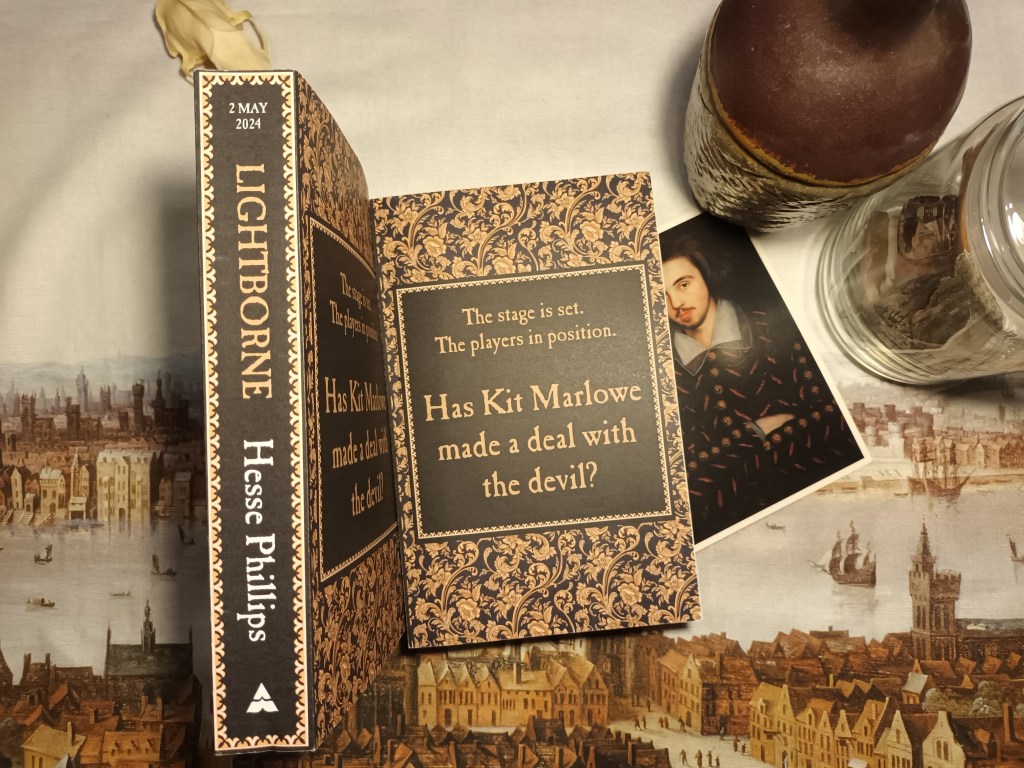
Color photo of a pair of books decorated in black and gold damask print lying on top of Wenceslas Hollar's Panorama of early modern London. One book is shown face-up, the other displays the spine, which reads "2 May 2024 LIGHTBORNE Hesse Phillips." The cover on the other book features a black square framing the tagline, "The stage is set. The players are in position. Has Kit Marlowe made a deal with the Devil?" Peeking out from under neath the face-up book is a postcard of Christopher Marlowe's alleged portrait.
Photo by Hesse Phillips. Yes, it was fun.

Oh yes – in case you missed it, LIGHTBORNE is an ARC now, and looks very fetching in gold, if I do say so. I’m told that copies will be available on NetGalley soon!

Read more about LIGHTBORNE here.

Featured image: Fede Galizia, Portrait of Paolo Morigia (detail), Public Domain, Wikimedia Commons

  1. Brown Kuriyama is an outlier here for her “no-nonsense” approach, i.e., taking all of the documents and testimony associated with Marlowe’s murder completely at face-value, for better or for worse. ↩︎

“Interesting places”

According to my bio, I’ve written one book.

But if you actually bother to go through all the myriad files within files squirreled away in the recesses of my laptop, it amounts to something more like four or five books. Four or five books, some weighing-in at over 400 pages, just to whittle it all down to ONE.

This is not as unusual as you might imagine. Depending on what kind of writer you are, what kind of book you’re writing, and what kind of support is available to you, the sum total of words you generate towards completing a novel might be thousands or hundreds of thousands more than the finished product. Sometimes you fall down rabbit-holes, and sometimes…

Sometimes you have to go a long distance out of the way in order to come back a short distance correctly.

Edward Albee
Werner Holmberg, Landscape from Leppälahti in Kuru, Unfinished, Wikimedia Commons

Throughout the process of writing Lightborne, I wrote a hefty historical fiction novel centered on William Shakespeare; tossed it out, then wrote something quite ambitious, a novel which alternated between the 16th, 17th, and 21st centuries; trashed that, then wrote another novel, alternating between just two time-periods this time – and oh yes let’s not forget the TWO MORE hist-fic novels I wrote after that, by which time Shakespeare had long since disappeared from the book (except in a blink-and-you’ll-miss-it cameo), and Christopher Marlowe was the main character. This isn’t even counting the numerous revisions that each of those earlier novels went through before being unceremoniously scrapped and scavenged for parts.

So what was it that finally got me to “done?”

Depends on how you define “done.” The thing about writing a book is that the goalposts are always moving. Even as I write this, I know my book will likely go through still more changes before it (fingers crossed) ends up on a shelf at Waterstones or Barnes & Noble, as even a publication deal is rarely the end of revising. Another quote springs to mind:

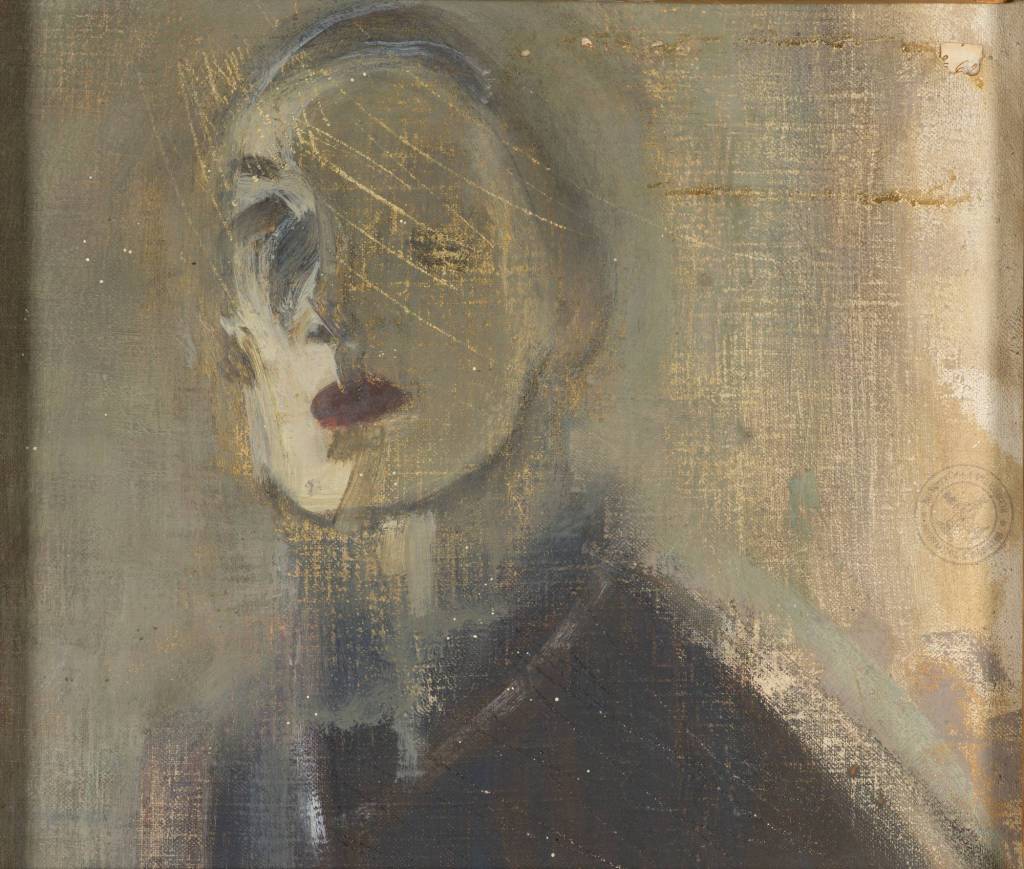
A painting is never finished. It simply stops in interesting places.

Paul Gardner
Helene Schjerfbeck, Unfinished and Defaced Self-Portrait, Wikimedia Commons

Painting and literature may seem like very different mediums, but all art shares some DNA in the process of its creation. Anyone trying to make art goes through a trial of false starts, erasures, making, and remaking. In all art there is is a discovery process, where at times you think you know where you are going only to find yourself going in circles, or occasionally, ending up in interesting places you’d no idea were there.

I often use maps as a metaphor for the writing process, because in my experience there are many roads through a novel, with many possible endings. As in real life, the most interesting places are almost never found at the end of a single, straight path, with no diversions, bushwhacking, or backtracking involved. The way through the landscape sometimes requires going all the way back to zero, and then setting out again.

I never would have gotten this far if it hadn’t been for good beta-readers, workshop partners, and instructors showing me that there was more beyond the horizon I had previously set for myself. Draft after draft, I kept arriving at interesting places only to discover even more interesting places a little further down the road. The “finished” novel, as it stands, doesn’t cover even half the territory I mapped out over all those related but different books, all those out-of-the-way journeys I had to take in order to come back to the right place by the right route. But, like a painting, my book eventually found a view to put in its frame – not the whole view, but an interesting one.

My favorite novels always feel like this: landscape paintings with more going on over the horizon, or in the distant city, or the harbor, or even in the sky. The reader will never see it all, never know it all, but the fact of it being there, just outside the frame, makes all the difference.

Pieter Bruegel the Elder, Landscape with the Fall of Icarus, Wikipedia

More Posts…

Good Advice/Bad Advice

Today I had a conversation with a friend about her past experience with a manuscript consultant. “He gave some good advice,” she said. “But also a lot of bad suggestions.” At the time, she was still relatively new to novel writing, and didn’t know what to make of the reader’s comments. The wisdom in the good advice eluded her for years because it was buried under the bad.

The question is, how do you tell the difference?

Experience certainly counts for a lot. The more people you ask to read and critique your work, the better you will become at telling gold from brass. But if you’re just starting out, it’s helpful to know how to recognize red flags.

Red Flag #1: Runaway Ego. If you receive comments along the lines of, “Instead of having them get married at the end, she should murder him and hide his body in the freezer,” or “She would be sexier if she were a redhead” or “Turn the cat into an eight-year-old child,” that’s the reader’s ego talking. They’re trying to write your book for you, not helping you write the story you want to write.

Feedback of this kind must always be relevant to the story (so, no trying to rewrite the ending), free from the reader’s own biases (the redhead comment is just gross), and justified in context (how would a child serve the story better than a cat?) Generally speaking, if a reader encourages you to experiment with an idea, that idea should have originated in you, not them.

Red Flag #2: The Prophet of Doom. One particularly unhelpful piece of advice my friend received from her consultation was, “Cut the prologue – agents hate prologues.” Trusting that this advice came from a place of expert, insider knowledge, she followed it. A few years and many frustrating revisions down the road, she realized that what her book needed was a prologue – the same prologue that the consultant made her cut!

Literary types are often full of “insider knowledge” based on hearsay, or even from their own unique experiences in the I N D U S T R Y. But literary agents and editors are human. Some may indeed “hate” prologues, but others will like them. Most will have no opinion one way or another. If a reader tells you to change any major building-block of the story, make sure they can back this up with something other than, “the gods demand it so,” or “I heard it on Twitter.”

Red Flag #3: The Morality Police. “I don’t like the protagonist – make her ‘likeable.'” “I can’t stand this character.” “This character makes bad choices and I therefore can’t relate to them.” You have never made a bad choice in your life, have you? Sure, Jan.

Aside from the reductive insistence that protagonists must be “likeable” (barf), comments of this sort focus on the wrong problem and inevitably lead to confusion and frustration on the part of the writer. It’s never a reader’s place to declare whether they “like” a character or not, or agree with the character’s choices. Characters, like real people, will not get along with everybody. In fact, characters need to stand in opposition to something, make questionable choices, and occasionally stick their foot in it if they’re going to hold up a riveting plot. If a character is not coming across, the issue is never likeability or moral purity, but often a question of whether the character’s motivations are clear enough. A good reader will know where to put their focus.

Which brings me to Red Flag #4: No Further Questions. A reader with your best interests in mind should mostly ask questions, rather than make statements or offer suggestions. This has to do with the reader’s understanding of their role in the writing process: not to help the writer “finish the book,” but to inspire them to see it anew.

Often, we turn our writing over to a reader only once we’ve convinced ourselves it’s “perfect.” But really, the best time to seek feedback is when we’re at an impasse: we think we might be on to something, but we’re not sure; we tried something new but don’t know if it’s working; we like what we did, but will anyone else? Those who hand over monuments will receive piles of rubble. The trick is to treat your book like fertile ground.

Some of the most fruitful creative periods I’ve ever experienced directly followed feedback that made me ugly-cry. But this is the true test of good advice. Good advice should make you want to experiment, branch out, investigate. It should make your book feel alive, and full of possibility.

In my next post, I plan on talking more about how good advice actually works, using my own novel, Lightborne, as an example.

More Posts…