Today is filled with all the usual excitement, expectation, and nail-biting dread of every milestone I’ve faced thus far in this weird business of being a published author. However, today also marks a bittersweet end of the road in my publishing journey. Unless I pull a Pachinko within the next year or two, this will be the last UK pub day Lightborne ever gets.
I loved this book. I worked on it through my 20s and 30s, and into my 40s. It was a way of life for so long that tearing myself away from it took nearly as much discipline as writing the damn thing. Now I’ve moved on, and it already feels distant at times, but the lessons I learned in writing it will hopefully stick with me forever.
I’ve been living a weird double-life over the past two years, embarking on my next book while my first was making its international debut by slow stages. In the beginning, transitioning away from a book I knew so well I could set the characters free in the maze of my head and simply sit back and “observe” them was painful at times. After two years, I still don’t know my new cast of characters that well, although I am getting closer. It’s a strange feeling to be back in a part of the writing process which I last experienced so long ago it’s only a distant memory for me, leading me to second-guess myself – to think I’m doing it wrong. Connecting with other writers is keeping me grounded, but I already can’t wait to be in the 15th or 20th revision again, at the point where “mess becomes book.”
Those are some of my most treasured memories of Lightborne, even now. While publication is exciting and vindicating, it’s also a lengthy process of letting go. And while I still love “my boys” – even the wicked ones (looking at you, Poley) – I will never again experience that sense of mutual habitation that came with writing their story. This is what people mean, I suppose, when they talk about being visited by the Muse: a collaboration between me and the imaginary beings I’ve created, acting not independently of me (obviously) but in ways I can’t entirely explain. People also call writing a lonely profession, but when the writing is going well, it’s anything but.
So I’m a bit sad, but very excited to keep working, keep writing, and celebrate not the last, but the first of many last, glorious voyages of my debut into the world, with hope that it will find readers who will love it and need it as much as I did.
I can’t help but want to talk about perhaps too many things in this post, as I know many of us are still reeling after last week. Perhaps shocked and blindsided, perhaps proven right in the worst way possible, perhaps teetering just above despair. Anyone celebrating is invited to leave at this point. Anyone lashing out, lighting fires, throwing blame at those more vulnerable than themselves, screeching “I told you so” as they rub salt into others’ open wounds, is invited to seek therapy.
It feels very strange and not a little delusional to be talking about my book at a time like this. Not that it doesn’t feel strange to talk about the future at all, given how little we can say for certain about it, other than that things look bleak. They certainly look bleak if, like me, you are a queer author who writes queer books. As I discussed at length in my previous blog post, we could easily be entering a dark age in terms of art and literature, an age in which books like mine will become hotly contested objects. But it’s one thing to worry about whether or not your book might still be legal in your home country a year from now, quite another to worry whether you, as a human being, will also be legal: your marriage, your passport, your family, your friends, your livelihood, your joy, your resistance, your thoughts, your dreams.
However, as a number of other queer authors have also pointed out, there’s no sense whatsoever in backing down before the fight has even truly begun. We are already tired, especially those of us who have been targeted before, but I hope we are far from giving up. Now is a time for those of us who can afford to be loud to scream with all our might.
Knowing my history as a queer person is a double-edged sword, because I’ve seen my community in its darkest hour, but I’ve also seen us emerge from that darkness, again and again. Whatever is coming, we have every right to feel dread in the pits of our stomachs, but also every reason to believe we will find ways to survive it. As Marlowe says in Lightborne, “to live is a form of vengeance, when so many have sought to destroy you.”
As long as humanity lives, we live. I’m sure it drives those who hate us crazy.
All that said, I’m extremely lucky to have exciting things to look forward to in 2025, among them the paperback launch of Lightborne in the UK. Come what may, in March there will be a whole new edition of the book out in the world, with a stunning new cover to rival the old one.
And now, without further ado:
Courtesy of Atlantic Books
We still have the beautiful gold accents that gave the original cover such a bold presence on the shelf, but now with a much darker, moodier atmosphere, and even a subtle appearance from Kit Marlowe himself. I chose this design among several options – it wasn’t easy, as they were all impressive – but I loved this one for that rich blue tapestry background, and the vintage feel of the design.
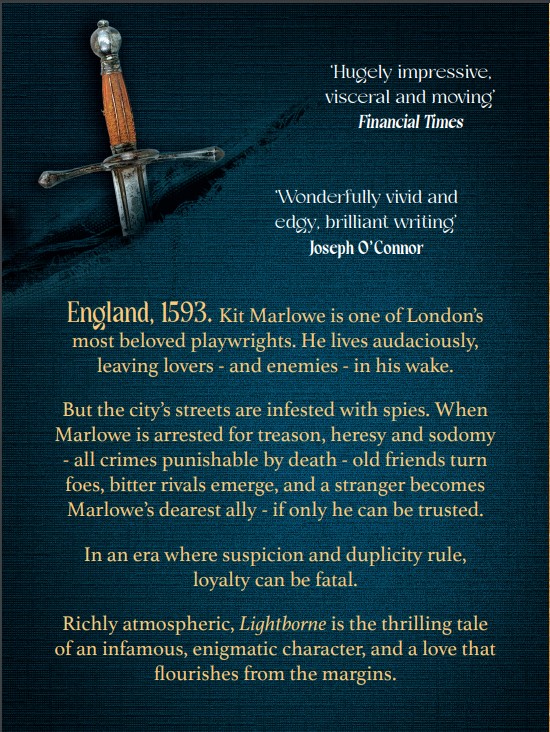
The back cover, I should add, is equally gorgeous:
Courtesy of Atlantic Books.
Those who have read the book already will surely recognize Frizer’s knife peeking out! I fought for that knife, I will say, and I’m so glad I did. Authors – this is me advising you to fight for things you want on the cover. You might not get them, but you’ll have no regrets.
I’m beyond excited to see the paperback in its full glory, as I hope readers will be as well. Whatever dangers are barreling down at us from the future, I hope we’re able to find reasons to stay excited and engaged. After all, the world desperately needs that from us. Our anger and outrage is necessary, but so is our hope, our creativity, our joy.
It might mean the difference between simply getting through whatever comes next, and doing the work that desperately needs to be done: of building a better world than the one we started with.
It’s summer, 1997. My sixteen-year-old self is in their room, on the phone with their best friend, who says she isn’t interested in being friends anymore.
(This is a conversation I’ve been dreading, having sensed it coming for months – the gradual tapering off of phone calls, the resignation in her voice when I cancel plans, again. My best friend won’t fight for me. Truth is, I don’t even want her to.)
She says, “It seems like writing a book is more important to you than having friends.”
At sixteen, I didn’t have a lot of friends to spare. For starters, though I attended high school in downtown Pittsburgh I lived way out in what everyone referred to as “farm country,” a two hour bus ride away. And then there was the truly unconventional way I spent my free time. Every afternoon, as soon as I got home from school, I’d rush upstairs to my desk and barely move for the rest of the night. I was the only person I knew who wrote books – for fun.
It certainly couldn’t have looked like fun, from the outside. Most nights I ate dinner at my desk like some sad corporate drudge, squeezing in every last minute I could. Some time after midnight I’d crash into bed, get maybe four hours of sleep in before my mother woke me by shouting my name downstairs. Then another two hours to school, in the dark, during which I might write six pages in my head, tucking them into a mental folder to be opened again at the end of the day.
God how I miss that superpower now: the ability to hold whole texts in my memory, to summon them up hours or even days later with all the revisions and additions intact. It would really come in handy.
It came at a cost, of course. I expended so much mental energy keeping stories on ice that I had little left over for “normal” sixteen-year-old concerns. I was emphatically not a “normal girl,” and proud of it. But everything I knew about girlhood came from stories I absorbed through books and media, which were nothing at all like my reality. Girl stories, I thought, were about going to the mall, vying for the attention of boys and counting calories, despite the heroine always being thin, blonde, popular; or maybe unpopular but thin anyway, pretty if she takes her glasses off. Before the story ended, she would learn lessons about the importance of loyalty, forgiveness, sacrifice; the transformative power of a new dress, the transformative power of dropping five pounds.
Above all, in every story, the girls were always surrounded by friends, typically three or four, each with her own small, inoffensive quirks, who were there when the heroine’s story began and would be there till the end, standing by her side with blank smiles, their own stories (if they had them) tidily and expediently resolved.
In hindsight, I think girl stories made me uncomfortable because they were all about being visible, about being consumed. The heroine survives or triumphs because she steps out into the world with arms wide open, having done the hard work of changing herself to please others, or (more rarely) the even harder work of accepting herself.
You could say that girl stories are often “coming out” stories.
Girls almost never figured into the stories I wrote at sixteen. The book I’d spent my whole summer working on, instead of hanging out with my best friend, was a sprawling bildungsroman, loosely based on a true story, about an autistic painter who escapes a Soviet mental institution and defects to the United States. The next summer it would be a historical thriller set in 1899 about a traumatized gay man who builds a vast city underneath Manhattan as a respite from the surface world. After that, there would be a fantasy trilogy in which Lucifer and Jesus Christ are the same entity, and in order to save humanity, they must rally angels and demons alike to kill a smite-happy God.
All my stories were about escaping, defecting, retreating, un-making, un-doing. They were the opposite of “coming out.”
On a class trip in 1997, looking like a roly-poly Robert Smith.
At sixteen, I didn’t yet know I was queer. Correction: I’d known I was queer even before I’d ever heard the word, but over time I’d managed to wipe that knowledge from my mind. It was a matter of survival. I lived in a town with more churches than supermarkets. Not long before that fateful phone call with my best friend, I’d had to switch schools for the second time in four years because I was acting out, destroying school property, self-harming. The first time, I had been bullied so badly the teachers themselves had suggested my parents find another school for me – I had been essentially run out of my home town, or at least my public school district.
At sixteen, I didn’t yet know I was queer, because even though I compulsively wrote characters who loved or existed unconventionally, changed genders or were genderless, I didn’t live in a world where queer was something I could be. Queer was for other people. (It was the 1990s, so, tragic, doomed people.) But writing was a place where I could safely try on different versions of myself. Some of my characters were parts I stepped into as if for the stage. Others stepped into me. Gradually, I came to recognize which ones brought me strength, or confidence. I started to crave their visitations, to grieve them when they were gone.
My senior year of college, one character would set up shop in my head, and not leave until I’d done him justice. An Elizabethan playwright whose name I’d heard in my early teens, and whose story I’d never been able to forget – Christopher Marlowe – came storming out of one of my mental folders, dragging four-hundred years’ worth of queer rage at having to escape, to hide, to un-make ourselves along with him.
Ultimately, it would take me twenty years of multiple false-starts, failed attempts and “life stuff” delays, but when the dust finally settled, I would be holding Lightborne, my first published book. And I would not be alone: standing to either side of me would be the friends who had never stopped cheering me on, the fellow writers who gave me their time, the partner who gave me all the love and patience I could possibly ask for. I would not be alone in the dark any longer.
Up in my bedroom on the old cordless phone, my sixteen-year-old self has no idea how long it will take, or how much will be lost and gained along the way. They can’t imagine going more than a day without writing, but being published isn’t necessarily part of the plan. They write to live.
When their best friend says, “writing a book is more important to you than having friends,” she sounds as if she pities them. Maybe it is sad. A sixteen-year-old kid who spends all their free time locked away in a room, and who, to be honest, has only one friend in the world. Reality is, it’s 1997 and this kid should be begging their parents for a pager or Alanis Morissette tickets; reality is, this kid survives one day at a time, by pretending they are a stateless refugee, or the queer king of an underground realm, or some half-divine, half-demonic creature, at war with an unjust God. Reality is, this kid survives by being anything but what the world sees when it looks at them.
So, sixteen-year-old me tells their friend, yes – writing a book is more important to them.
And their heart sinks as they say this, realizing they can never take it back. But after sitting with the dread for a few minutes, in the silence after they hang up the phone, it dissipates. They’re at their desk, in their room. Their book is on the screen in front of them, flickering white, like a hearth that burns cold.
I want to tell them: twenty-seven years from now, I promise you, it will have been worth it.
Not because you’ll publish a book.
Because you’ll find out who your real friends are.
If nothing else, I am learning a lot about my worst habits as a writer, and I suppose this knowledge ought to come in handy down the road. The first editorial phase was instructive on a global scale, subjecting characters, plot and overall themes to forensic examination. I came away from it feeling like I’d just gotten a free MFA in creative writing. The copy editing stage, however, will humble you up in a heartbeat.
What impresses me the most about this part of the process is the indefatigable patience of copy editors, who can turn over a page of prose the way a seasoned detective turns over a crime scene. Invariably, if something is out of place, they will find it. At the moment, I’m so highly attuned to the incorrect usage of hyphens that I agonized for a good several minutes over whether or not to hyphenate “highly attuned.” As you can see, I gave up.
Sighs, for that matter, are starting to give me eye-twitches. I can’t let out an audible breath without wondering whether I should just go back and delete it altogether; no exhales for me, only inhales from now on (passes out).
Well, as my extremely generous copy editor has reminded me, all writers have their tics. Even the great Cormac McCarthy, as this Electric Literature article reminds us, had a “smiling” compulsion (though naturally he sometimes managed to make gold out of it).
I suppose the copy editing stage is a little like seeing a doctor – embarrassing but necessary for your health. And in my case, I feel confident that my work is in good hands. Now to try as hard as I can to retain all of the insights I’ve received for the next big thing.
Although I still have no idea how to use hyphens. Did I promise to learn? Yes. Will I?…
Yesterday I made my podcast debut on Michelle Hoover’s brilliant, informative, possibly life-changing “7AM Novelist” series – a 50-day writing challenge designed to give new and experienced writers the tools they’ll need to write a solid first draft. Michelle was my instructor at Grub Street Boston, through the Novel Incubator and the Novel Generator, so I can’t recommend her podcast highly enough to anyone who dreams of writing a book.
I was on along with Louise Berliner, author of Texas Guinan: Queen of the Nightclubs, to talk about how to handle setting and time period in your early pages. As often happens when you only have half an hour to talk about a topic, I signed-off positively bursting with still more to say, so I’m doing what I suppose any one of us would do in that situation: blogging about it.
From Michael Drayton’s Poly-Olbion (detail), Folger Shakespeare Library
Our conversation started from Louise’s wonderful idea of setting as a “container,” which characters bump up against throughout the story – a site of conflict, struggle, and most importantly of all, drama. Often, writers will make the mistake of thinking of their setting as more or less static, a blank set onto which their characters are air-dropped. But whether you’re writing historical, sci-fi/ fantasy, gothic horror, or contemporary literary fiction, the “setting” in a novel should be dynamic, a hybrid of both time and place that moves and is moved by the characters.
We’ve all heard of or read books that treat setting like a character, but what exactly does that mean? How is it achieved? All novels begin with what some writers refer to as the “Unstable Ground” situation – a nomenclature which, by no accident, suggests setting. In the opening pages, we find ourselves amongst certain people on a particular day, one where something big will be set in motion. Whatever happens, it doesn’t just happen in any time or place, but on this day and no other, in this very spot and no other.
Take Virginia Woolf’s Mrs. Dalloway, for example, which takes place on one particular day. “Mrs. Dalloway said she would buy the flowers herself,” is one of the most iconic opening lines in all of literature. Over the next few pages, we learn that Mrs. Dalloway is part of a culture that is desperately trying to return to a setting that no longer exists, i.e., pre-WWI Britain. As she moves through what could easily be a perfectly ordinary day – buying flowers, sewing a dress, taking a nap, throwing a party – her story becomes entangled with the ghosts of war. Her search for the comforts of the ordinary is constantly interrupted by reminders of all that she and her country have lost, in the form of supporting characters like the shell-shocked veteran Septimus Smith, whose visions of the battlefield create a sense of constant instability in the landscape of London.
Mrs. Dalloway and Septimus Smith represent the opposing forces that come together to create dynamic settings: status quo versus change. Or, the “unstoppable force” meeting an “immoveable object,” if you prefer. Each character is embattled within themselves just as they are against the world: wanting to move on by going backwards, which is, of course, impossible. Spoiler alert: it costs Septimus his life.
Woolf’s setting for Mrs. Dalloway was her own present day. For historical fiction, setting takes on an even larger presence, firstly because it is always unfamiliar to the reader. Every author will interpret history differently, choosing to emphasize certain details over others, offering different answers to historical mysteries, or characterizing historical figures differently. Each year, about a dozen novels based on the life of Anne Boleyn come out, and yet no two feature exactly the same take on their protagonist.
Historical fiction is where the “setting as container” notion really comes into play. This is partly because, as modern writers, we are ourselves frequently in conflict with the era that we are trying to bring to life. Hilary Mantel likened this task to “chasing ghosts” – although in her words, the ghosts often chase us back. It is through these conflicts between the author and the past that we often find our way to the characters’ conflicts with their own time. In my case, Lightborne is about queer men living in an era fraught with dangers for anyone stepping outside the status quo, and so their conflict with the setting is quite literal. Many books of historical fiction feature protagonists who don’t exactly “fit” into the world around them, and thus offer ever-fertile ground for stories about outsiders.
Historical fiction and sci-fi/ fantasy books also often come with a map somewhere in the opening pages. This is partly because the settings are so unfamiliar to average readers, but it’s also a consequence of just how important the settings are to these stories. The landscape of Middle Earth or the streets of medieval London shape who the characters are and who they are becoming, while also being shaped by the characters throughout the course of the novel. The maps represent both time and place.
There is no escape from the hours and the days. Neither from tomorrow, nor from yesterday. There is no escape from yesterday because yesterday has deformed us, or been deformed by us.
Samuel Beckett, Proust and Three Dialogues with George Duthuit
I think this is a good quote to keep in mind when working on setting. Every novel begins with Unstable Ground – the time and place when the story is propelled into being by circumstances that exist even before page one. After that, the ground continues to shift – time and place “deform” the characters as they pass through it, and are “deformed” by their passage. As the ground shifts, details will emerge, pathways will be uncovered, exits will be blocked. The setting is alive – and has a big role to play.
Of course there’s still plenty more to say about setting. WAY more than I can fit here. Another post, perhaps?
It took me nearly twenty years and at least twice as many drafts to write my first novel Lightborne, which, at the time of writing this, is finally out on submission. Point-of-fact, it isn’t really my first novel, but my twelfth or thirteenth, if you count all of the now-embarrassingly adolescent “novels” I churned out from years 14 to 23 while my peers were out doing fun things, such as, I dunno, hanging-out in malls. What I mean to say is, my journey to this point in my writing career, such as it is, brought me down a long and winding road, possibly longer and windier than average. But there’s an end in sight for me at last. Or possibly a beginning.
In those early years, I shuddered at the thought of anyone else reading my work, as much as I yearned to be a “real writer.” But the road didn’t lead me much of anywhere until I finally got myself some travelling companions. Whatever I’ve learned about novel-writing comes not from solitary hours bent over a desk, but from other people: reading other writers, and sharing my work with other writers. In many cases, these writers were people like me, who had started out writing for themselves long before it ever occurred to them to write for anyone else. Workshops, writing classes, even just having a “writer-buddy” who will support you through the tough times, and keep you on track – all of these things can make the difference between having a book in a drawer and a book that’s ready to submit.
What made the biggest difference, for me anyway, were beta-readers. Beta-readers are fellow writers who will read and critique your full manuscript in exchange for you returning the favor, and they are among my favorite people on Earth. Without the sharp feedback of other writers, I’d still be wandering around the vast wastes of aimless rewriting (Draft 46, Draft 46.2, Draft 46.3, Draft 46.3.1… You get the idea.) Before I submitted my novel to the Irish Writers Centre Novel Fair, through which I met my agent, it was a handful of beta-readers who whipped my book into shape: people who were readers of my genre (literary-historical fiction), who knew something about writing themselves, and whose opinions I trusted.
I have been a beta-reader as many times as I’ve worked with one. That too has been an education: in writing craft, of course, but also in humility, which we writers need to have in scads. When offering criticism or feedback on someone else’s novel (their BABY, for God’s sake!) it was essential for me to learn to silence that little voice that says “I could do this better.” No, I can’t. That story belongs to the author, not to me. Feedback should never be proscriptive, because it’s always based in a subjective interpretation of what the author is trying to get across. Every reader’s interpretation will be a little different. The author’s goal is to create a world that feels open to the inhabitation of outsiders – a time, place, or person that anyone can exist in comfortably for a while.
It took me ages to figure out that the problem with my novel was that it was not welcoming to outsiders. The characters I knew and loved seemed like complete strangers when other people described them to me; the plot-points that I thought ran smoothly were, to others, complicated or obscure. This was devastating to hear at first, but gradually, a new and marvelous excitement kicked in. Now, I could go back into my little world armed with the knowledge necessary to bring readers along with me. This was my opportunity to get to know my characters and my story deeper, to experiment and explore. In time, a new roadmap took shape – rough at first, as are all maps into uncharted territory. But I could see multiple paths ahead.
My experiences with beta-readers absolutely made me a better writer. And it made my book not just a better book, but my book, my vision: a world with open doors, one which nearly anybody can step into, and live.







 HESSE PHILLIPS